Home › Toenail Fungus Treatment Comparison

Toenail Fungus Treatment Comparison: Evidence-Graded Guide (2026)

Affiliate disclosure: Some links on this page are affiliate links. If you buy through them we may earn a commission at no extra cost to you. See our disclosure policy →

A neat lineup of plain treatment options on a counter, for a toenail fungus treatment comparison

The Short Answer

Prescription pills, topical lacquers, OTC products and natural remedies differ in how well they have been studied, how long they take, what they cost and whom they suit. This page applies one evidence grading framework to compare every major option.

For confirmed onychomycosis, oral terbinafine has the strongest evidence: roughly 46% complete cure at 72 weeks in the L.I.ON trial (Evans & Sigurgeirsson, BMJ 1999). Prescription topical Jublia achieves around 15–18% complete cure (Elewski 2013, JAAD). OTC topicals such as undecylenic acid have Limited evidence for penetrating the nail plate. No OTC product is FDA-approved for onychomycosis. Plan 12–18 months for a full nail to grow in clear.

At a Glance

Top Two Without a Prescription

Fungi-Nail (OTC)Kerasal (OTC)
Fungi-Nail: undecylenic acid 25%; Anecdotal as a product (undecylenic acid: Limited); ~$8–$20 a bottleKerasal Fungal Nail Renewal: cosmetic, no antifungal; Anecdotal (urea: Limited); ~$12–$24

Prescription medicines (information only): oral terbinafine has the strongest study evidence, ~46% complete cure at 72 wk (L.I.ON), ~$10–$40/mo generic; Jublia (topical) has moderate evidence, ~15–18% complete cure, $65–$830+ per bottle. A doctor or podiatrist can prescribe them.

Key Facts

Without a prescription

Fungi-Nail for mild cases

OTC products

None FDA-approved for nail fungus

Cost range

Under $20 (OTC) to $1,500 (laser)

Time to clear nail

12–18 months to grow in clear

Toenail Fungus Treatment Comparison: The Master Table

The table below ranks every major treatment category by evidence strength. “Complete cure” means mycological eradication (confirmed by lab test) plus clear nail appearance — the gold standard endpoint in clinical trials. No OTC product is FDA-approved to treat onychomycosis; OTC labelling refers to topical skin fungal infections.

TreatmentTypeEvidenceComplete cure (reported)Time to clear nailEst. cost
Undecylenic acid OTC (e.g. Fungi-Nail)OTC topicalLimited EvidenceNot established for nail56–12+ months~$8–$20
Kerasal Fungal Nail RenewalOTC cosmeticAnecdotal Evidence (urea: Limited)Cosmetic improvement only2–8 weeks (cosmetic)~$12–$24
Tea tree oilNatural topicalLimited EvidenceNot establishedUnproven~$5–$15
KerassentialsNatural topical blendAnecdotal Evidence (undecylenic acid, tea tree oil: Limited)No product trialNot established$49–$79 per bottle (2–6 packs)
Guarantee: 60 days; buyer pays return postage
Check Kerassentials price
KlaroNailNatural topical blendAnecdotal Evidence (undecylenic acid, tea tree oil: Limited)No product trialNot established$207 for 3 bottles ($69 each)
Guarantee: 60 days; buyer pays return postage
Check KlaroNail price
Nail RefreshNatural topical blendAnecdotal Evidence (tea tree oil: Limited)No product trialNot established$177 for 3 bottles ($59 each)
Guarantee: 180 days; return terms unclear
Check Nail Refresh price
TerraCalmNatural topical blendAnecdotal Evidence (tea tree oil: Limited)No product trialNot established$49–$69 per jar
Guarantee: 60 days; buyer pays return postage
Check TerraCalm price
Metanail ComplexTopical serum + oral cleanseAnecdotal EvidenceNo product trialNot established$79 for 1 serum
Guarantee: 60 days, minus shipping fees
Check Metanail Complex price
NanoDefense ProNatural topical blendAnecdotal EvidenceNo product trialNot established$49–$79 per bottle (2–6 packs)
Guarantee: 180 days; buyer pays return postage
Check NanoDefense Pro price
KeraBioticsNatural topical blendAnecdotal EvidenceNo product trialNot established$49–$69 per bottle
Guarantee: 60 days; buyer pays return postage
Check KeraBiotics price
Keravita ProOral supplement blendAnecdotal EvidenceNo product trialNot established$49–$69 per bottle
Guarantee: 60 days; buyer pays return postage
Check Keravita Pro price
SupraNailOral supplement blendAnecdotal EvidenceNo product trialNot established$79 + $9.95 shipping
Guarantee: 60 days, unopened bottles only
Check SupraNail price
Bio Fungus NukerOral supplement blendAnecdotal EvidenceNo product trialNot establishedNot verified
Guarantee: Reportedly 60 days (not verified)
Check Bio Fungus Nuker price
Oral supplements (various)SupplementAnecdotal EvidenceNo product-specific RCTNo proven timeline~$40–$80/mo

Prescription medicines are not in this table because we can’t offer or prescribe them. For information, here is how they compare (a doctor or podiatrist can prescribe them):

  • Terbinafine (Lamisil): Type: Oral Rx pill; Evidence: Strong Evidence; Complete cure (reported): ~46% at 72 wks (L.I.ON)1; Time to clear nail: 12–18 months; Est. cost: ~$10–$40/mo (generic).
  • Itraconazole (Sporanox): Type: Oral Rx pill; Evidence: Strong Evidence; Complete cure (reported): ~23% (pulse, L.I.ON)1; Time to clear nail: 12–18 months; Est. cost: ~$20–$60/mo.
  • Efinaconazole (Jublia 10%): Type: Topical Rx lacquer; Evidence: Moderate Evidence; Complete cure (reported): ~15–18%3; Time to clear nail: 48 weeks; Est. cost: $65–$830+ per bottle.
  • Ciclopirox lacquer (Penlac): Type: Topical Rx lacquer; Evidence: Moderate Evidence; Complete cure (reported): ~8–12%4; Time to clear nail: 12–24 months; Est. cost: Varies (Rx).

Superscript numbers correspond to sources cited below. Cash prices as of November 2026. “Time to clear nail” = time for a fully uninfected nail to grow in, not when you stop medication. Nail grows ~1–3 mm per month. Natural and supplement blends: prices and guarantees from the official order pages as of November 2026; none has a published clinical trial or FDA approval for nail fungus.

How We Grade Toenail Fungus Treatment Evidence (A–D)

Every treatment grade on this site is based on the quantity and quality of published human clinical data, not on what brands tell us or what we sell. We use four grades. Read our full methodology →

Strong Evidence

Definition: Multiple large, well-designed randomised controlled trials (RCTs) in humans with onychomycosis. Results replicated across independent studies.

Example: Oral terbinafine: L.I.ON. (BMJ 1999) and multiple confirmatory RCTs.

Moderate Evidence

Definition: At least one well-designed RCT for the specific nail indication, or strong real-world evidence. Some limitations in design or replication.

Example: Efinaconazole (Jublia): two phase 3 RCTs (Elewski 2013, JAAD).

Limited Evidence

Definition: Small studies, lab-only evidence, or studies on skin (not nail) fungal infections. May help some people but nail-penetration data is weak.

Example: Tea tree oil: small pilot studies, no large nail-specific RCT.

Anecdotal Evidence

Definition: No product-specific RCT for onychomycosis. Evidence comes from ingredient-level lab data, testimonials or case reports.

Example: Oral supplement blends (Kerassentials, ProNail Complex, etc.).

Prescription vs OTC vs Natural Toenail Fungus Treatments

The three main categories of toenail fungus treatment work by fundamentally different mechanisms and are supported by very different bodies of evidence.

Illustration comparing prescription pills, topical treatments and natural remedies by strength of evidence

Prescription antifungals (oral and topical)

Prescription options include oral terbinafine and itraconazole, and topical lacquers such as efinaconazole (Jublia) and ciclopirox (Penlac). Oral antifungals travel through the bloodstream and deposit antifungal drug in the nail matrix, which is why they have higher mycological cure rates than topicals. They require a prescription because they carry systemic side-effect risks, including rare liver effects with terbinafine and itraconazole. Baseline liver function tests are often recommended before starting.

Topical prescription lacquers penetrate the nail plate better than OTC creams, but still have lower cure rates than oral options because reaching the nail bed through a thickened, infected nail is chemically difficult. They are preferred when systemic medication is not suitable.

OTC topicals (undecylenic acid, tolnaftate, clotrimazole)

OTC antifungal creams and solutions are FDA-approved for topical skin conditions such as athlete’s foot. No OTC product is FDA-approved for onychomycosis (nail fungal infection). Products such as Fungi-Nail (undecylenic acid 25%) and tolnaftate-based solutions may help in very mild, early-stage infections affecting only the nail surface, but published nail-specific clinical trial data are limited. Urea-based products like Kerasal are cosmetic nail conditioners, not antifungals: they soften and visibly improve the nail’s appearance without treating the underlying infection.

Natural and home remedies

Tea tree oil contains terpinen-4-ol, which has demonstrated antifungal properties in lab conditions. A small pilot study published in the Journal of Family Practice (Buck et al., 1994) showed modest benefit. Vicks VapoRub contains thymol, camphor and eucalyptol, all of which have antifungal properties; a 2011 small case series in the Journal of the American Board of Family Medicine showed improvement in 83% of participants, though this was not a controlled trial. Apple cider vinegar, Listerine and baking soda soaks have no peer-reviewed nail-specific trial data. All natural options have Limited evidence grades on this site. They are most plausibly useful as adjunct support for very mild surface infections, not as standalone treatment for established onychomycosis.
See our home remedies guide for details.

Toenail Fungus Treatment Cure Rates Compared

Clinical trials for toenail fungus use two main endpoints: mycological cure (no fungus detectable by culture or microscopy) and complete cure (mycological cure plus fully clear nail appearance). Complete cure is the harder threshold and the one that reflects what most patients care about. Note that cure rates are assessed at a fixed follow-up point (usually 72 weeks), not at the end of treatment: a nail that looks clear at the end of treatment may still have residual yellow or thickening from prior damage.

TreatmentMycological cureComplete cureStudy / source
OTC undecylenic acidNot established for nailNot establishedNo nail-specific large RCT5
Tea tree oilModest (small studies)Not establishedBuck 1994, J Fam Pract5
Natural blends (e.g., KlaroNail, Kerassentials)Not establishedNot establishedNo product trials found on PubMed or ClinicalTrials.gov (Nov 2026)

Prescription medicines, for information (study results):

  • Oral terbinafine: Mycological cure: ~76% at 72 wks; Complete cure: ~46% at 72 wks; Study / source: Evans et al., BMJ 1999 (L.I.ON.)1.
  • Oral itraconazole (pulse): Mycological cure: ~38.3% at 72 wks; Complete cure: ~23% at 72 wks; Study / source: Evans & Sigurgeirsson, BMJ 1999 (L.I.ON)1.
  • Efinaconazole (Jublia): Mycological cure: ~55–58%; Complete cure: ~15–18%; Study / source: Elewski 2013, JAAD3.
  • Ciclopirox lacquer: Mycological cure: ~29–36%; Complete cure: ~5–12%; Study / source: Gupta 2000, JAAD4.

Mycological cure data vary between studies. The figures above represent typical ranges from the most cited trials. Recurrence rates are significant across all treatments: up to 20–25% relapse within 1 year (AAFP, 2015).

Toenail Fungus Treatment Cost Compared

Toenail fungus treatment costs vary enormously — from under $20 for OTC options to over $1,000 for a laser course. Insurance typically covers prescription oral antifungals for medically confirmed onychomycosis. Topical Rx products like Jublia are often not covered. Laser treatment is almost universally considered cosmetic and is out-of-pocket. Prices below are US cash estimates as of November 2026. For every option with low, typical and high prices, sources and check dates, see our toenail fungus treatment cost tracker (2026).

TreatmentEst. cost per courseNotes
In-office laser$500–$1,500 per courseUsually not covered by insurance; 3–4 sessions typical
OTC topicals (Fungi-Nail, etc.)~$8–$20 per bottleNot covered by insurance; readily available over the counter
Kerasal Fungal Nail Renewal~$12–$24Cosmetic only; not insurance-covered
Natural blends (e.g., KlaroNail, Kerassentials)~$49–$79 per bottle (multi-bottle packs)Not covered; 60–180-day guarantees, and the buyer usually pays return postage
Oral supplements~$40–$80/monthNot covered; ongoing subscription often required

Prescription medicines, for information (typical costs):

  • Oral terbinafine (generic): Est. cost per course: ~$30–$120 (12-week course); Notes: Often covered by insurance; GoodRx coupons available.
  • Oral itraconazole (generic): Est. cost per course: ~$80–$240 (pulse course); Notes: Often covered by insurance; brand Sporanox much higher.
  • Jublia (efinaconazole): Est. cost per course: $65–$830+ per 4 mL bottle (maker program $65 for eligible patients; SingleCare about $741 with coupon, about $1,067 average retail, Nov 2026); Notes: Manufacturer coupon may reduce to $65; rarely covered by insurance.
  • Ciclopirox lacquer: Est. cost per course: Varies (often $30–$150 generic); Notes: Generic available; insurance coverage varies.

Toenail Fungus Treatment Time to Results Compared

The most important thing to understand about toenail fungus timelines is that medication duration and nail-clearance time are different things. You take terbinafine for 12 weeks. The nail takes 12–18 months to fully grow in clear, because toenails grow approximately 1–3 mm per month. This is not a treatment failure — it is normal biology.

What to expect by treatment type:

  • Oral terbinafine: 12-week course. First signs of new clear nail growth may appear at 3–4 months. Full nail clearance: 12–18 months from start of treatment.
  • Oral itraconazole (pulse): Three 1-week pulses, 3 weeks apart. Similar nail-clearance timeline to terbinafine.
  • Jublia / efinaconazole: 48 weeks of daily application. Efficacy assessed at 52–72 weeks.
  • Ciclopirox lacquer: Up to 48 weeks of daily application, with weekly nail removal of the treated nail surface. Clearance 12–24 months.
  • OTC topicals: No established cure timeline. Best-case scenarios: several months of consistent daily use for mild surface infections.
  • Kerasal (cosmetic): Visible cosmetic improvement in 2–8 weeks, but this reflects nail softening, not fungal eradication.
  • Laser: Typically 3–4 sessions spaced 4–6 weeks apart. Nail clearance assessment at 6–12 months. Results are variable.
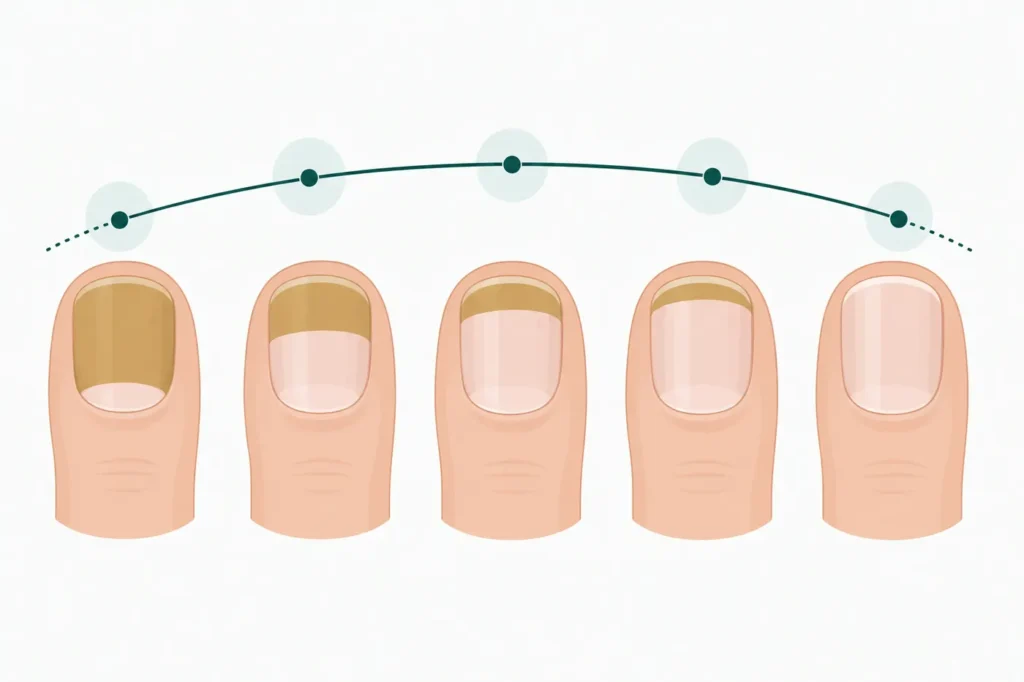
Illustration of a toenail growing in clear from the base over 12 to 18 months

Bottom line: If your nail has not changed appearance at 4 weeks, that is not a reason to stop — especially with oral medications. Clearance only happens as the new, treated nail grows out. See your prescriber if you have no visible new clear growth at 3–4 months.

Toenail Fungus Treatment Side Effects Compared

Side-effect profiles vary significantly between treatment categories. This is one reason prescription oral antifungals require a clinician’s oversight and cannot be purchased OTC.

Oral terbinafine

Most common: GI upset (nausea, diarrhoea), headache, taste disturbance. Rare but serious: hepatotoxicity (liver damage) — baseline liver function tests are recommended. Drug interactions include warfarin, some antidepressants (SSRIs/TCAs) and beta blockers. Tell your prescriber about all medications before starting.

Oral itraconazole

GI upset is common. Itraconazole is a CYP3A4 inhibitor with significant drug interaction potential. Contraindicated with many common medications including some statins, certain antihistamines and benzodiazepines. Requires a full medication review before prescribing. Rare: heart failure risk (caution in cardiac patients).

Topical prescription (Jublia, ciclopirox)

Primarily local: application-site redness, irritation or burning. Systemic absorption is very low, so systemic side effects are uncommon. No liver function test required for topical-only treatment.

OTC topicals and natural remedies

Generally well tolerated. Skin irritation is possible, particularly with tea tree oil (which can cause contact dermatitis in some people at higher concentrations). Undecylenic acid products are suitable for most adults without systemic concerns.

People with diabetes: special considerations

Toenail fungus is more common in people with diabetes (up to 2.5 times the general population rate). Drug interactions and reduced circulation make self-treatment decisions more complex. A podiatrist visit before starting any treatment — including OTC options — is strongly recommended for anyone with diabetes. See our diabetes-specific guide.

Which Toenail Fungus Treatment Fits Your Case

The right treatment depends on severity, your overall health, any medications you take, and how much time you are willing to invest. Use this table as a starting reference, then discuss with a clinician or podiatrist for a confirmed diagnosis.

Your situationStarting pointEvidence level
Mild (1–2 nails, surface discolouration only)OTC undecylenic acid (e.g. Fungi-Nail) or tea tree oil — monitor for 3 monthsLimited Evidence
Moderate (thick or yellow, nail involved throughout)See a doctor or podiatrist for a lab-confirmed diagnosis and treatment planSee a doctor
Severe (crumbling nail, multiple nails, spreading)See a doctor or podiatrist for a lab-confirmed diagnosis and treatment plan (lab confirmation: KOH / culture)See a doctor
Can’t take oral antifungals (liver issue, drug interactions)Discuss non-oral options with a doctor or podiatristSee a doctor
Diabetic or immunocompromisedSee a podiatrist first — do not self-treatSee a doctor
Want appearance improvement while treatingKerasal Fungal Nail Renewal (cosmetic) alongside a real antifungalAnecdotal Evidence for Kerasal (urea: Limited)
Mild and prefer a natural optionNatural blends (e.g., KlaroNail, Kerassentials) as an add-on, not a replacement for proven care; see a clinician if nothing changes in 3–6 monthsLimited Evidence

For information: for moderate or severe confirmed nail fungus, prescription oral terbinafine has the strongest study evidence (Strong); for people who can’t take oral antifungals because of a liver problem or drug interactions, prescription topicals such as Jublia or ciclopirox have Moderate evidence. Only a doctor or podiatrist can decide whether they suit you.

See a podiatrist or clinician if…

  • You have diabetes, peripheral neuropathy or poor circulation in the feet.
  • You are immunocompromised (HIV, organ transplant, immunosuppressant medication).
  • Your nail is painful, the surrounding skin is red or swollen, or there is pus.
  • You have tried OTC treatment for 3 months with no improvement.
  • You have significant nail thickening that makes self-trimming dangerous.

Toenail Fungus Treatment Comparison: Common Questions

Prescription oral terbinafine (generic Lamisil) has the strongest clinical evidence, achieving roughly 46% complete cure and ~76% mycological cure at 72 weeks after a 12-week course in the L.I.ON trial (Evans & Sigurgeirsson, BMJ 1999). It requires a prescription, a liver function test before starting, and a 12-week daily course. Full nail clearance takes 12–18 months as the new nail grows in. OTC options can help in mild cases but have significantly lower evidence for established infections.

Oral terbinafine is the most effective option in head-to-head trial data. The L.I.ON. trial (BMJ 1999) showed terbinafine outperforming itraconazole at 72-week follow-up. Combining oral treatment with nail debridement (thinning of the nail) may improve topical penetration as an adjunct, though evidence for combination superiority is mixed. For patients who cannot take oral antifungals, prescription topicals (Jublia, ciclopirox) are the next-best option.

Yes. In the L.I.ON trial, about 46% of patients achieved complete cure with a 12-week course of oral terbinafine at 72-week follow-up, and about 76% achieved mycological cure (no live fungus) (Evans & Sigurgeirsson, BMJ 1999). That means many people do clear their infection, but it is not guaranteed, and recurrence rates are significant (up to 20–25% within a year). Consistent treatment, full nail grow-out time (12–18 months), and prevention habits (keeping feet dry, rotating footwear) all improve outcomes.

No natural remedy reliably eliminates an established toenail fungal infection (onychomycosis). Tea tree oil has antifungal properties demonstrated in lab studies and a small pilot trial (Buck 1994), and Vicks VapoRub showed improvement in 83% of participants in a small case series (Derby 2011), but neither has been tested in large, rigorous nail-specific RCTs. Natural options may help with very mild surface infections or as adjunct care, but for moderate or severe onychomycosis, prescription medication has far stronger evidence. Nothing kills nail fungus instantly: plan months of consistent treatment regardless of which option you choose.

Sources

  1. Evans EG, Sigurgeirsson B. Double blind, randomised study of continuous terbinafine compared with intermittent itraconazole in treatment of toenail onychomycosis. BMJ. 1999;318(7190):1031–1035. (L.I.ON. trial)
  2. FDA. Sporanox (itraconazole) capsules prescribing information, NDA 020083.
  3. Elewski BE, Rich P, Pollak R, et al. Efinaconazole 10% solution in the treatment of toenail onychomycosis. J Am Acad Dermatol. 2013;68(4):600–608.
  4. Gupta AK, Scher RK, De Doncker P. Current management of onychomycosis. Dermatol Clin. 1997;15(1):121–135.
  5. Buck DS, Nidorf DM, Addino JG. Comparison of two topical preparations for the treatment of onychomycosis. J Fam Pract. 1994;38(6):601–605.
  6. Westerberg DP, Voyack MJ. Onychomycosis: current trends in diagnosis and treatment. Am Fam Physician 2013;88(11):762–70.
  7. Derby R, Rohal P, Jackson C, et al. Novel treatment of onychomycosis using over-the-counter mentholated ointment. J Am Board Fam Med. 2011;24(1):69–74.

Medical disclaimer: This content is for informational purposes only and is not a substitute for professional medical advice, diagnosis or treatment. Always consult a qualified healthcare provider before starting any treatment.

Not sure which treatment fits your case?

Use our interactive treatment finder or see the full evidence-graded guide.