Home › Home Remedies for Toenail Fungus
Home Remedies for Toenail Fungus (2026): What Evidence Says About 13 Popular Options
By Best Toenail Fungus Treatments · Reviewed 15 Nov 2026 · 14 min read
Home › Home Remedies for Toenail Fungus
By Best Toenail Fungus Treatments · Reviewed 15 Nov 2026 · 14 min read
Home remedies for toenail fungus have limited clinical evidence—none are FDA-approved to treat onychomycosis. Nail fungus (onychomycosis) affects 3–12% of adults and rarely resolves without treatment. The best-studied herbal option is snakeroot extract (Limited Evidence); others such as tea tree oil, Vicks, ACV, and garlic have only small pilot-study or lab-only data. For established or severe infection, prescription oral terbinafine has the strongest evidence (~38% complete cure). Home remedies may assist with very early or mild cases, or as adjuncts to prescription treatment.
Evidence Strength (best-studied remedy)
StrongModerateLimited ✓Anecdotal
Key Facts
Best-studied herbal
Snakeroot extract (Limited)
Evidence
All Limited or Anecdotal; none FDA-approved
How common
Nail fungus affects 3–12% of adults
Options compared
13 home remedies graded
| Home Remedy | Grade | Best Evidence | How to Use |
|---|---|---|---|
| Apple cider vinegar | Limited Evidence | No quality RCT | Foot soak 15–20 min daily |
| Hydrogen peroxide (3%) | Limited Evidence | No quality RCT | Direct application or soak |
| Tea tree oil | Limited Evidence | Syed 1999 (60 patients) | Apply twice daily to nail |
| Vicks VapoRub | Limited Evidence | Derby 2011 (25 patients) | Apply at bedtime daily |
| Oregano oil | Limited Evidence | Lab studies only | Apply diluted twice daily |
| Garlic | Limited Evidence | Lab studies only | Apply 20–30 min daily |
| Baking soda | Limited Evidence | No quality RCT | Paste 15 min, 3–4×/day |
| Coconut oil | Limited Evidence | Lab studies only | Apply 2–3×/day |
| Epsom salt | Limited Evidence | No antifungal RCT | Soak 20 min; softens nail |
| Listerine | Limited Evidence | No quality RCT | Soak 20–30 min daily |
| Amish remedy | Anecdotal Evidence | Traditional; no RCT | Varies (vinegar+H2O2 mix) |
| Japanese remedy | Anecdotal Evidence | Traditional; no RCT | Varies by formulation |
| Diluted bleach | Limited Evidence | No quality RCT | 1 tsp per gallon, 10 min max |
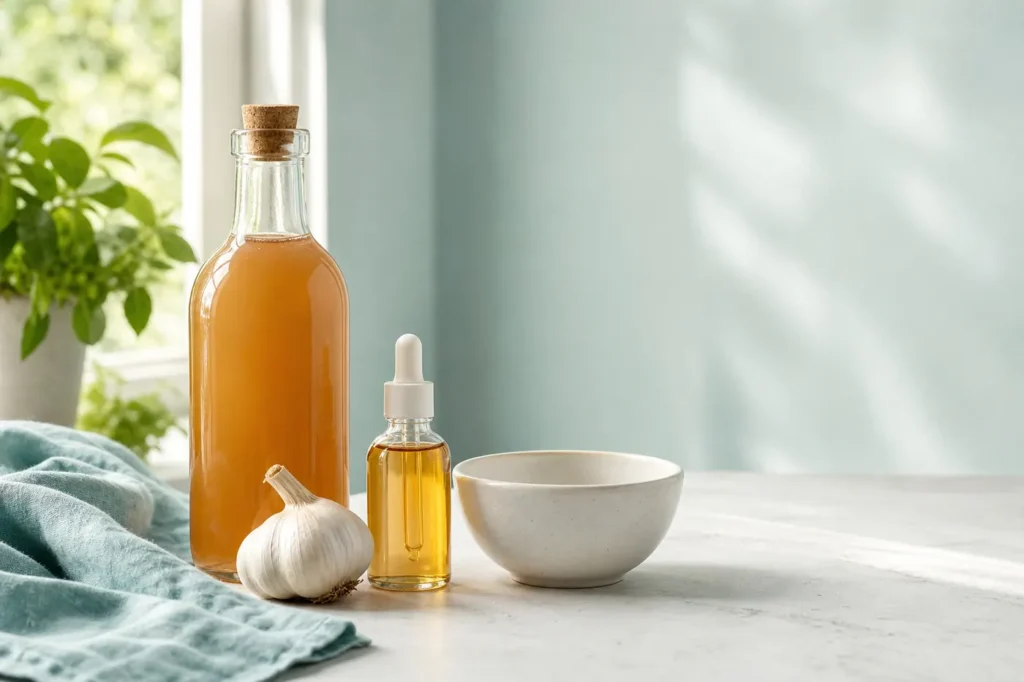
Apple cider vinegar (ACV) may inhibit fungal growth by lowering the local pH, creating conditions less hospitable to dermatophytes, and helping restore the skin’s pH. Mix 2 tablespoons in a basin of lukewarm water and soak feet for 15–20 minutes daily. You can also apply undiluted ACV directly to the affected nail with a cotton ball. No large RCT has confirmed clinical mycological cure for onychomycosis with ACV. Evidence grade: Limited Evidence.
Hydrogen peroxide at 3% concentration (the standard drugstore dilution) produces reactive oxygen species that disrupt fungal cell membranes. As a foot soak (15 minutes in a 3% solution), it may reduce surface fungal load and help disinfect. It is safe for intact skin at 3% concentration but can irritate broken or macerated skin. No quality RCT has established clinical clearance rates for onychomycosis with H2O2. Evidence grade: Limited Evidence.
Tea tree oil (terpinen-4-ol) has the strongest clinical pilot data among topical herbal options for nail fungus. Syed 1999 (60 participants, randomized) compared 1% clotrimazole solution to 100% tea tree oil over 6 months: both produced similar rates of partial or full resolution, but the trial was small and not independently replicated. Apply 100% pure tea tree oil to the affected nail and surrounding skin twice daily. Some practitioners combine it with antifungal cream. Important: tea tree oil is toxic if swallowed. Never ingest. Evidence grade: Limited Evidence.
Vicks VapoRub contains thymol (from the same plant family as oregano), camphor, and eucalyptol—each with antifungal activity in lab tests. Derby 2011 (25 participants, open-label, uncontrolled): 18 showed positive response; 5 achieved complete mycological clearance. This is a small, uncontrolled study with high risk of bias, but Vicks is safe, inexpensive, and widely available. Apply a thin coat to the affected nail at bedtime nightly. Evidence grade: Limited Evidence.
Oregano oil contains carvacrol and thymol, which inhibit Trichophyton rubrum (the most common dermatophyte causing toenail fungus) in laboratory studies. No randomized controlled trial has tested topical oregano oil on human onychomycosis. Oregano oil can irritate skin; always dilute in a carrier oil (e.g., olive or coconut) before applying to the nail and surrounding skin. Evidence grade: Limited Evidence.
Garlic contains ajoene and allicin, with demonstrated antifungal activity against dermatophytes in lab studies. Apply a paste of crushed garlic cloves directly to the affected nail for 20–30 minutes once daily. Garlic can cause skin irritation with prolonged direct contact; test on a small area first. No large RCT has confirmed clinical mycological clearance for onychomycosis with garlic. Evidence grade: Limited Evidence. See a garlic remedy photo (top10homeremedies) for the preparation method.
Baking soda is fungistatic—it inhibits fungal growth rather than eliminating existing infection. At alkaline pH (above 8), many dermatophytes grow poorly. Mix baking soda with water to form a paste and apply to the affected nail for 15 minutes, 3–4 times daily. It also absorbs excess moisture from footwear. As a standalone treatment for established onychomycosis, it is unlikely to achieve clinical clearance. Most useful as part of a broader hygiene and dryness regimen. Evidence grade: Limited Evidence.
Coconut oil contains medium-chain fatty acids—particularly caprylic acid, capric acid, and lauric acid—with antifungal activity against Candida species in lab studies. Activity against dermatophytes (the more common toenail fungus pathogen) is less well-established. Apply unrefined coconut oil to the affected nail 2–3 times daily. No quality RCT has confirmed efficacy for onychomycosis in humans. Evidence grade: Limited Evidence.
Epsom salt (magnesium sulfate) has no direct antifungal properties, but it softens and exfoliates the nail plate, potentially allowing topical antifungal agents to penetrate more effectively after soaking. Mix 1 cup of Epsom salt into 2 quarts of warm water; soak feet for up to 20 minutes. Most useful as an adjunct before applying a topical treatment (tea tree oil, tolnaftate, etc.) rather than as a standalone remedy. Evidence grade: Limited Evidence.
Listerine contains menthol, thymol, eucalyptol, and methyl salicylate—each with antimicrobial properties. The alcohol base (21.6% in original formula) also has antifungal activity. Soak the affected foot in full-strength Listerine or a 1:1 mix with white vinegar for 20–30 minutes daily. The vinegar–Listerine combination is a popular combination due to the acidic pH of vinegar complementing the antifungal compounds. No quality RCT has confirmed clinical mycological cure rates for onychomycosis with Listerine alone. Evidence grade: Limited Evidence.
The “Amish remedy” for toenail fungus is a traditional formulation typically combining equal parts white vinegar, hydrogen peroxide, and water, sometimes with the addition of isopropyl alcohol or Listerine. The rationale is that this combination lowers the local pH (vinegar), disrupts fungal membranes (H2O2 + alcohol), and delivers antifungal plant compounds (Listerine). No clinical trial has tested this specific combination for onychomycosis. Evidence grade: Anecdotal Evidence. Use caution if skin is broken; never apply straight peroxide at concentrations above 3%.
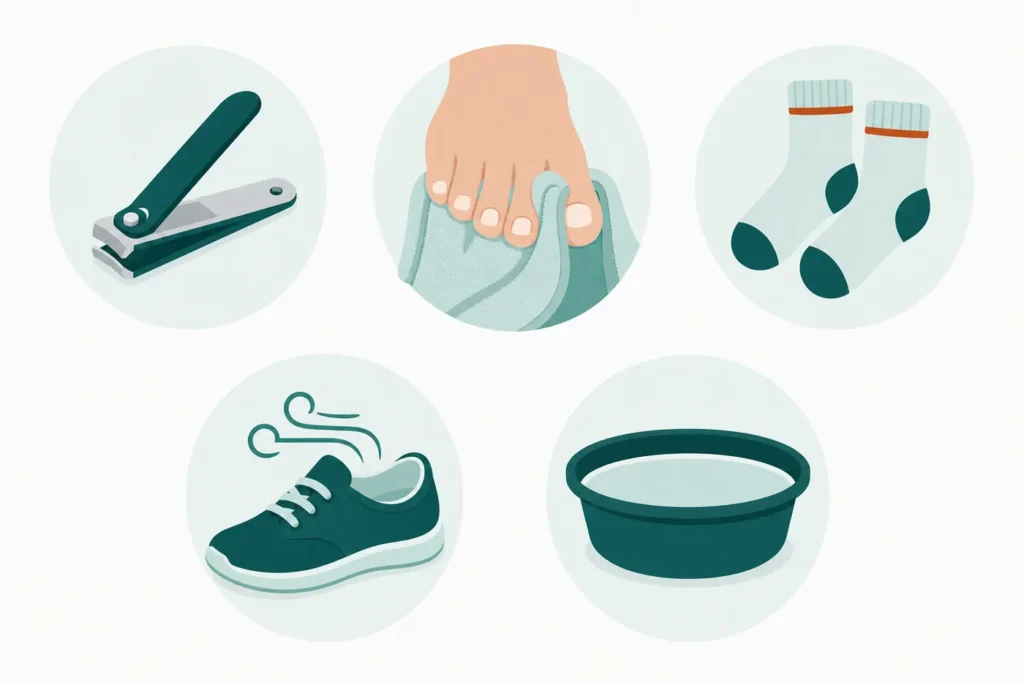
The term “Japanese toenail fungus code” refers to a traditional Japanese nail hygiene approach that emphasizes maintaining very clean, dry nails, using diluted essential-oil soaks, and changing footwear regularly. The approach is rooted in the observation that onychomycosis has historically been less prevalent in populations with strict foot-hygiene habits. No clinical trial has tested this specific approach. Evidence grade: Anecdotal Evidence. The hygiene principles (dry feet, clean nails, ventilated footwear) are consistent with dermatological guidelines.
Sodium hypochlorite (household bleach) has strong antifungal activity. Diluted to a low concentration (1 teaspoon per gallon of water), it may reduce surface fungal load on the nail. Important precautions: never use undiluted bleach on skin; never exceed a 10-minute soak; avoid if skin is broken, irritated, or sensitive; never recommend for people with diabetes without physician approval. No quality RCT has established clinical clearance rates for onychomycosis with bleach soaks. Evidence grade: Limited Evidence.
Source: Top 10 Home Remedies for Toenail Fungus.
See also lemon juice remedy photo (top10homeremedies) for lemon juice preparation guidance.
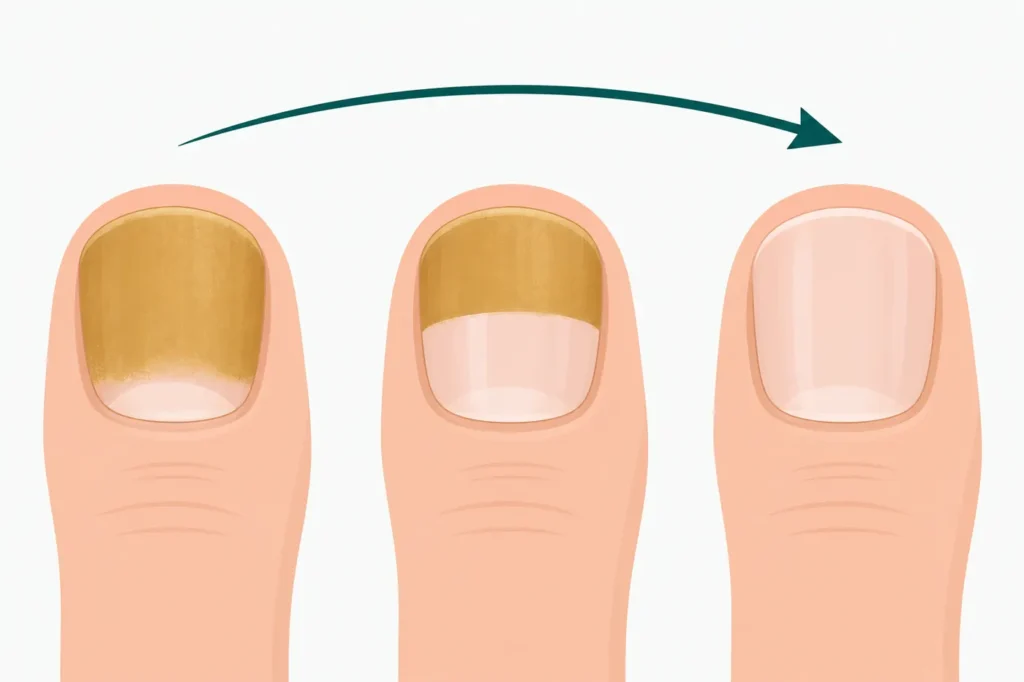
No clear timeline exists because no large clinical trial has established one. What is known from nail biology:
For confirmed nail fungus, prescription oral terbinafine (Lamisil) achieves ~38% complete cure in the FDA label trials—far ahead of any home remedy. See the full medication guide for all prescription options, or the best toenail fungus treatments overview for a complete comparison.
No single home remedy is proven to reliably clear established onychomycosis. Among options with any clinical pilot data, tea tree oil (Syed 1999) and Vicks VapoRub (Derby 2011) have small-study support. All home remedies grade Limited Evidence or Anecdotal Evidence. If the infection is mild or early, consistent daily application of one of these for 3 months is a reasonable first step. See all 13 options above with their evidence ratings.
Probably not for established infection. ACV lowers local pH and may inhibit fungal growth, but no large randomized trial has confirmed clinical mycological cure. It is safe and inexpensive, making it reasonable to try for very early or mild nail involvement. If no improvement at 3 months, prescription evaluation is warranted.
3 months of consistent daily application is a reasonable trial period for very early-stage nail involvement. If no improvement is visible at 3 months (or sooner if more than 50% of the nail is affected, or if you have diabetes or circulation problems), seek prescription treatment. Early-stage infections respond better to all treatments than advanced ones.
The honest answer: none have been proven to work in a large, independent randomized controlled trial for established nail fungus. Tea tree oil and Vicks have small pilot data showing modest improvement in some participants. Snakeroot extract has three small RCTs against ciclopirox, with ~8.6% complete cure at 24 weeks. All grade Limited Evidence. Prescription oral terbinafine (~38% complete cure) is significantly more effective than any home option.
No home remedy has been shown to eliminate onychomycosis reliably. Prescription oral terbinafine (12-week course) achieves approximately 38% complete cure in the FDA label trials—the highest rate of any single treatment. Lasting clearance also requires preventing re-infection through ongoing hygiene practices (dry feet, clean footwear, treating athlete’s foot). See our complete treatment guide for options graded by evidence.
Medical disclaimer: Informational only. Not a substitute for professional medical advice. Consult a qualified healthcare provider before starting any treatment.
Answer 4 quick questions and see evidence-graded picks for your situation.