Home › Product Reviews › KlaroNail Review
KlaroNail Review (2026): Ingredients, Price, Refund Terms and Honest Verdict
By Best Toenail Fungus Treatments · Reviewed 16 Nov 2026 · 13 min read
Affiliate disclosure: This page contains affiliate links. If you buy through them, we may earn a commission at no extra cost to you. It does not change our evidence grades. Full disclosure →
This KlaroNail review reads the actual product label, the sales page, the refund policy and the published research on each ingredient, so you can judge the spray on facts rather than on its video headline. Everything below was checked on 16 November 2026.
Our Verdict in 60 Seconds
Evidence grade: Limited Evidence
KlaroNail is a 30 mL topical spray whose label lists 5% undecylenic acid plus 16 oils and botanicals, including tea tree, menthol and camphor. The ingredient mix is sensible for a cosmetic foot-care routine, but no clinical trial of KlaroNail itself has been published, and its 5% undecylenic acid sits below the 10–25% range the FDA OTC antifungal monograph allows for skin use. No OTC product is FDA-approved to treat toenail fungus. Our grade for the blend is Limited.
Who it may suit: adults with mild, early nail discoloration who want an easy spray routine alongside good foot hygiene, and who accept that the evidence is thin.
Who should skip it: people with diabetes, poor circulation or a weakened immune system; thick, painful or widespread infections; children; and anyone allergic to tea tree, essential oils or undecylenic acid.
At a Glance
Evidence Strength
StrongModerateLimited ✓Anecdotal
The Claim vs. the Evidence
| The marketing claim | What the evidence says |
|---|---|
| “A breakthrough spray formula” for stubborn toenail fungus (sales page) | No trial of KlaroNail; 5% undecylenic acid, below the 10–25% monograph range |
Key Facts
Price
$207 for 3 bottles ($69 each)
Form
30 mL topical spray
Guarantee
60 days; buyer pays return postage
Trials
None of this product
No published clinical trials of this exact blend.
What Is KlaroNail?
KlaroNail is a topical spray sold in 1 fl oz (30 mL) bottles for people dealing with discolored or thickened toenails. The sales page calls it “a breakthrough spray formula… created for people struggling with stubborn toenail fungus, recurring infections.” The label lists one ingredient with a stated amount (undecylenic acid USP at 5%) and 16 supporting oils and extracts.
Who sells it: the official site routes checkout and order support through BuyGoods. The label reads “Distributed By: Klaronail, 11870 62nd St N Largo, Fl. 33773” and says the spray is “Manufactured in the United States from the finest of foreign and domestic ingredients.” No legal company name or named manufacturer appears, so we could not verify who makes it.
Where to buy it: the vendor says KlaroNail “can be found only on this page and it is not available for purchase anywhere else,” and its FAQ warns that copies sold elsewhere “might not be legit.” Even so, we found an Amazon listing (ASIN B0HCPNGY7Q) sold by a third-party seller called Virtuo Alliance at $29.99, with 4.2 stars from 23 ratings as of November 2026. We could not confirm whether that seller is authorized. If you want the vendor’s guarantee, buy from the official KlaroNail website.
Regulatory status: KlaroNail is not FDA-approved. No over-the-counter product is approved to treat onychomycosis (toenail fungus), and the site itself notes that its statements have not been evaluated by the FDA.
KlaroNail Ingredients: Every Label Item Graded
We graded each ingredient on the label image linked from the vendor’s references page, against human studies of nail or foot fungus. Only undecylenic acid has a stated amount. How we grade evidence →
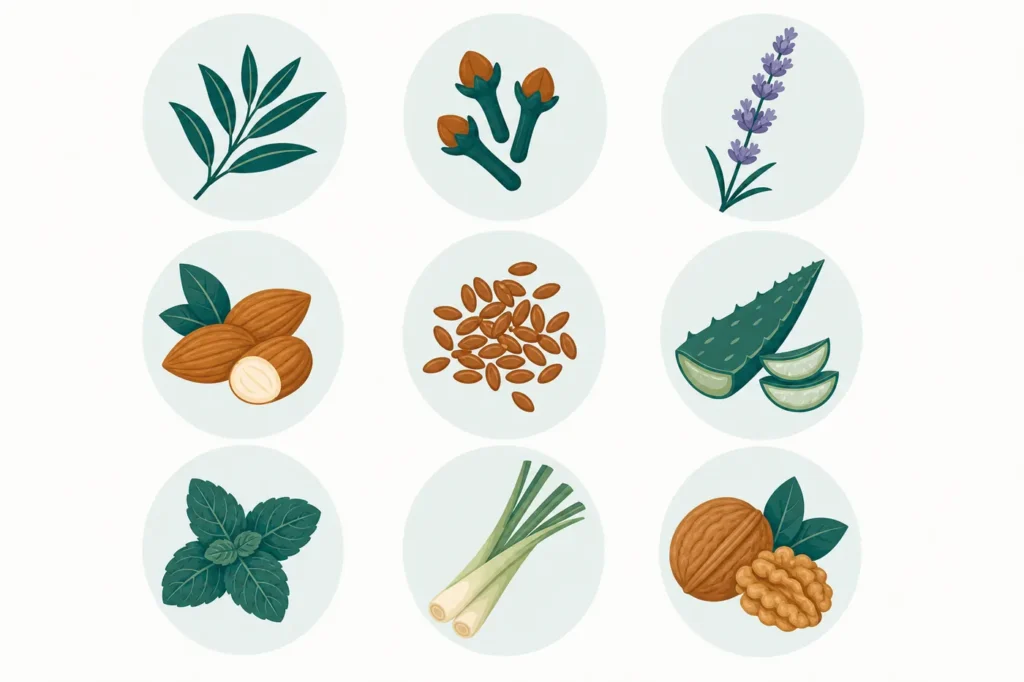
| Ingredient | Evidence | What the research shows |
|---|---|---|
| Undecylenic acid USP (5%) | Limited Evidence | The one FDA-monograph antifungal on the label. Trials show it helps athlete’s foot on skin (Smith 1977, PMID 832943; Fuerst 1980, PMID 6991217) at 10–25%. We found no toenail trial, and an ex vivo study compared how OTC and Rx topicals pass through nail (Elabbasi 2024, PMID 39133361). |
| Tea tree oil | Limited Evidence | 100% tea tree oil was compared with 1% clotrimazole in 117 patients with nail fungus (Buck 1994, PMID 8195735). KlaroNail uses it as one oil in a blend, at an undisclosed amount. |
| Menthol + camphor oil | Limited Evidence | The same pairing as mentholated chest rub, which improved nails in an 18-person case series without a control group (Derby 2011, PMID 21209346). |
| Vitamin E (tocopheryl acetate) | Limited Evidence | An open, uncontrolled study of a different vitamin E and essential-oil nail oil reported improvement in mild nail fungus (Alessandrini 2020, PMID 32021856). |
| Clove bud oil | Anecdotal Evidence | Lab-dish activity against nail fungi only (Chee 2007, PMID 24015106). |
| Lavender oil | Anecdotal Evidence | Lab-dish activity only, including by vapour (Inouye 2001, PMID 11413931). |
| Manuka oil | Anecdotal Evidence | Lab-dish antimicrobial data only (Christoph 2000, PMID 10985085). |
| Lemongrass oil | Anecdotal Evidence | No nail-fungus clinical data found. |
| Sweet almond, flaxseed, walnut, jojoba, chia, canola oils | Anecdotal Evidence | Carrier oils and emollients that soften skin and help the spray spread. No antifungal trials. |
| Aloe vera leaf extract, mineral oil | Anecdotal Evidence | Soothing and moisturising base ingredients. |
Label vs sales page: the sales page lists “Manuka Honey” and leaves out mineral oil, canola, jojoba and lemongrass, while the label lists manuka oil and includes all four. Go by the label on the bottle you receive.
The 5% question: the FDA OTC antifungal monograph allows undecylenic acid at a total concentration of 10 to 25 percent, and its required labeling says “This product is not effective on the scalp or nails” (21 CFR 333.210 and 333.250). KlaroNail’s 5% is below that range.
Does KlaroNail Work? What the Evidence Says
Nobody has published a trial of KlaroNail. A PubMed search for the name returned no records, and ClinicalTrials.gov lists no study (both checked 16 November 2026). The vendor’s references page cites papers on single ingredients, not on the finished spray.
That leaves the ingredients. The strongest of them, undecylenic acid, has solid trial support for athlete’s foot on the skin, but at higher strengths than KlaroNail uses, and not for nails. Tea tree oil and mentholated rubs have small or uncontrolled nail studies. The rest are lab-dish results or simple moisturisers. A 2022 systematic review of complementary nail-fungus treatments (Nickles 2022, PMID 35983465) and a Cochrane review of topical foot and nail antifungals (Crawford 2007, PMID 17636672) both show how little high-quality evidence exists for plant-based options.
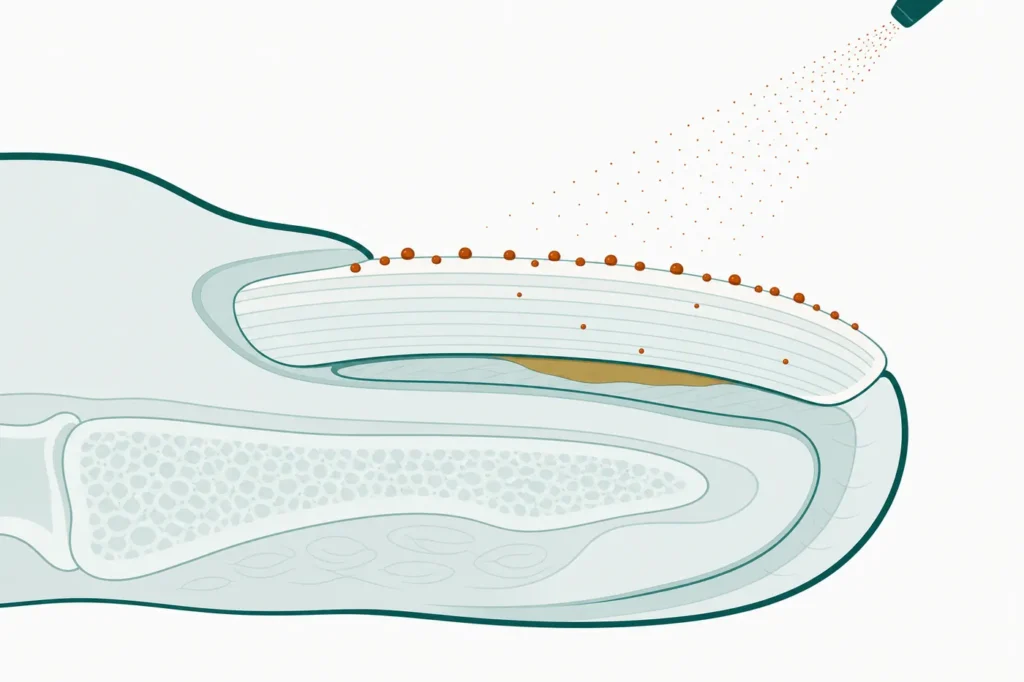
Why topicals struggle on nails: fungus lives in and under the hard nail plate. A spray has to soak through that plate to reach it, which is why even prescription topicals such as efinaconazole (Jublia) reach only 15–18% complete cure in phase III trials (Elewski 2013, PMID 23177180).
The realistic best use: a reasonable cosmetic add-on for mild cases alongside proven care: keeping the nail trimmed and thinned, drying feet and shoes, and treating any athlete’s foot. An oil-based spray can soften the skin around the nail and make the nail look less dry. It should not be your only plan for a confirmed infection.
How to Use KlaroNail, and a Realistic Timeline
Label directions: “Spray 4 times per day (twice in the morning and twice in the afternoon). Spray to coat the nail and cuticle.” The label also says “For external use only… Discontinue use if irritation occurs.”
- Wash and fully dry the foot, including between the toes.
- Trim the nail straight across and gently file down thick areas so the spray can reach more of the nail.
- Coat the nail and the cuticle, following the label’s four sprays a day.
- Wash your hands afterwards and let the oil absorb before putting on socks.
- Take a photo of the nail on day one and every month, so you can judge new growth honestly.
| When | What to expect |
|---|---|
| First weeks | The skin around the nail may feel softer. The damaged nail itself will not change. |
| About 3 months | The vendor advises using the spray “at least 3 months” before deciding. Look for clearer new nail growing out from the cuticle. |
| 12–18 months | A big toenail takes this long to grow out fully. Only then can you see whether the whole nail is clear. |
See a doctor or podiatrist if the nail is painful, the skin is red or swollen, you have diabetes, or nothing has improved at the cuticle after about 3 months. A lab test can confirm whether the problem is fungus at all; nail psoriasis and injury can look the same.
KlaroNail Price, Shipping and Bonuses (as of Nov 2026)
The official page does not print its prices as plain text; they load from the page script. This is what that script and the page showed on 16 November 2026:
| Package (as shown) | Bottles | Total | Per bottle | Shipping |
|---|---|---|---|---|
| Basic | Page box says “2 bottles”; script says 1 | $158 | $79 or $158 | + $9.99 |
| Most Popular | 3 (2 + 1) | $207 | $69 | Free (US) |
| Best Value | 6 (3 + 3) | $294 | $49 | Free (US) |
- Confirm the Basic tier at checkout. The page and its script disagree on whether $158 buys one bottle or two.
- International shipping: $15.95 to Canada, the UK, Ireland, Australia and New Zealand.
- Bonuses with 6 bottles: three e-books (“Clear Skin…”, “Perfect Feet…” and “Move Without Pain…”), with stated retail values of $79, $67 and $69.
- Upsells: extra bottles after checkout ran $29–$43 each in the script.
- Amazon: a third-party listing sold one bottle for $29.99, but the vendor’s guarantee only covers orders from its own site.
Value check: the 3-bottle pack lasts about the 3 months the vendor recommends trying it, and costs $207. Prices change, so check the current offer before you order.
KlaroNail Refund Policy: What the 60-Day Guarantee Covers
KlaroNail offers a 60-day guarantee from delivery. Under its refunds page:
- Email support with “Refund Request” in the subject line.
- Return all bottles, empty or not, with the packing slip, to 11870 62nd St N, Largo, FL 33773.
- “We do not support the return shipping costs,” so you pay postage.
- Refunds are processed in 5–10 days.
The catch: the vendor recommends using KlaroNail for at least 3 months, which is longer than the 60-day window, and a toenail needs 12–18 months to grow out. In practice, you need to decide by about week 7 or 8, before most nail changes can show. Mark the deadline in your calendar on the day the parcel arrives.
KlaroNail Complaints and Red Flags to Watch For
We found no independent complaint record for KlaroNail: no Trustpilot page, no BBB profile and no Reddit threads as of November 2026. Search results were mostly paid press releases. So instead of repeating unverifiable complaints, here are the issues we could see in the vendor’s own materials:
- An unnamed “surgeon”: the video page headline reads “Top Foot Surgeon: 3-Minute Shower Hack Flushes Away Fungus In Record Time.” No surgeon is named.
- Review counts we could not check: the page claims “13,872 reviews” and that “96% Of Customers Order 6 Bottles.” Neither figure is verifiable, and the named testimonials cannot be confirmed.
- “FDA-approved facility”: the FAQ says the spray is made in an “FDA-approved facility.” The FDA does not approve facilities in that way.
- “All ages and medical conditions”: the FAQ says the formula “has been designed for all ages and medical conditions.” People with diabetes, and children, should see a clinician first.
- “Proven to be safe in clinical trials”: the vendor says this of the ingredients. The finished spray has not been trialled, and tea tree oil and undecylenic acid can both cause contact allergy.
- Label vs page mismatch on several ingredients, and a price-tier mismatch on the Basic pack.
Regulatory context: we found no FDA warning letter or FTC action naming KlaroNail (searched 16 November 2026). For context, in April 2026 the FDA warned Chemco Corp. that a nail-fungus product it sold was an unapproved new drug, because topical antifungal claims for nails are not covered by the OTC monograph. That is a reason to read any product’s nail claims as marketing, not as a medical finding.
KlaroNail Side Effects and Who Should Avoid It
No side-effect data exist for KlaroNail itself. The ingredient research points to skin reactions as the main risk:
- Contact allergy to undecylenic acid has been reported from an antifungal nail solution (Ochando-Ibernón 2019, PMID 30537336).
- Tea tree oil is a known contact allergen, especially once it oxidises (de Groot 2016, PMID 27173437).
- Menthol and camphor rubs have caused contact dermatitis (Noiles 2010, PMID 20487662).
- Nut-derived oils (almond, walnut) may matter if you have a nut allergy; ask your doctor.
Patch test first: spray a little on the inside of your forearm and wait 48 hours. Stop if you see redness, itching or blistering, as the label says.
Skip KlaroNail and see a clinician if you: have diabetes, poor circulation or a weakened immune system; have a thick, painful or crumbling nail, or several infected nails; are treating a child; or are pregnant or breastfeeding and unsure about essential oils.
KlaroNail Pros and Cons
| Pros | Cons |
|---|---|
| Easy spray format that covers the nail and cuticle without a brush | No clinical trial of the product itself |
| Contains undecylenic acid, an FDA-monograph antifungal for skin | 5% undecylenic acid is below the 10–25% monograph range |
| Full ingredient label published, with the active’s strength stated | You pay return postage and must send back every bottle |
| Free US shipping on the 3- and 6-bottle packs | Guarantee window is shorter than the 3 months the vendor recommends |
| 60-day money-back guarantee from delivery | Unverified review counts and an unnamed “surgeon” in the ads |
KlaroNail vs Alternatives
| Option | Type | Evidence | Key result |
|---|---|---|---|
| Oral terbinafine | Prescription tablet | Strong Evidence | 46% complete cure at week 72 (Evans 1999, PMID 10205099) |
| Efinaconazole (Jublia) | Prescription topical | Moderate Evidence | 15–18% complete cure (Elewski 2013, PMID 23177180) |
| Tea tree oil | OTC oil | Limited Evidence | Compared with clotrimazole (Buck 1994, PMID 8195735) |
| KlaroNail | Spray blend | Limited Evidence | No product trial |
If the nail is thick, painful or several nails are involved, prescription treatment has far stronger evidence than any spray. Our best toenail fungus treatment guide ranks the options by evidence, and our undecylenic acid guide explains how the same active works at monograph strength.
Other MaxWeb Nail Products We Reviewed
KlaroNail FAQ
There is no published trial of KlaroNail, so nobody can say how well it works. Its main active, undecylenic acid, helps athlete’s foot on the skin at 10–25%, but KlaroNail uses 5% and nail evidence is lacking. We grade it Limited: a reasonable cosmetic add-on for mild cases, not a replacement for proven treatment.
The label lists undecylenic acid USP (5%), mineral oil, sweet almond, flaxseed, tea tree, aloe vera, canola, vitamin E, walnut, menthol, camphor, clove bud, jojoba, chia, lemongrass, lavender and manuka oil.
We found a third-party Amazon listing (seller “Virtuo Alliance”, $29.99, November 2026), although the vendor says KlaroNail is sold only on its own site. We could not verify that seller. The 60-day guarantee applies to official-site orders.
No product-specific data exist. Undecylenic acid, tea tree oil, and menthol or camphor have all caused contact dermatitis in some people. Patch test first and stop if irritation occurs.
60 days from delivery. Email support with “Refund Request” in the subject, return all bottles with the packing slip to the Largo, Florida address, and pay the return postage yourself. Refunds take 5–10 days.
Neither is proven for nails. On paper, a product at 10–25% undecylenic acid matches the FDA monograph strength for skin fungus, while KlaroNail’s 5% does not. KlaroNail adds tea tree, menthol and other oils. For nail fungus itself, prescription options have the strongest evidence.
No. No over-the-counter product is FDA-approved to treat toenail fungus, and the site says its statements have not been evaluated by the FDA.
Sources
1. KlaroNail official sales page, label image and help pages (references, refunds, contact), theklaronail.com, accessed 16 Nov 2026.
2. eCFR. 21 CFR Part 333 Subpart C, sections 333.210 and 333.250 (OTC topical antifungal monograph), accessed 16 Nov 2026.
3. Amazon listing ASIN B0HCPNGY7Q, accessed 16 Nov 2026.
4. Smith EB, et al. Topical undecylenic acid in tinea pedis: a new look. Int J Dermatol 1977. PMID 832943.
5. Fuerst JF, et al. Comparison between undecylenic acid and tolnaftate in the treatment of tinea pedis. Cutis 1980. PMID 6991217.
6. Elabbasi A, et al. Transungual penetration and antifungal activity of prescription and OTC topical antifungals. Dermatol Ther (Heidelb) 2024. PMID 39133361.
7. Ochando-Ibernón G, et al. Allergic contact dermatitis caused by undecylenic acid in an antifungal nail solution. Contact Dermatitis 2019. PMID 30537336.
8. Buck DS, et al. Comparison of two topical preparations for the treatment of onychomycosis. J Fam Pract 1994;38(6):601–605. PMID 8195735.
9. de Groot AC, et al. Tea tree oil: contact allergy and chemical composition. Contact Dermatitis 2016. PMID 27173437.
10. Derby R, et al. Novel treatment of onychomycosis using over-the-counter mentholated ointment. J Am Board Fam Med 2011. PMID 21209346.
11. Noiles K, et al. Contact dermatitis to Vicks VapoRub. Dermatitis 2010. PMID 20487662.
12. Alessandrini A, et al. Open study of a nail oil composed of vitamin E and essential oils. Skin Appendage Disord 2020. PMID 32021856.
13. Chee HY, et al. Antifungal activity of clove essential oil against dermatophytic fungi. Mycobiology 2007. PMID 24015106.
14. Inouye S, et al. In-vitro and in-vivo anti-Trichophyton activity of essential oils by vapour contact. Mycoses 2001. PMID 11413931.
15. Christoph F, et al. In vitro antimicrobial activity of tea tree oils, including manuka oil. Planta Med 2000. PMID 10985085.
16. Nickles MA, et al. Complementary and alternative therapies for onychomycosis: a systematic review. Skin Appendage Disord 2022. PMID 35983465.
17. Crawford F, et al. Topical treatments for fungal infections of the skin and nails of the foot. Cochrane Database Syst Rev 2007. PMID 17636672.
18. Evans EGV, Sigurgeirsson B, et al. Terbinafine vs itraconazole in onychomycosis (L.I.ON. study). BMJ 1999;318:1031. PMID 10205099.
19. Elewski BE, et al. Efinaconazole 10% topical solution for onychomycosis: two phase III trials. J Am Acad Dermatol 2013. PMID 23177180.
20. FDA warning letter to Chemco Corporation, 7 Apr 2026. fda.gov
Medical disclaimer: This page is general information, not medical advice. See a doctor or podiatrist before treating a nail problem, especially if you have diabetes, poor circulation or a weakened immune system, or are pregnant or breastfeeding.
Want to try KlaroNail? Check the current offer and the label first.
Confirm the bottle count and the 60-day refund terms at checkout. For thick, painful or widespread nail fungus, start with an evidence-backed treatment instead.