Home › Treatments › Keravita Pro vs Kerassentials

Keravita Pro vs Kerassentials (2026): Pill vs Oil — Evidence-Graded Comparison

Affiliate disclosure: This page contains affiliate links, including links to the official Keravita Pro and Kerassentials sites. If you buy through them we may earn a commission at no extra cost to you. That does not change our evidence grades, which are based on published research only. Full disclosure → See how we review →

Important supplement notice (DSHEA): Keravita Pro is an oral dietary supplement. These statements have not been evaluated by the Food and Drug Administration. This product is not intended to diagnose, treat, cure, or prevent any disease. Dietary supplements are regulated differently from prescription drugs — efficacy does not need to be proven to the FDA before sale.
Generic capsule bottle and brush-cap oil bottle compared side by side

Keravita Pro vs Kerassentials: The Short Answer

Kerassentials: Anecdotal Evidence (undecylenic acid, tea tree oil: Limited); Keravita Pro: Anecdotal Evidence for nail fungus. Neither has a product-specific randomised controlled trial.

Critical difference: Keravita Pro is an oral dietary supplement. Kerassentials is a topical oil. They target nail health through completely different mechanisms, so they cannot be directly compared for effectiveness. No oral dietary supplement (non-drug) has FDA approval or clinical-trial evidence for treating nail fungus.

If you are comparing these products expecting one to “win,” the honest answer is that neither has the evidence to win over prescription oral terbinafine or prescription topical efinaconazole.

Price: both list at about $69 per bottle on their vendor sites (verify before purchasing).

At a Glance

Side by Side

Keravita ProKerassentials
Oral capsules, hidden-dose blend incl. graviola; Anecdotal; $49–$69/bottleTopical oil, label lists undecylenic acid 5%; Anecdotal (ingredients Limited); $49–$79/bottle

Key Facts

Best evidence

Neither; Rx oral terbinafine is far stronger

Prefer a pill

Keravita Pro (no product RCT)

Prefer a topical

Kerassentials (no product RCT)

Use both together?

No evidence of added benefit

How Keravita Pro Works on Toenail Fungus

Important supplement notice (DSHEA): Keravita Pro is an oral dietary supplement. These statements have not been evaluated by the Food and Drug Administration. This product is not intended to diagnose, treat, cure, or prevent any disease. Dietary supplements are regulated differently from prescription drugs — efficacy does not need to be proven to the FDA before sale.

Keravita Pro is an oral dietary supplement sold via ClickBank. It contains a blend of botanical extracts and vitamins. No ingredient in Keravita Pro is an FDA-registered antifungal active. All ingredients are in the Anecdotal evidence category for nail fungus.

Keravita Pro ingredient grades:

IngredientGrade (nail fungus)
Cat’s claw (Uncaria tomentosa)Anecdotal Evidence
Garlic extractAnecdotal Evidence
LycopeneAnecdotal Evidence
QuercetinAnecdotal Evidence
Pomegranate extractAnecdotal Evidence
Olive leaf extractAnecdotal Evidence
Vitamin C, Vitamin E, SeleniumAnecdotal Evidence (antioxidant support, not antifungal)

Critical honest note: Oral dietary supplements marketed for nail fungus face a fundamental challenge: antifungal drug activity requires reaching therapeutic concentrations in the nail bed. The best-evidenced oral antifungal, terbinafine, achieves this because it is a pharmaceutical drug with controlled pharmacokinetics designed for it. No dietary supplement ingredient has demonstrated equivalent nail-bed antifungal concentrations in clinical trials. Full Keravita Pro review →

How Kerassentials Works on Toenail Fungus

Kerassentials is a topical oil applied with a brush to the nail and surrounding skin. Its one FDA-registered antifungal active is undecylenic acid — approved at up to 25% for skin fungal infections.

Kerassentials ingredient grades:

IngredientGrade (nail fungus)
Undecylenic acidLimited Evidence skin; Anecdotal Evidence nail
Tea tree oilLimited Evidence
Lavender, lemongrass, almond oilsAnecdotal Evidence
Aloe vera, Vitamin EAnecdotal Evidence

Topical advantage: Unlike oral supplements, topical products can deliver active ingredients directly to the nail site. The limitation is nail penetration — the nail plate is a dense keratin barrier that OTC topicals struggle to penetrate deeply enough to reach the fungus in the nail bed. Full Kerassentials review →

Keravita Pro vs Kerassentials: Cure Rates and What the Evidence Shows

TreatmentEvidenceComplete cure rate
OTC undecylenic acid (skin)Limited EvidenceNot established (nail)
Kerassentials (topical)Anecdotal Evidence (undecylenic acid, tea tree oil: Limited)Not established
Keravita Pro (oral supplement)Anecdotal EvidenceNot established

For reference: prescription treatments. These are not sold here and are not among the products we suggest; a doctor or podiatrist decides whether one suits you.

  • Oral terbinafine (Rx): evidence: Strong Evidence; complete cure rate: ~38% at 48 wks (FDA label).
  • Jublia / efinaconazole (Rx topical): evidence: Moderate Evidence; complete cure rate: 15–18%.

Neither Keravita Pro nor Kerassentials has a published, independent controlled trial for onychomycosis. The cure rate column for both is “Not established” because no trial has established it. Compare this to oral terbinafine (~38%) and Jublia (15–18%), both of which have multiple independent RCTs confirming their cure rates.

How Long Each Takes

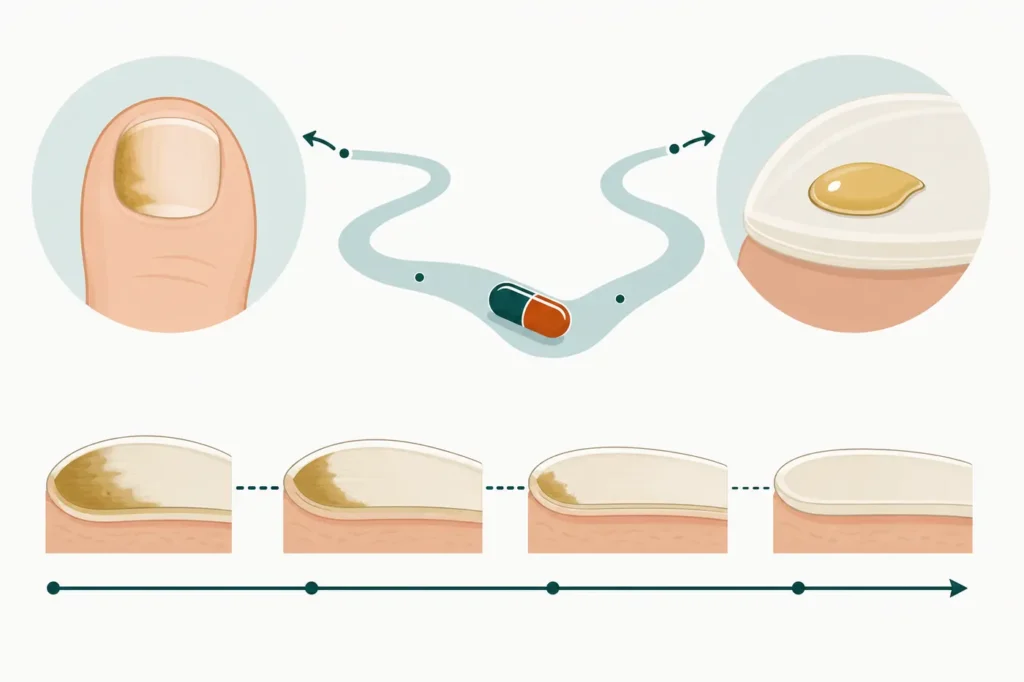
Both products have vendor-stated timelines that conflict with nail growth biology:

Illustration of an oral capsule versus a topical oil and the slow toenail grow-out

Side Effects and Safety

Keravita Pro (oral supplement):

Kerassentials (topical):

Cost and Where to Get It

Before you buy either: prices and refund terms above are from the official sites, checked 16 Nov 2026. Both refunds require returning all bottles at your own cost, and only the official sites are covered. Amazon listings using either name could not be verified as authorised.

Cost comparison: Generic oral terbinafine prescription costs approximately $10–$30 for a 12-week course with GoodRx discount cards. The cost premium for these products does not reflect a stronger evidence base.

Who Should Choose Keravita Pro and Who Should Choose Kerassentials

Given that neither has a product trial (both Anecdotal as products), neither is a first-line recommendation. That said:

Keravita Pro (oral) may appeal to:

Kerassentials (topical) may appeal to:

Worth knowing: For confirmed nail fungus, prescription oral terbinafine has the strongest study evidence at a low cost; only a doctor can decide whether it suits you (read about terbinafine pills). For options you can buy without a prescription, see our best over-the-counter toenail fungus treatments →

Can You Use Keravita Pro and Kerassentials Together?

No clinical rationale supports using both together. There is no evidence that combining an oral supplement and a topical oil for nail fungus produces synergistic benefit. Using both simultaneously doubles the cost without a proven additional benefit. If neither works alone over 3–4 months, the most effective next step is a clinician consultation and a prescription antifungal, not adding a second unproven product.

Keravita Pro vs Kerassentials: Common Questions

Both are real products sold by their respective vendors. Whether their marketing claims are legitimate is a separate question. Both are Anecdotal Evidence as products (Kerassentials’ undecylenic acid and tea tree oil are Limited) for nail fungus — neither has a product-specific RCT. Keravita Pro is a dietary supplement (DSHEA-regulated; efficacy not proven to FDA before sale). Kerassentials contains an FDA-registered antifungal active (undecylenic acid) for skin fungus. Neither is FDA-approved to treat onychomycosis.

Kerassentials contains undecylenic acid (FDA-approved for skin fungus) plus botanicals (undecylenic acid is Limited for nail fungus; the botanicals are Anecdotal). Evidence grade for the product itself: Anecdotal Evidence — no product RCT. Full Kerassentials review →

Among topical oils with any clinical evidence, tea tree oil has the most studied antifungal profile: Limited Evidence (small RCTs, including one nail trial). No single botanical oil has demonstrated nail-fungus cure in a controlled trial. Prescription topical efinaconazole (Jublia, 15–18% cure) is the best-evidenced topical oil for nail fungus, though it is a pharmaceutical solution, not a botanical oil.

No specific documented traditional Amish treatment for nail fungus exists in the clinical literature. Products marketed under this label typically contain vinegar, essential oils or other home remedies with Anecdotal to Limited evidence grades. None has been confirmed in a controlled nail-fungus trial.

Sources

1. Gupta AK, Foley KA, Mays RR, et al. Monotherapy for toenail onychomycosis: a systematic review and network meta-analysis. Br J Dermatol 2020;182(2):287–99.

2. Evans EG, Sigurgeirsson B. Double blind, randomised study of continuous terbinafine compared with intermittent itraconazole in treatment of toenail onychomycosis (L.I.ON). BMJ 1999;318(7190):1031–5.

3. Elewski BE et al. Efinaconazole 10% solution. JAAD. 2013;68(4).

4. FDA Dietary Supplement Guidance (21 USC 342, DSHEA 1994).

5. FTC Health Products Compliance Guidance (ftc.gov, 2022).

Medical disclaimer: This page is for informational purposes only. Always consult a qualified healthcare professional before starting any treatment. Dietary supplement statements have not been evaluated by the FDA.

Not sure which treatment fits your case?

Our finder covers mild through severe cases — including diabetes and special situations.