Home › Treatment Comparison › Jublia vs Kerydin

Jublia vs Kerydin (2026): Which Prescription Topical Works Better for Toenail Fungus?

Affiliate disclosure: Some links on this page are affiliate links. If you buy through them, we may earn a commission at no extra cost to you. See our disclosure policy →
Two plain prescription topical bottles side by side on a pharmacy counter, comparing Jublia and Kerydin

The Short Answer

Jublia (efinaconazole 10%) and Kerydin (tavaborole 5%) are the two newest FDA-approved prescription topical solutions for toenail onychomycosis, both engineered to penetrate the nail plate, the barrier that defeats most older topicals. Both are applied daily for 48 weeks. Jublia achieves complete cure in roughly 15–18% of patients (JAAD 2013). Kerydin achieves complete cure in roughly 6.5–9.1% (JAAD 2015). Both have significantly lower cure rates than oral terbinafine (~38%, FDA Lamisil label). Evidence grade for both: Moderate. Talk to your doctor about which is right for your case, insurance coverage, and cost.

At a Glance

Evidence Strength (both drugs)

StrongModerate ✓LimitedAnecdotal

How we grade evidence

Side by Side

  • Jublia (efinaconazole 10%): ~15–18% complete cure; daily brush-on, 48 wk; brand $500+ per 4 mL (SingleCare ~$741–$1,067, Nov 2026; maker program $65–$75)
  • Kerydin (tavaborole 5%): ~6.5–9.1% complete cure; daily dropper, 48 wk; brand discontinued, generic available

Key Facts

Higher cure rate

Jublia

Lower cost

Generic tavaborole

Different mechanism

Tavaborole (oxaborole) after triazole failure

Stronger than both

Oral terbinafine (~38%), if suitable

Jublia vs Kerydin: Side-by-Side Table

How the two prescription topicals compare, point by point (information only):

  • Drug class: Jublia (Efinaconazole 10%): Triazole antifungal; Kerydin (Tavaborole 5%): Oxaborole antifungal (boron-based)
  • Mechanism: Jublia (Efinaconazole 10%): Inhibits lanosterol 14α-demethylase (CYP51) — disrupts fungal cell membrane; Kerydin (Tavaborole 5%): Inhibits fungal cytoplasmic leucyl-tRNA synthetase (LeuRS) — unique mechanism
  • FDA approved: Jublia (Efinaconazole 10%): Yes — onychomycosis of toenails (2014); Kerydin (Tavaborole 5%): Yes — onychomycosis of toenails (2014)
  • Complete cure rate: Jublia (Efinaconazole 10%): ~15–18% at 52 weeks (JAAD 2013); Kerydin (Tavaborole 5%): ~6.5–9.1% at 52 weeks (JAAD 2015)
  • Application: Jublia (Efinaconazole 10%): Once daily for 48 weeks; brush-on applicator; Kerydin (Tavaborole 5%): Once daily for 48 weeks; dropper applicator
  • Evidence grade: Jublia (Efinaconazole 10%): Moderate; Kerydin (Tavaborole 5%): Moderate
  • Typical cost (no insurance): Jublia (Efinaconazole 10%): $500+ per 4 mL bottle (SingleCare lists about $741 with its coupon and about $1,067 average retail as of Nov 16, 2026; the maker’s Rx Access Program lists $65–$75 per 4 mL for eligible non-Medicare patients); Kerydin (Tavaborole 5%): $400+ per 10 mL bottle (brand discontinued; generic available; SingleCare lists generic tavaborole 5% (10 mL) from about $40 with its coupon, against about $1,332 average retail, as of Nov 16, 2026)
  • Requires prescription: Jublia (Efinaconazole 10%): Yes; Kerydin (Tavaborole 5%): Yes

Cure rates are from pivotal Phase 3 RCTs. Complete cure = clear nail + negative mycology. Partial improvement rates are higher.

How Jublia Works on Toenail Fungus

Moderate Evidence   Evidence grade: Moderate

Jublia (efinaconazole 10% solution) is a triazole antifungal that works by inhibiting lanosterol 14α-demethylase (CYP51), an enzyme critical to fungal cell membrane synthesis. Without the enzyme, fungi cannot produce ergosterol — the main sterol in the fungal cell membrane — leading to fungal cell death.

What makes Jublia different from earlier topicals like ciclopirox: efinaconazole has a low protein-binding affinity, allowing better nail-plate penetration. The vehicle was specifically formulated for high nail permeation. This engineering is why Jublia achieves higher cure rates than ciclopirox 8% (Penlac) in head-to-head comparisons.

FDA approval: Jublia was approved by the FDA in 2014 for topical treatment of onychomycosis of the toenails caused by Trichophyton rubrum and Trichophyton mentagrophytes.

Pivotal trial results: In two Phase 3 RCTs (Elewski BE et al., JAAD 2013), complete cure (clear nail + negative mycology) was achieved in 15–18% of patients at week 52. Partial improvement was seen in a substantially higher proportion.

Talk to your doctor or pharmacist before starting Jublia. See our full Jublia guide →

How Kerydin Works on Toenail Fungus

Moderate Evidence   Evidence grade: Moderate

Kerydin (tavaborole 5% solution) uses a completely different mechanism from all other antifungals: it is a boron-containing oxaborole compound that inhibits fungal cytoplasmic leucyl-tRNA synthetase (LeuRS). By blocking this enzyme, tavaborole disrupts fungal protein synthesis, leading to fungal cell death by a pathway that is distinct from triazoles, allylamines, and all other antifungal classes. This novel mechanism means no cross-resistance with existing antifungals.

Tavaborole’s small molecular size and boron chemistry also enable nail penetration. The molecule can pass through the nail plate in clinically relevant concentrations, reaching the nail bed where fungal infection resides.

FDA approval: Kerydin was FDA-approved in 2014 for onychomycosis of the toenails caused by Trichophyton rubrum and Trichophyton mentagrophytes. Note: the brand-name Kerydin has been discontinued; generic tavaborole 5% is available.

Pivotal trial results: In two Phase 3 RCTs (Elewski BE et al., JAAD 2015), complete cure was achieved in 6.5–9.1% of patients at week 52. Mycological cure (negative culture without full nail clearance) was higher.

Talk to your doctor or pharmacist before starting tavaborole. Ask specifically whether generic tavaborole is available for your prescription.

Jublia vs Kerydin: Cure Rates and What the Evidence Shows

Both Jublia and Kerydin are FDA-approved prescription drugs with Phase 3 RCT data — that places them firmly in the Moderate evidence tier alongside ciclopirox. The key difference from each other: Jublia achieves roughly twice the complete cure rate of Kerydin in pivotal trials. The key difference from oral terbinafine: both topicals achieve much lower complete cure rates than the oral standard of care.

For reference, the prescription options (information only, not a recommendation; a doctor or podiatrist decides whether one fits you):

  • Jublia (efinaconazole 10%): evidence grade: Moderate; FDA-Approved for nails: Yes (topical); complete cure rate: ~15–18% at 52 weeks (JAAD 2013)
  • Kerydin / tavaborole 5%: evidence grade: Moderate; FDA-Approved for nails: Yes (topical); complete cure rate: ~6.5–9.1% at 52 weeks (JAAD 2015)
  • Ciclopirox 8% (Penlac): evidence grade: Moderate; FDA-Approved for nails: Yes (topical); complete cure rate: 5.5–8.5% at 48 weeks (FDA label)
  • Terbinafine oral (generic): evidence grade: Strong; FDA-Approved for nails: Yes (oral); complete cure rate: ~38% at 48 wks (FDA label)

Complete cure = negative mycology + clear nail. Partial improvement rates are higher for all treatments.

What the gap between Jublia and Kerydin in cure rates means clinically: both drugs fail to achieve complete cure in roughly 80–93% of patients. The majority of patients who complete 48 weeks of treatment still have some residual fungal presence or incomplete nail clearance. Topical treatment is most appropriate for mild, distal/lateral subungual onychomycosis without matrix involvement — your prescriber should guide this judgment.

Jublia vs Kerydin: How Long Each Takes

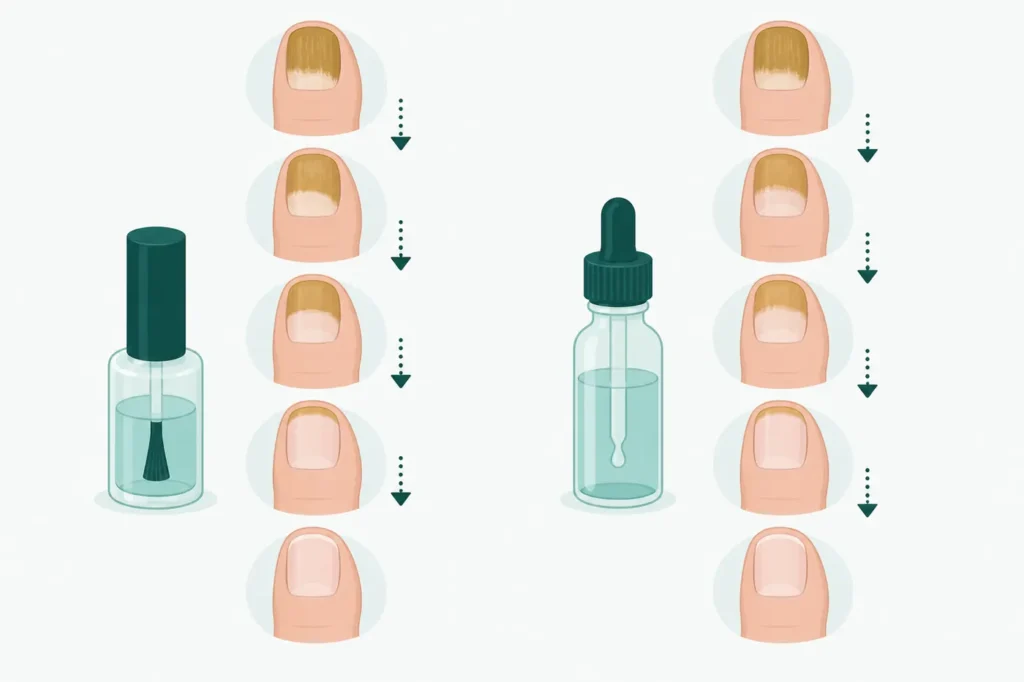
Both treatments require 48 weeks of daily application — nearly one full year — before the final assessment. Here is the realistic timeline:

Illustration of two 48-week topical treatment timelines with clear nail growing out from the base
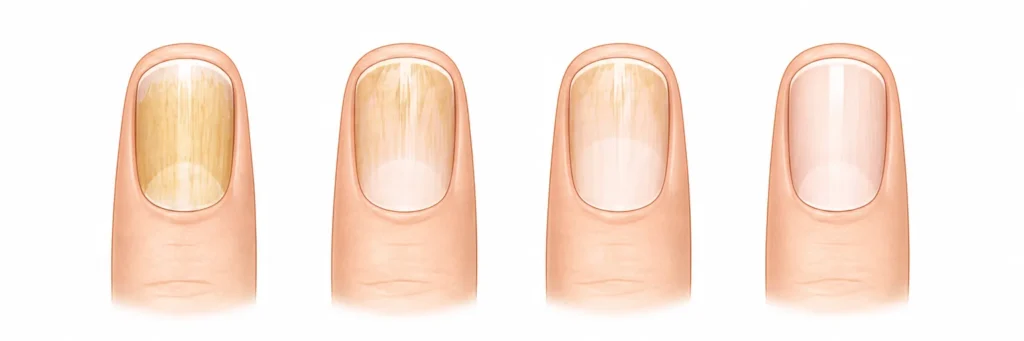
Four toenails showing fungus progression from infected to clear

Consistency is critical. Missing applications, failing to thin the nail before applying, or stopping early dramatically reduces the chance of success. Reinfection after completing treatment is common — prevention strategies (antifungal foot spray, changing shoes, keeping feet dry) matter as much as the treatment itself.

Jublia vs Kerydin: Side Effects and Safety

Both topicals have excellent systemic safety profiles — because they are applied to the nail surface with minimal systemic absorption, neither requires liver monitoring or blood tests for most patients. This is a major advantage over oral terbinafine and itraconazole.

Jublia (efinaconazole) side effects:

  • Most common (≥1%): ingrown toenail (≈2.6%), application-site dermatitis, vesicles, pain/irritation. (FDA label, 2014)
  • Systemic absorption is minimal; no clinically significant drug interactions reported.
  • Not evaluated in pregnancy; use during pregnancy or breastfeeding only if potential benefit outweighs risk — discuss with your doctor.

Kerydin (tavaborole) side effects:

  • Most common: application-site exfoliation (2.3%), erythema (1.6%), dermatitis, pain, and ingrown toenail. (FDA label, 2014)
  • Systemic absorption minimal; no clinically significant drug interactions reported.
  • No liver monitoring required. No blood test requirement.

Both are generally not recommended for use under nail lacquers — the nail should be clean and dry before application.

Talk to your doctor or pharmacist about your complete medication list before starting either drug.

Jublia vs Kerydin: Cost and Where to Get It

Both drugs are prescription-only. Without insurance, they are among the most expensive toenail fungus treatments available:

  • Jublia: Brand name can exceed $500 per 4 mL bottle (SingleCare lists about $741 with its coupon and about $1,067 average retail as of Nov 16, 2026; the maker’s Rx Access Program lists $65 per 4 mL for commercially insured patients whose plan does not cover it and $75 for cash payers, at Walgreens and participating independent pharmacies (Medicare and Medicaid patients are excluded)). A 48-week course may require multiple bottles. Some insurance plans cover it; prior authorization is often required.
  • Kerydin / generic tavaborole: Brand-name Kerydin has been discontinued; generic tavaborole 5% is available and significantly cheaper. GoodRx pricing may bring generic cost below $100 per bottle (SingleCare lists generic tavaborole 5% (10 mL) from about $40 with its coupon, against about $1,332 average retail, as of Nov 16, 2026) — check the current GoodRx price at your preferred pharmacy before filling.

For comparison: generic oral terbinafine costs roughly $10–$30 for a full course with GoodRx — and achieves about twice the complete cure rate of Jublia. The cost-effectiveness argument strongly favors oral terbinafine for most eligible patients.

If you are uninsured or cannot afford the topicals, an online prescription visit is an option for some cases. See online prescription options →

How Doctors Choose Between Jublia and Kerydin

A doctor may lean toward Jublia when...

A doctor may lean toward Kerydin / generic tavaborole when...

When to consider oral terbinafine instead:
For moderate or severe onychomycosis (more than half the nail, multiple nails, or nail matrix involvement), oral terbinafine has approximately twice the complete cure rate of Jublia at a fraction of the cost. If your liver and medication profile allow it, that is the clinically stronger choice. See terbinafine side effects and candidacy →

Can You Use Jublia and Kerydin Together?

No clinical trial has tested the combination of efinaconazole and tavaborole for onychomycosis. Using two prescription antifungals simultaneously on the same nail is not a standard clinical practice and is not supported by published evidence.

Both drugs require the same application conditions: a clean, dry nail free of nail lacquer. Applying two topicals to the same nail may also affect the delivery vehicle and reduce penetration of each.

If one topical is not working after 3–6 months of consistent use, the appropriate next step is to revisit the diagnosis (confirm fungal infection by culture) and discuss switching to oral terbinafine with your doctor, rather than adding a second topical.

When to See a Doctor

Both Jublia and Kerydin require a prescription. See a podiatrist or dermatologist for confirmation of onychomycosis (KOH scraping or culture) before starting either drug — roughly half of nails that look infected are another condition. Patients with diabetes, liver disease, or multiple medications should discuss drug candidacy with their physician before starting any antifungal. Learn when to see a podiatrist →

Options You Can Buy Without a Prescription

We can’t prescribe or sell prescription medicine. If you want to start with something you can buy today, these are the best options available without a prescription. They have weaker evidence than prescription treatment, so they suit mild cases or work alongside a doctor’s plan. If you have diabetes, poor circulation or a painful, spreading infection, see a podiatrist first.

Fungi-Nail (undecylenic acid, OTC)

An over-the-counter undecylenic acid solution with a brush applicator. Anecdotal evidence as a product (no trial of Fungi-Nail itself); its active, undecylenic acid, has Limited evidence. Cheap, easy to apply daily, and suited to mild cases at the edge of the nail.

Lamisil AT cream (terbinafine 1%, OTC)

The same active ingredient as the prescription pills, as a 1% cream you can buy at any pharmacy. It is labelled for athlete’s foot, not nails: use it on the skin around the nail to stop the fungus spreading back. Limited evidence for nails: its approval data are for skin fungus, and cream penetrates the nail poorly.

Kerassentials (topical oil blend)

A nail and skin serum sold online that combines undecylenic acid 5% with plant oils such as tea tree. Anecdotal evidence as a product (no trial of Kerassentials itself); undecylenic acid and tea tree oil each have Limited evidence. Read our full Kerassentials review.

Jublia vs Kerydin: Common Questions

Yes. Kerydin is the brand name; tavaborole 5% is the generic. The brand-name Kerydin has been discontinued, but generic tavaborole 5% topical solution remains available and is therapeutically equivalent at potentially much lower cost. Ask your pharmacy to dispense the generic if Kerydin is unavailable.

FDA-approved topical alternatives include ciclopirox 8% nail lacquer (Penlac) and tavaborole 5% (generic Kerydin). Oral terbinafine has the strongest evidence (~38% complete cure in the FDA label trials; Lamisil prescribing information) and is the most cost-effective option for most eligible patients. Itraconazole (pulse dosing) is an alternative when terbinafine is contraindicated. See all treatment options →

Jublia (efinaconazole 10%) inhibits lanosterol 14α-demethylase (CYP51), an enzyme essential for fungal cell membrane synthesis. Without ergosterol (the sterol product of this enzyme), the fungal cell membrane is disrupted and the fungus dies. Its low protein-binding allows better nail penetration than older topicals. Complete cure in ~15–18% of patients at 52 weeks (JAAD 2013).

For most healthy adults, oral terbinafine is considered first-line therapy for onychomycosis. Complete cure ~38% in the FDA label trials (Lamisil prescribing information) — roughly double Jublia’s complete cure rate at a fraction of the cost. Main risks: hepatotoxicity (rare), taste changes, CYP2D6 drug interactions. Liver function test at baseline is recommended. See full terbinafine side effects guide →

The most common reasons: inconsistent daily application, not filing the nail before applying, applying over nail lacquer, and unrealistic timeline expectations. Visible clear nail growth takes months. Jublia’s complete cure rate is 15–18% — most patients do not achieve full clearance with topical alone. If no new clear nail is appearing at the nail base after 3–6 months of consistent use, discuss switching to oral terbinafine with your prescriber.

For complete mycological cure rate: yes, oral terbinafine (~38% complete cure in the FDA label trials; Lamisil prescribing information) significantly outperforms Jublia (~15–18%). For patients who cannot take oral antifungals, Jublia is the best FDA-approved topical by cure rate. Ciclopirox (Penlac) has lower cure rates (5.5–8.5%) but may be more accessible by insurance coverage.

Medical disclaimer: This page is informational only and not medical advice. Both Jublia and Kerydin require a prescription from a licensed clinician. Do not start, stop, or switch antifungal therapy without consulting your prescriber.

Sources: Elewski BE et al., JAAD 2013 (efinaconazole Phase 3 RCTs, 15–18% complete cure at 52 weeks); Elewski BE et al., JAAD 2015 (tavaborole Phase 3 RCTs, 6.5–9.1% complete cure at 52 weeks); FDA label for Jublia (efinaconazole 10%, 2014); FDA label for Kerydin (tavaborole 5%, 2014); FDA Lamisil (terbinafine tablets) prescribing information, NDA 020539 (~38% complete cure at week 48); FDA label ciclopirox 8% nail lacquer (Penlac); accessed Nov 2026; SingleCare. Jublia prices (4 mL). singlecare.com/prescription/jublia (prices updated Nov 16, 2026); SingleCare. Tavaborole prices (10 mL). singlecare.com/prescription/tavaborole (prices updated Nov 16, 2026); Ortho Dermatologics. Rx Access Program terms for Jublia. orthorxaccess.com (accessed Nov 16, 2026); FDA. Drugs@FDA: Kerydin (tavaborole) NDA 204427, marketing status Discontinued; generic tavaborole ANDAs approved 2020–2023 (accessed Nov 16, 2026).

Not sure which treatment is right for you?

Use our finder to match your case to the strongest-evidence option.