Home › Treatments › Best Toenail Fungus Treatment

Best Toenail Fungus Treatment (2026): Evidence-Graded Picks for Mild, Moderate and Severe Nails

Affiliate disclosure: Some links on this page are affiliate links. If you buy through them, we may earn a commission at no extra cost to you. See how we review →
Person putting on clean socks, knees down, healthy feet, for a guide to the best toenail fungus treatment

Short answer: for most adults with a lab-confirmed infection, the best toenail fungus treatment is prescription oral terbinafine: about 38% complete cure in the FDA label trials, and 46% complete cure at 72 weeks in the L.I.ON trial. For one or two mildly affected nails, a prescription topical (Jublia) or an OTC antifungal is a reasonable first step. No option works fast.

Toenail fungus (onychomycosis) affects roughly 1 in 10 adults. Prescription oral terbinafine has the strongest clinical evidence; over-the-counter topicals are a reasonable first step for mild cases. No treatment works overnight: plan 12 to 18 months for a full nail to grow in clear.

Use the table below to match your case to the right starting point.

Best For Your Case
Mild (1–2 nails, surface only)OTC topical with undecylenic acid or tolnaftateLimited
Moderate (thick or yellow)Prescription terbinafine or Jublia (ciclopirox)Strong
Severe (crumbling, several nails)Oral prescription + confirm with lab testStrong
Diabetic or painful?See a podiatrist or clinician firstSee a doctor

At a Glance

Evidence Strength (top pick)

Strong ✓ModerateLimitedAnecdotal

How we grade evidence

Key Facts

Top pick

Oral terbinafine (Lamisil), Rx

Evidence

Strong (Rx) to Limited (OTC)

Price range

~$5 (tea tree oil) to $830+ (Jublia)

Options compared

7 options; 4 picks reviewed

About 1 in 10 adults has toenail fungus. Plan 12–18 months for a clear nail.

Best Toenail Fungus Treatment: Our Top Picks at a Glance

TreatmentBest forEvidenceTime to clear nail
Product imageOur PickTerbinafine (Lamisil) — oral RxModerate to severeStrong Evidence12–18 months for full nailCheck Price
Product imageFungi-Nail Undecylenic Acid — OTCMild, budgetLimited Evidence6–12+ monthsCheck Price
Product imageKerasal Fungal Nail Renewal — OTCDiscoloured nailsLimited EvidenceCosmetic in 2–8 wksCheck Price
Product imageJublia (efinaconazole 10%) — Rx topicalMild–moderate, can’t take oralModerate Evidence48 weeks dailyCheck Price

Complete nail clearance rates vary. Terbinafine ~38% complete cure in the FDA label trials (Lamisil prescribing information); Jublia ~15–18% in registration trials. OTC products have no FDA-approved efficacy claim for onychomycosis. Prices verified Nov 2026.

How We Graded Each Toenail Fungus Treatment Pick

We read the actual studies, not just summaries. Here is what each evidence grade means.

Strong Evidence

Multiple large, well-designed RCTs. Terbinafine ~38% complete cure in the FDA label trials (Lamisil prescribing information).

Moderate Evidence

Some good studies, limited by sample size. Jublia (efinaconazole) ~15–18% complete cure (Elewski 2013, JAAD).

Limited Evidence

Small studies or inconsistent results. Examples: undecylenic acid OTC, tea tree oil.

Anecdotal Evidence

No controlled trials. Marketing claims or personal reports only. Most supplement blends fall here.

Our Toenail Fungus Treatment Picks, Reviewed One by One

Product image

Terbinafine (Lamisil)

Oral prescription antifungal

Strong Evidence

The highest-evidence oral antifungal. A 12-week course achieves ~38% complete cure in the FDA label trials (Lamisil prescribing information). The nail may take 12–18 months to fully grow in clear.

Pros

Cons

Best for

Moderate to severe onychomycosis in healthy adults

Active ingredient

Terbinafine

Evidence

Strong Evidence

Est. price

~$10–$40/month (generic)

Visit Lamisil Toenail Fungus Treatment

Product image

Jublia (efinaconazole 10%)

Prescription topical antifungal

Moderate Evidence

Topical Rx with better nail penetration than older lacquers. Complete cure ~15–18% (Elewski 2013, JAAD). Once-daily for 48 weeks.

Pros

Cons

Best for

Mild–moderate; patients who cannot take oral antifungals

Active ingredient

Efinaconazole 10%

Evidence

Moderate Evidence

Est. price

$65 (maker program) to ~$830+ cash

Product image

Fungi-Nail Anti-Fungal

OTC undecylenic acid topical

Limited Evidence

FDA-approved for topical skin fungal infections. Limited evidence for penetrating the nail plate. Best for mild, early cases.

Pros

Cons

Best for

Mild infections; OTC-first preference

Active ingredient

Undecylenic acid 25%

Evidence

Limited Evidence

Est. price

Under $15 (verify at checkout)

Product image

Kerasal Fungal Nail Renewal

OTC cosmetic nail softener

Limited Evidence

Contains urea + lactic acid — not a clinical antifungal. Visibly improves appearance in 2–8 weeks. Use alongside real treatment.

Pros

Cons

Best for

Discoloured, thickened nails; cosmetic improvement while treating

Active ingredient

Urea + lactic acid

Evidence

Limited Evidence

Est. price

~$12–$24

Popular Natural & Supplement Blends We Reviewed

Readers often ask about the natural blends sold online. We reviewed ten of the most popular. They rank below the picks above on evidence, so treat them as an option for mild cases or as a cosmetic add-on to proven care. Seven are topicals; Keravita Pro, SupraNail and Bio Fungus Nuker are oral capsules, and Metanail Complex bundles a serum with an oral cleanse.

How these compare: none of these blends has a published clinical trial, and none is FDA-approved for nail fungus. Our grades are Limited or Anecdotal, below prescription terbinafine (Strong) and efinaconazole (Moderate). They may suit readers who want a natural cosmetic add-on for a mild case, alongside proven care, not instead of it. Prices and guarantees are from the official order pages (as of Nov 2026). How we grade evidence.

Kerassentials

Limited Evidence

  • Format: Topical oil, 15 mL
  • Price from: $49–$79 per bottle (2–6 packs) (as of Nov 2026)
  • Guarantee: 60 days; buyer pays return postage

Undecylenic acid 5% plus 15 oils. No trial of the product itself.

KlaroNail

Limited Evidence

  • Format: Topical spray, 30 mL
  • Price from: $207 for 3 bottles ($69 each) (as of Nov 2026)
  • Guarantee: 60 days; buyer pays return postage

Undecylenic acid 5%, below the 10–25% OTC range. No product trial.

Nail Refresh

Limited Evidence

  • Format: Topical oil, 30 mL
  • Price from: $177 for 3 bottles ($59 each) (as of Nov 2026)
  • Guarantee: 180 days; return terms unclear

Tea tree, thyme, oregano and clove oils; most data is lab-only.

TerraCalm

Limited Evidence

  • Format: Topical cream, 3 oz jar
  • Price from: $49–$69 per jar (as of Nov 2026)
  • Guarantee: 60 days; buyer pays return postage

Clay and essential-oil cream; no antifungal data for the clay.

Metanail Complex

Anecdotal Evidence

  • Format: Topical serum + oral “Total Cleanse” (bundles)
  • Price from: $79 for 1 serum (as of Nov 2026)
  • Guarantee: 60 days, minus shipping fees

No named antifungal active and no amounts listed.

NanoDefense Pro

Anecdotal Evidence

  • Format: Topical drops, 15 mL
  • Price from: $49–$79 per bottle (2–6 packs) (as of Nov 2026)
  • Guarantee: 180 days; buyer pays return postage

Contains colloidal silver; the label differs from the marketing.

KeraBiotics

Anecdotal Evidence

  • Format: Topical liquid, 15 mL
  • Price from: $49–$69 per bottle (as of Nov 2026)
  • Guarantee: 60 days; buyer pays return postage

Sold as a “probiotic” but no CFU count is listed.

Keravita Pro

Anecdotal Evidence

  • Format: Oral capsules, 60 per bottle
  • Price from: $49–$69 per bottle (as of Nov 2026)
  • Guarantee: 60 days; buyer pays return postage

Proprietary blend that includes graviola; ask your doctor first.

SupraNail

Anecdotal Evidence

  • Format: Oral capsules, 60 per bottle
  • Price from: $79 + $9.95 shipping (as of Nov 2026)
  • Guarantee: 60 days, unopened bottles only

Contains laxative herbs (senna, cascara); ask your doctor first.

Bio Fungus Nuker

Anecdotal Evidence

  • Format: Reportedly capsules (not verified)
  • Price from: Not verified (as of Nov 2026)
  • Guarantee: Reportedly 60 days (not verified)

We could not verify the formula. Check the label before buying.

Best Toenail Fungus Treatment Comparison Table

TreatmentActive ingredientEvidenceTime to clearEst. cost
Terbinafine (oral Rx) Our PickTerbinafineStrong Evidence12–18 months~$10–$40/moCheck Price
Jublia (efinaconazole Rx)EfinaconazoleModerate Evidence48 weeks$65–$830+Check Price
Ciclopirox (Rx lacquer)CiclopiroxModerate Evidence12–24 monthsVariesCheck Price
Undecylenic acid OTC (Fungi-Nail)Undecylenic acidLimited Evidence6–12+ months~$8–$20Check Price
Kerasal Fungal Nail RenewalUrea + lactic acidLimited EvidenceCosmetic only~$12–$24Check Price
Tea tree oilTerpinen-4-olLimited EvidenceUnproven~$5–$15
Natural blends (e.g., KlaroNail, Kerassentials)Undecylenic acid 5% or essential oilsLimited EvidenceNo product trials~$49–$79/bottleSee blends
Oral supplementsVarious proprietaryAnecdotal EvidenceNo proven timeline$40–$80/mo

Cash prices as of November 2026. “Time to clear nail” = how long for a full uninfected nail to grow in, not when you stop medication. Full price breakdown for every option, including coupons and Medicare rules: toenail fungus treatment cost 2026.

Which Toenail Fungus Treatment Fits Your Case: Mild, Moderate or Severe

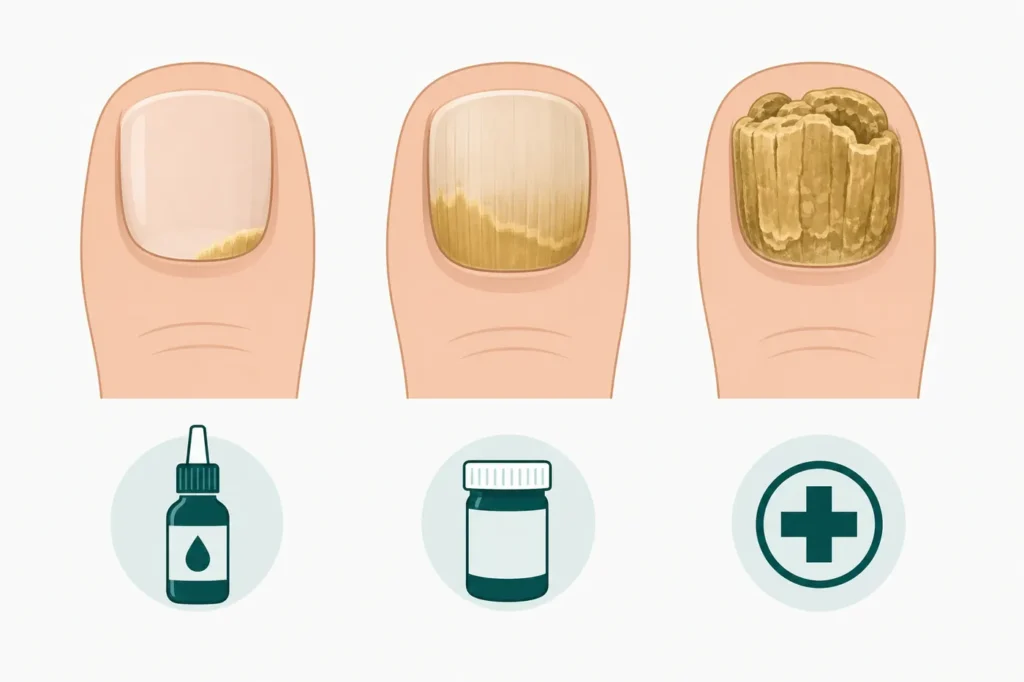
Illustration of mild, moderate and severe toenail fungus with the matching treatment type for each

Mild

Limited Evidence

Small white or yellow spots; nail mostly intact. Try OTC topicals first for 3 months.

Moderate

Strong Evidence

Nail is thickened, yellow-brown, hard to trim. See a doctor for a prescription.

Severe

Strong Evidence

Crumbling, lifting, painful. See a podiatrist. Oral antifungal and debridement usually needed.

See a Doctor Immediately If:

Active Ingredients That Matter in a Toenail Fungus Treatment

The active ingredient determines how a treatment works, how well it penetrates the nail plate, and how strong the clinical evidence is. Oral medications reach the nail via the bloodstream and generally outperform topicals.

TerbinafineStrong EvidenceInhibits squalene epoxidase — disrupts fungal cell membrane synthesis. Oral; reaches nail via bloodstream. ~12-week course. ~38% complete cure in the FDA label trials (Lamisil prescribing information).
Efinaconazole (Jublia)Moderate EvidenceTriazole; inhibits ergosterol synthesis. Topical; better nail penetration than older lacquers. 48 weeks once-daily. Complete cure ~15–18% (Elewski 2013, JAAD).
CiclopiroxModerate EvidenceChelates metal ions needed for fungal enzymes. Prescription nail lacquer (8%). Daily application, weekly wipe. Used when oral antifungals are contraindicated.
Undecylenic acidLimited EvidenceFatty acid that disrupts fungal membranes. FDA-approved for topical skin fungal infections. Evidence for nail penetration is limited; best for mild early cases.
Tea tree oilLimited EvidenceTerpinen-4-ol has in vitro antifungal activity. Small trials show cosmetic improvement. No large RCT for onychomycosis cure.
Urea / lactic acid (Kerasal)Limited EvidenceNot antifungal. Urea softens thickened nail; lactic acid adds moisturizing effect. Cosmetic improvement only. Does not resolve the fungal infection.

How Long a Toenail Fungus Treatment Takes to Work

Toenails grow roughly 1.5 mm per month. A full nail takes 12 to 18 months to replace itself. Here is what to expect at each stage of treatment.

  1. Week 4Drug is active; infection not growing further.
  2. Week 12Course complete. Clear nail grows at base.
  3. Month 6About half the nail may look cleaner.
  4. Month 12–18Full new clear nail has grown in.

Sources: AAD; Cochrane review of topical and device-based treatments for toenail fungus (Foley et al., 2020); L.I.ON. study BMJ 1999.

Healthy clear toenail after treatment

Toenail Fungus Treatment Side Effects and Safety

Oral terbinafine is well tolerated for most people. Rarely, it can affect liver enzymes. That is why baseline liver function tests are recommended, especially if you have a history of liver disease. Report nausea, fatigue, yellowing of skin or eyes, dark urine, or pale stools to your doctor.

Common OTC side effects: localised skin irritation. Tea tree oil can cause allergic dermatitis in sensitive people. Topical Rx (Jublia, ciclopirox): mild localised irritation; systemic absorption is low.

Prices for generic terbinafine vary by pharmacy. Compare generic terbinafine prices.

Before starting oral terbinafine:

  • Confirm fungal diagnosis — about half of suspected nail fungus is non-fungal on lab testing (KOH smear or nail culture).
  • Tell your doctor all medications: warfarin, some antidepressants and immunosuppressants interact with terbinafine.
  • Discuss liver function: a baseline LFT is recommended for higher-risk patients, though hepatotoxicity is rare (est. 1 in 50,000–120,000).

When a Prescription Beats Any Toenail Fungus Treatment

OTC topicals are a reasonable first step for mild infections. These signs indicate you need a prescription:

OTC Topical

VS

Oral Prescription

Verdict: For moderate to severe infections, a prescription oral antifungal (terbinafine) is significantly more effective than any OTC option. Terbinafine guide →

Other Toenail Fungus Treatment Options: Itraconazole, Laser and Nail Removal

Confirm it first. Several nail conditions look like fungus, and an exam alone can be wrong. The AAFP review recommends a lab test (PAS stain, KOH or culture) before you commit to months of treatment. See what looks like toenail fungus.

Itraconazole (Sporanox): the second-line pill

Itraconazole is FDA-approved for nail fungus. For toenails it is taken as 200 mg once a day for 12 weeks, or as “pulse” doses (200 mg twice a day for one week each month, for three months). In the L.I.ON head-to-head trial, pulse itraconazole reached 23% complete cure at 72 weeks versus 46% for terbinafine, so clinicians usually keep it for people who cannot take terbinafine. It also has more drug interactions. Details: itraconazole for toenail fungus.

Laser treatment

The American Academy of Dermatology notes that the FDA has not approved any laser to treat nail fungus (page updated June 2025). The AAFP review calls laser and photodynamic therapy promising but says more clinical studies are needed. Lasers are usually cash-pay. See laser treatment for toenail fungus.

Nail removal

For severe, painful or treatment-resistant nails, a podiatrist or dermatologist can remove the nail so a healthy one can grow back (Cleveland Clinic, May 2026; AAD). It is usually combined with an antifungal. See toenail removal for fungus.

Do you have to treat it at all?

Not always. In an April 2026 University of Utah Health interview, dermatologist Christopher Hull, MD, said he leaves the choice to the patient when the concern is cosmetic. Treatment matters more when the nail is painful, or when you have diabetes or poor circulation, because of the risk of foot ulcers.

How to Keep Toenail Fungus From Coming Back After Treatment

Even after successful treatment, toenail fungus comes back in roughly 10% to 50% of people, through reinfection or an infection that was never fully cleared (AAFP, 2013). The AAD notes that some people use maintenance treatment to prevent another infection. These habits lower the odds:

  • Treat athlete’s foot at the same time; it is the usual source of reinfection (athlete’s foot and toenail fungus).
  • Dry your feet fully, especially between the toes, and change damp socks.
  • Rotate shoes so each pair dries out; consider an antifungal powder or spray in shoes.
  • Wear sandals in gym showers and pool areas.
  • Use your own clippers and file, and keep nails trimmed short and straight across.
  • Keep nail polish off while you are treating (Cleveland Clinic says nail enhancements can make treatment less effective).

Full checklist: how to prevent toenail fungus.

Common Questions About Toenail Fungus Treatment

The most evidence-backed single treatment is a 12-week course of oral terbinafine (~38% complete cure in the FDA label trials; Lamisil prescribing information). Combining oral antifungal therapy with debridement of the thickened nail may improve outcomes. If you have diabetes or severe infection, see a podiatrist before starting.

Onychomycosis is a fungal infection of the nail plate, nail bed or nail matrix, most often caused by dermatophytes (Trichophyton rubrum). Symptoms: nail thickening, yellow/white/brown discoloration, brittleness, crumbling. It is the most common nail disease in adults, affecting an estimated 3%–12% of the general population (AAFP 2015).

Toenails grow roughly 1.5 mm per month, so a full nail takes 12–18 months to replace itself. Oral terbinafine is taken for a 12-week course, but the nail may not look fully clear until 12–18 months after you finish. Stopping early is the most common cause of treatment failure and recurrence.

Hepatotoxicity risk (rare: est. 1 in 50,000–120,000), drug interactions with warfarin and some antidepressants, and the fact that roughly half of suspected onychomycosis is non-fungal on lab testing. A brief medication review and a nail sample first make the prescription much safer.

Nail psoriasis, traumatic nail damage, lichen planus and simple yellowing from nail polish. Studies show about 50% of nails clinically suspected to be fungal are fungus-negative on KOH smear or culture.

Yes. Dermatophytes spread via direct contact or contaminated surfaces (pools, locker rooms, shared clippers). Keeping feet dry, using your own nail tools and wearing sandals in communal wet areas significantly reduces risk.

Usually not. Cleveland Clinic (May 2026) says nail fungus usually doesn’t go away on its own. Some people with mild, painless cases choose not to treat it; if it spreads, thickens or hurts, see a clinician.

The evidence is weaker than for terbinafine. The AAD notes the FDA has not approved any laser to treat nail fungus, and the AAFP review says more clinical studies are needed. It can be an option if you cannot take pills, but expect to pay out of pocket.

It is best to skip it. Cleveland Clinic notes that nail polish and enhancements can make treatments less effective, and they hide whether the new nail is growing in clear.

Recurrence runs about 10% to 50% after treatment (AAFP, 2013), mostly from reinfection (often from untreated athlete’s foot or damp shoes) or an infection that was never fully cleared. Finish the full course and keep treating the skin and shoes.

Sources

  1. L.I.ON. study. Terbinafine vs itraconazole. BMJ 1999;318:1031.
  2. Elewski BE, et al. Efinaconazole 10%. JAAD 2013;68(4):600.
  3. Ferrari J. Fungal toenail infections. Am Fam Physician 2015;92(2):132.
  4. Sigurgeirsson B, Baran R. Prevalence of onychomycosis. JEADV 2014;28(11):1480.
  5. GoodRx. Terbinafine prices. goodrx.com (Nov 2026).
  6. GoodRx. Jublia prices. goodrx.com (Nov 2026).
  7. AAD. Nail fungus: diagnosis and treatment. aad.org (Nov 2026).
  8. Wikipedia. Nail disease. en.wikipedia.org/wiki/Nail_disease
  9. FDA. Lamisil (terbinafine) tablets prescribing information: ~38% complete cure at week 48 (toenail trials).
  10. Westerberg DP, Voyack MJ. Onychomycosis: current trends in diagnosis and treatment. Am Fam Physician 2013;88(11):762–770. aafp.org
  11. American Academy of Dermatology. Nail fungus: diagnosis and treatment (last updated 26 Jun 2025). aad.org
  12. Cleveland Clinic. Toenail/Nail Fungus (onychomycosis), last updated 12 May 2026. my.clevelandclinic.org
  13. University of Utah Health, The Scope. Nail Fungus Treatments: What Works and What Does Not (Christopher Hull, MD; updated 17 Apr 2026). healthcare.utah.edu

Medical disclaimer: This content is for informational purposes only and is not a substitute for professional medical advice, diagnosis or treatment. Always consult a qualified healthcare provider before starting any treatment.

Not sure which treatment fits your case?

Answer 4 questions and get a recommendation matched to your nails.