Home › Onychomycosis
Onychomycosis (Toenail Fungus): Complete Medical Guide (2026)
By Best Toenail Fungus Treatments · Reviewed 15 Nov 2026 · 25 min read

Home › Onychomycosis
By Best Toenail Fungus Treatments · Reviewed 15 Nov 2026 · 25 min read
Onychomycosis is a fungal infection of the nail unit. It is the most common nail disease, affecting approximately 3–12% of the general population (rising to 20–30% in adults over 60). Caused primarily by dermatophytes (Trichophyton rubrum in ~70–80% of cases), it produces characteristic nail thickening, discoloration, crumbling and onycholysis (nail separation). Without treatment, it rarely resolves spontaneously. The most effective treatment is oral terbinafine (~38% complete cure in the FDA label trials). (AAFP, 2013; AAD guidelines; de Berker, NEJM 2009.)
How it clears
| Treatment | Wk 12–24 | Mo 6–12 | 12–18 mo |
|---|---|---|---|
| Terbinafine 12 wk; itraconazole 3–4 mo; Jublia 48 wk | Lab clearance typical with terbinafine | Visible nail improvement starts | Full regrowth, base to tip |
Key Facts
Prevalence
3–12% of people; 20–30% over 60
How it’s diagnosed
KOH, culture or PAS before treating
See a doctor if
Diabetes, or OTC fails after 3+ months
First-line Rx
Oral terbinafine (~38% complete cure)
Onychomycosis (from the Greek onyx, nail, + mykes, fungus) is a fungal infection of the nail unit — the nail plate, nail bed, nail matrix, and surrounding structures. It is the most common nail disorder, accounting for approximately 50% of all nail disease presenting to clinicians. (de Berker DA. N Engl J Med 2009;360:2108–2116.)
Prevalence: approximately 3–12% of the general population (AAFP 2013); rising to 20–30% in adults over 60; up to 56% in adults over 70. More common in men than women (ratio approximately 2:1 to 3:1). Toenails are affected 7–10 times more often than fingernails.
Why it matters: beyond cosmetic concern, onychomycosis causes nail pain and difficulty wearing footwear, can serve as a reservoir for recurrent athlete’s foot, and in immunocompromised individuals (diabetes, HIV, organ transplant recipients) can lead to serious complications including cellulitis and secondary bacterial infection.
Three types of fungi cause onychomycosis:
The hallmark features of onychomycosis, in rough order of earliest to latest presentation:
Clinical subtypes: dermatology classifies onychomycosis into subtypes based on the entry point and pattern of spread: distal and lateral subungual onychomycosis (DLSO, most common), white superficial onychomycosis (WSO), proximal subungual onychomycosis (PSO, associated with immunocompromise), and total dystrophic onychomycosis (TDO, the end-stage). Detailed stage guide →
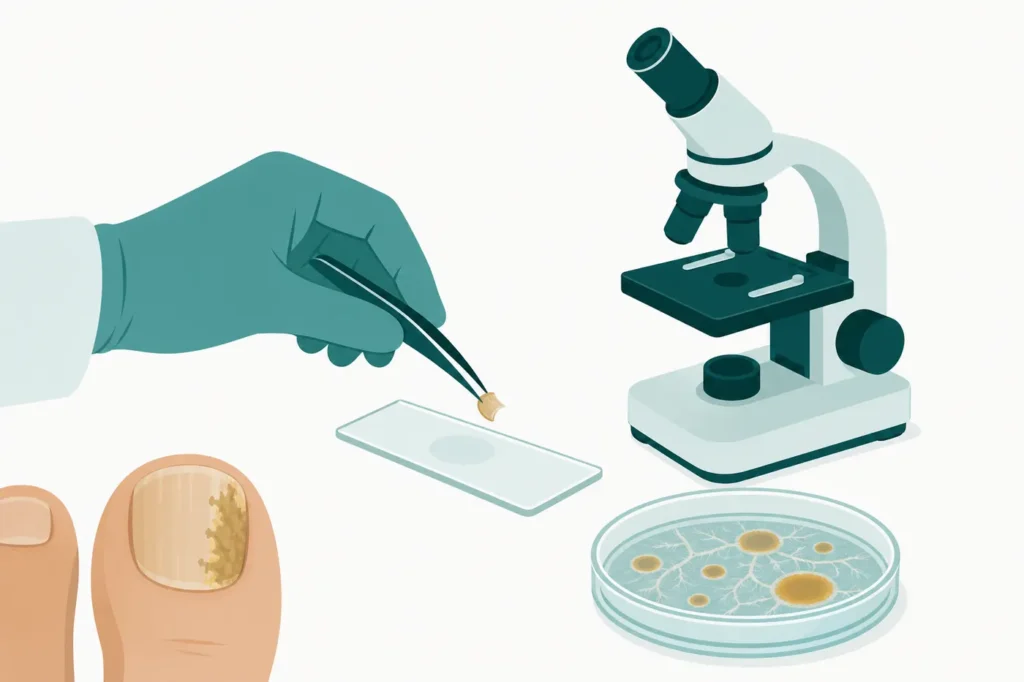
Visual diagnosis alone is unreliable. Studies report that up to 50% of nails with an abnormal appearance are not fungal — psoriasis, lichen planus, alopecia areata (nail involvement), traumatic onychodystrophy, and bacterial infections all produce similar-appearing nails. Starting antifungal therapy without confirmation wastes 12–18 weeks of treatment time and exposes the patient to unnecessary drug interactions (oral terbinafine and itraconazole have significant drug interaction profiles). (AAFP 2013; de Berker 2009.)
Treatment choice depends on severity, number of nails affected, organism type (dermatophyte vs. yeast vs. mold), patient age, comorbidities (especially hepatic function and drug interactions), and patient preference. The American Academy of Family Physicians (AAFP 2013) and the American Academy of Dermatology (AAD) both endorse oral terbinafine as first-line therapy for most cases of moderate–severe onychomycosis. See how we grade treatments →
| Treatment | Grade | Complete cure rate | Duration | Key notes |
|---|---|---|---|---|
| Oral terbinafine (Lamisil) | Strong Evidence | ~38% at 48 wks (FDA label) | 12 weeks | Hepatotoxicity screening req. Drug interactions: warfarin, TCAs, etc. |
| Oral itraconazole (pulse) | Moderate Evidence | ~14–27% complete cure | 3–4 monthly pulses | CYP3A4 inhibitor; significant drug interactions; cardiac contraindications |
| Efinaconazole 10% (Jublia, Rx) | Moderate Evidence | 15–18% at 48 wks | 48 weeks daily | FDA-approved for DLSO; best topical option; no systemic interactions |
| Tavaborole 5% (Kerydin, Rx) | Moderate Evidence | ~7% at 52 wks | 52 weeks daily | FDA-approved; lower cure rate than efinaconazole |
| Ciclopirox 8% lacquer (Rx) | Limited Evidence | 5–10% complete cure | 48 weeks daily | Older agent; lower efficacy; still used for mild–moderate |
| Undecylenic acid OTC | Limited Evidence | Not established for nails | Ongoing | FDA drug for skin fungal infections; not for onychomycosis |
Terbinafine (allylamine class): inhibits squalene epoxidase in the fungal cell membrane synthesis pathway. The standard dose is 250 mg daily for 12 weeks (toenails). Side effects are uncommon but include gastrointestinal upset and rare hepatotoxicity — baseline liver function tests are recommended before starting, particularly in patients with pre-existing liver disease. Key drug interactions: terbinafine is a potent CYP2D6 inhibitor. It increases levels of tricyclic antidepressants, beta-blockers metabolized by CYP2D6, and selected antipsychotics. It also increases warfarin levels — monitor INR if the patient is anticoagulated.
Itraconazole (triazole class): inhibits ergosterol synthesis via CYP51 inhibition. Available as continuous daily dosing (200 mg daily for 12 weeks) or pulse dosing (400 mg/day for 7 days per month for 3–4 months). Pulse dosing reduces drug exposure and cost. Key interactions: itraconazole is a potent CYP3A4 inhibitor. It increases levels of statins (rhabdomyolysis risk), digoxin, calcium channel blockers, cyclosporine, warfarin and many other drugs. Contraindicated in certain cardiac conditions (ventricular dysfunction, prolonged QTc). Drug interactions in seniors →
Topicals are appropriate for mild–moderate onychomycosis (DLSO affecting less than 50% of the nail, without matrix involvement) and for patients who cannot take oral antifungals. The key challenge: most topicals have poor nail penetration. Efinaconazole 10% (Jublia) has better nail penetration than older formulations. Full Jublia review →
Several laser systems are FDA-cleared for “temporary increase of clear nail in patients with onychomycosis.” Note: FDA-cleared does not mean FDA-approved for cure. Published randomized controlled trial data show modest and inconsistent results. Evidence grade: Limited Evidence. In-office laser costs $1,000–$4,500 total. Not typically covered by insurance.
Nail avulsion (complete or partial removal) may be indicated for: total dystrophic onychomycosis unresponsive to pharmacotherapy; nails causing significant pain or functional impairment; nails where chemical avulsion (urea 40%) + antifungal can then be applied to the nail bed directly. Surgical or chemical avulsion is not effective alone — always combined with antifungal therapy to prevent reinfection of the regrown nail.
Among herbal options, snakeroot extract (Ageratina pichinchensis) has the best published evidence: three small Mexican RCTs comparing it to ciclopirox, with complete mycological cure of ~8.6% at 24 weeks. All other herbal options (tea tree oil, oregano oil, garlic) have only in vitro data or one small pilot trial. Full snakeroot evidence review →
Three timelines govern onychomycosis resolution:
What this means in practice: a patient completing 12 weeks of terbinafine may not see visible nail improvement until months 6–12. Apparent lack of improvement at the nail tip while new, clear nail grows from the base is not treatment failure — it is normal biology.
Recurrence: even after confirmed mycological clearance, recurrence rates reach 25–50% within 3 years without ongoing prevention. Prevention measures (moisture-wicking socks, antifungal foot powder, UV shoe sanitizers, clean nail tools) reduce recurrence risk.
Primary prevention reduces initial risk; secondary prevention reduces recurrence after successful treatment:
See a healthcare provider before starting treatment if:
Oral terbinafine (Lamisil) has the highest evidence-based clearance rates: approximately 38% complete cure in the FDA label trials (Lamisil prescribing information). It is first-line for most moderate–severe cases. For mild infections or when oral therapy is not appropriate: efinaconazole 10% (Jublia) has 15–18% complete cure at 48 weeks. See a healthcare provider for diagnosis and prescription evaluation. Full treatment guide →
Dermatophytic fungi — primarily Trichophyton rubrum (approximately 70–80% of cases) and T. mentagrophytes (approximately 15–20%) — are the dominant causes. These organisms digest keratin and thrive in warm, moist environments. Transmission occurs through direct contact with infected persons or contaminated surfaces (locker rooms, shared nail tools). Yeasts (Candida) cause 5–10% of cases, more in fingernails and immunocompromised individuals. (AAFP 2013; de Berker 2009.)
Rarely and unreliably. Spontaneous resolution has been reported but is not the typical course. Most cases persist and slowly worsen over time, with the infection spreading to more nails and deeper nail structures. The AAD and AAFP both recommend treatment for onychomycosis that is bothering the patient, noting that without treatment, the infection typically progresses. Early treatment is significantly more effective than treating advanced stages.
Vicks VapoRub contains thymol (from thyme oil), which has in vitro antifungal activity against Trichophyton species. A small open-label pilot study (Derby et al., 2011) reported that 18 of 25 participants who applied Vicks daily showed “positive response” and 5 of 25 showed mycological clearance. This is a small, uncontrolled study without a comparator group. It has not been replicated in a larger RCT. Vicks is well-tolerated and low-risk; it may help with mild superficial infections. It is not an evidence-based first-line treatment.
Medical disclaimer: Informational only. Not a substitute for professional medical advice, diagnosis or treatment. Consult a qualified healthcare provider before starting any treatment for onychomycosis.
Answer 4 quick questions and see evidence-graded picks for your situation.