Home › Toenail Fungus Stages
Toenail Fungus Stages (2026): What Each Stage Looks Like and What to Do
By Best Toenail Fungus Treatments · Reviewed 15 Nov 2026 · 8 min read

Home › Toenail Fungus Stages
By Best Toenail Fungus Treatments · Reviewed 15 Nov 2026 · 8 min read
Toenail fungus (onychomycosis) progresses through recognizable stages — from an early white or yellow spot to a severely thickened, crumbling nail. Earlier stages respond better to topical treatments; advanced stages typically require prescription oral antifungals. Key point: nail fungus rarely resolves on its own. The earlier you identify and treat it, the better the outcome. (AAD; Mayo Clinic — accessed Nov 2026.)
How it progresses
| Stage 1 | Stage 2 | Stage 3 | Stage 4 |
|---|---|---|---|
| White or yellow spot at the tip; normal thickness | 25–50% of nail discoloured; early thickening | Most of nail discoloured, thick and crumbling | Entire nail plate affected (total dystrophic) |
Key Facts
Usual cause
T. rubrum in ~70–80% of cases
How it’s diagnosed
KOH scraping or nail culture
See a doctor if
Spreading, thick, painful or stage 4
First-line Rx
Oral terbinafine or itraconazole from stage 2
Onychomycosis does not appear overnight. The infection spreads gradually from an entry point — usually the distal (free) edge of the nail or the nail fold — and progresses toward the nail matrix at the base. Once it reaches the matrix, the infection is fully established and much harder to clear. Understanding which stage you are in helps guide the right treatment response. Full onychomycosis explainer →
Causes by stage: in stages 1–3, the infection is typically dermatophytic (Trichophyton rubrum in ~70–80% of cases). By stage 4, the nail structure is so compromised that secondary bacterial colonization and non-dermatophyte mold infections may also be present.
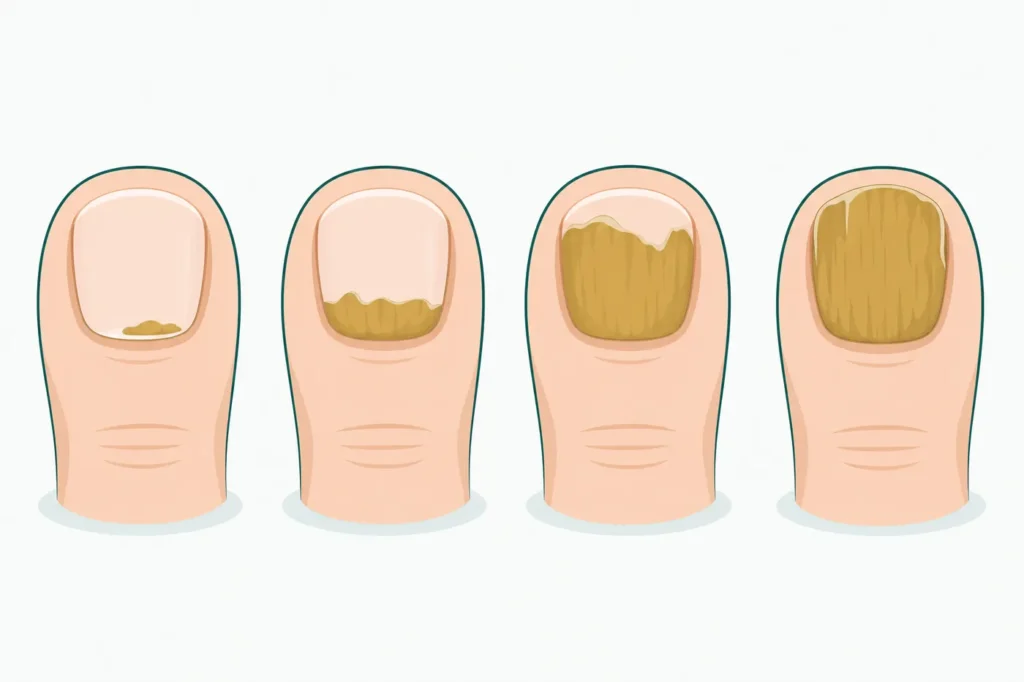
What it looks like:
What to do: Stage 1 is the best time to intervene. Topical OTC treatments (undecylenic acid) or prescription topicals (Jublia, ciclopirox) can be effective at this stage because the infection has not yet reached the nail matrix. Confirm the diagnosis with a healthcare provider if possible — a KOH scraping or nail culture distinguishes fungal from traumatic/psoriatic changes. Full toenail fungus symptoms guide →
What it looks like:
What to do: Stage 2 infections can still respond to prescription topicals, but outcomes are less reliable than stage 1. Oral antifungal therapy (terbinafine or itraconazole) becomes the preferred option for most patients. See a healthcare provider for diagnosis and prescription evaluation.
What it looks like:
What to do: Stage 3 almost always requires oral antifungal therapy to achieve mycological clearance. Topical treatments have insufficient nail penetration at this stage. Professional nail debridement (a podiatrist filing or thinning the nail) can reduce the fungal load and improve topical treatment penetration. Best treatment for severe toenail fungus →
What it looks like:
Important: Total dystrophic onychomycosis can look similar to other conditions including nail psoriasis, lichen planus, alopecia areata (nail involvement) and traumatic onychodystrophy. Lab confirmation (KOH, culture, nail biopsy with PAS stain) is essential before treating. See a podiatrist or dermatologist promptly.
How clinicians usually match prescription and surgical treatment to each stage (information only; a doctor or podiatrist decides):
The earliest signs are typically a white spot, cream-colored area or yellow discoloration at the free edge (tip) of the nail. The nail is still normal thickness. Many people initially attribute early changes to trauma or moisture. If the discoloration grows toward the nail base over weeks, fungal infection is the most likely cause. Early treatment is significantly more effective than waiting.
Tea tree oil (terpinen-4-ol) has in vitro antifungal activity and was tested in one small pilot RCT (Syed 1999, 60 participants) which showed modest improvement. It has not been tested in a large independent RCT for onychomycosis. Evidence grade: Limited. It may help as an adjunct for stage 1 infections but is unlikely to clear established nail fungus as a standalone treatment. Oregano oil comparison →
Treatment depends on severity (stage): Stage 1–2 may respond to prescription topicals (efinaconazole 10%, ciclopirox 8%). Stage 2–4 typically requires oral terbinafine or itraconazole. OTC products (undecylenic acid) may help mild stage 1 infections. Confirm diagnosis with a healthcare provider first — not all dystrophic nails are fungal. Full treatment guide →
Onychomycosis is the medical term for toenail or fingernail fungal infection. It affects an estimated 10% of the general population — rising to 20–30% in adults over 60. Trichophyton rubrum causes approximately 70–80% of cases. The condition does not resolve on its own and typically worsens over time without treatment. Full onychomycosis explainer →
Medical disclaimer: Informational only. Consult a qualified healthcare provider for diagnosis and treatment of nail conditions.
Answer 4 quick questions and see evidence-graded picks for your situation.