Home › Onycholysis
Onycholysis: Causes, Symptoms, and When It Is Toenail Fungus
By Best Toenail Fungus Treatments · Reviewed 15 Nov 2026 · 10 min read
Home › Onycholysis
By Best Toenail Fungus Treatments · Reviewed 15 Nov 2026 · 10 min read
Onycholysis is the medical term for the separation of the nail plate from the nail bed — the nail lifts away from the skin underneath, usually starting at the tip and spreading backward. The separated area typically appears white, yellow, or greenish because air fills the space between the nail plate and nail bed.
Onycholysis is a symptom, not a diagnosis. It can be caused by toenail fungus, nail psoriasis, trauma, thyroid disease, certain medications, or contact irritants — among other things. Lab testing is needed to confirm whether fungal infection is the cause.
How it progresses
| Starts | Spreads | Looks | Recovery |
|---|---|---|---|
| Nail lifts at the tip | Separation moves back toward the base | White, yellow or greenish as air fills the gap | Nail does not reattach; regrows over 12–18 months |
Key Facts
What it is
A symptom, not a diagnosis
Common causes
Fungus, psoriasis, trauma, irritants
How it’s diagnosed
Lab testing confirms if fungus
See a doctor if
Worsening, painful, or you have diabetes
Common causes of nail separation include:
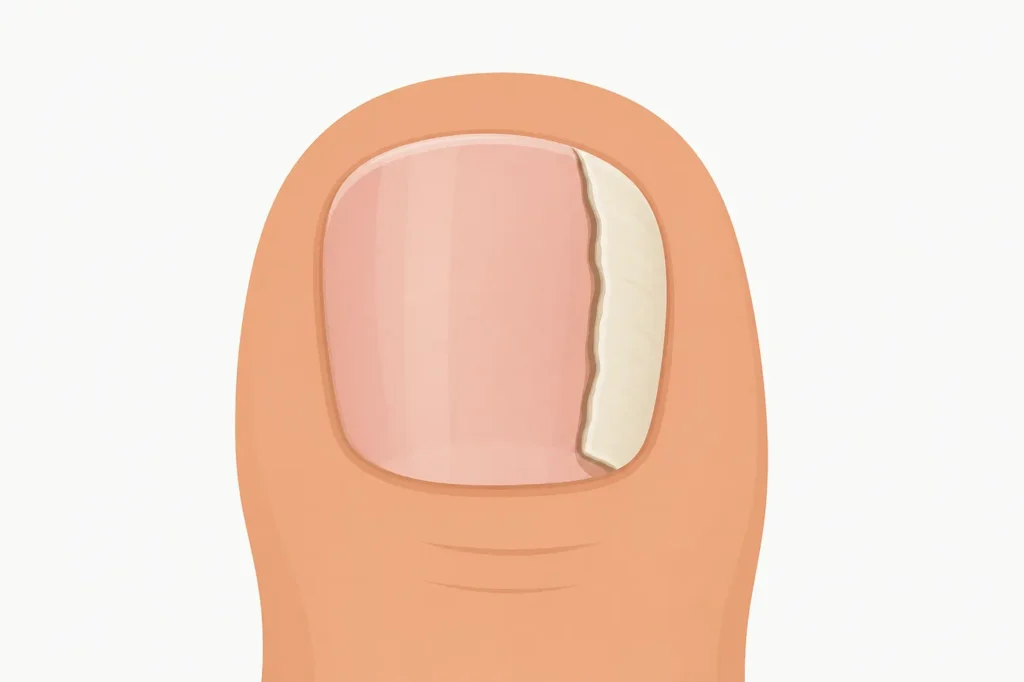
Fungal onycholysis tends to have certain features, but no appearance-based criteria are definitive. Lab testing is the only reliable way to confirm fungal infection.
Key point: Nail psoriasis and fungal infection frequently co-exist (up to 30% of patients with nail psoriasis have superimposed fungal infection). Treating one without diagnosing the other leads to treatment failure. Learn how lab testing distinguishes these conditions →
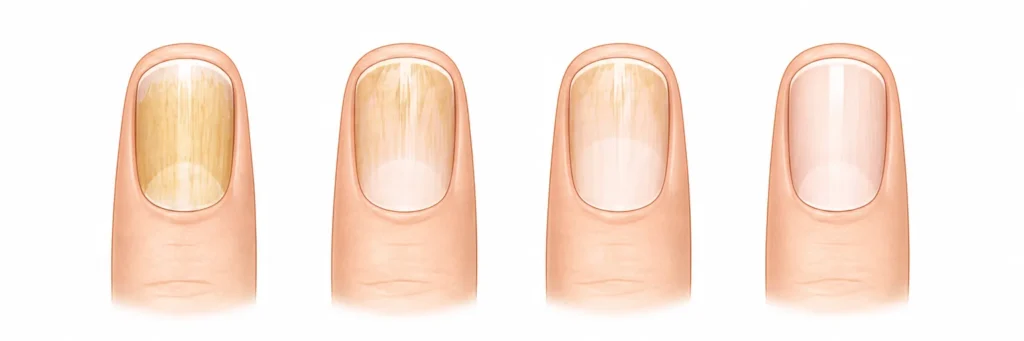
Because onycholysis has many causes, treatment must address the underlying reason for nail separation. Treating for fungus when the cause is psoriasis will not resolve the nail.
General nail care while the nail heals: Keep nails dry and clean; trim separated nail to prevent snagging; avoid excessive filing of the nail surface; do not push or force the nail back down.
See a dermatologist or podiatrist if: the nail separation is worsening, more than one nail is affected, you have pain or the skin around the nail is red and swollen, you have diabetes or circulatory disease, or you are unsure of the cause. Without a diagnosis, treatment is guesswork — and treating the wrong cause can allow the real problem to progress.
Onycholysis can resolve when the underlying cause is treated. The nail plate does not reattach; instead, the nail must grow out from the base. Toenails grow slowly (12–18 months for full regrowth), so even after successful treatment, cosmetic improvement is gradual.
Onycholysis itself is not contagious. If it is caused by a fungal infection, the fungal infection can be contagious (spread through contact with contaminated surfaces or skin). If caused by psoriasis, trauma, or medications, it is not contagious.
No. Once the nail plate separates from the nail bed, the attachment does not regenerate by pushing the nail back down. New nail grows from the nail matrix (base of the nail) and gradually covers the nail bed. Trying to reattach a separated nail can trap moisture and debris, increasing infection risk.
Onycholysis itself is usually painless. Pain may occur if the separated nail catches on clothing or socks, if the exposed nail bed becomes infected, or if the underlying condition (such as severe nail psoriasis) is painful. If you have significant pain, see a clinician.
Medical disclaimer: This page is informational only and not medical advice. Consult a licensed clinician for diagnosis and treatment.
Sources: Baran R et al. Onychomycosis: The Current Approach to Diagnosis and Therapy, 2nd ed.; Elewski BE. Clin Microbiol Rev 1998;11(3):415–429; AAFP 2015 (prevalence 3–12%).
Use our treatment finder to understand your options.