Home › Treatments › How to Prevent Toenail Fungus

How to Prevent Toenail Fungus: A Practical Daily Guide (2026)

Affiliate disclosure: Some links on this page are affiliate links. If you buy through them, we may earn a commission at no extra cost to you. See our disclosure policy →

Healthy bare feet relaxing on a sunny porch, illustrating everyday habits that help prevent toenail fungus

The Short Answer

Toenail fungus (onychomycosis) affects 3–12% of adults (AAFP 2015) and spreads through shared surfaces such as pool decks, locker-room showers, shared clippers and damp shoes. Preventing it means cutting off how the dermatophyte fungus spreads and takes hold. Key steps: keep feet clean and dry, wear moisture-wicking socks, use flip-flops in public showers and pool areas, trim nails straight across, disinfect nail tools, and treat athlete’s foot promptly — roughly half of toenail infections start there. Once an infection establishes, it takes 12–18 months of treatment for a toenail to fully clear. Prevention is far easier than treatment.

At a Glance

Your Prevention Routine

Every dayIn publicNail careAfter treatment
Wash, dry well, moisture-wicking socksFlip-flops in showers and on pool decksTrim straight across; disinfect toolsOTC antifungal on the skin for 3–6 months

Key Facts

Prevalence

3–12% of adults (AAFP 2015)

Common start

Athlete’s foot (about half of cases)

Comes back

20–25% within 1–3 years

See a doctor if

No help after 8–12 weeks, or diabetes

How to Prevent Toenail Fungus: The Daily Checklist

These habits address the conditions that dermatophytes need to colonize a nail: warmth, moisture, and an entry point.

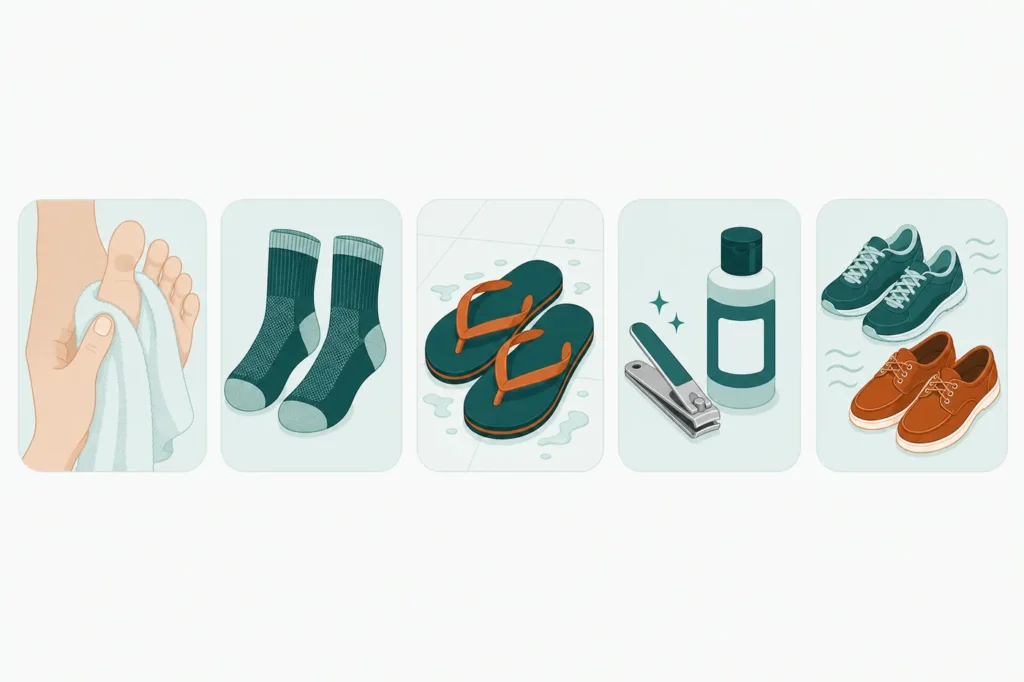
Icon checklist of daily foot hygiene habits that help prevent toenail fungus

Socks, Shoes and Shoe Sanitizers That Prevent Toenail Fungus

Your footwear environment has a large impact on fungal risk. Dermatophytes thrive in warm, dark, humid spaces — exactly what a sweaty closed shoe provides.

Socks: Choose moisture-wicking materials (wool, synthetic blends designed for sport). Cotton holds moisture against skin. Avoid wearing damp socks.

Shoes: Breathable uppers (leather, mesh) reduce internal humidity. Tight shoes that squeeze toes together increase both friction and moisture. Rotate between at least two pairs to allow full drying — a shoe needs 24 hours to dry out properly.

Shoe sanitizers: UV shoe sanitizers and antifungal sprays can reduce fungal load inside shoes. These are particularly useful if you share shoes (rentals, borrowing) or have had a previous infection. Replace old shoes after completing treatment for nail fungus — the inside may harbor surviving spores.

Preventing Toenail Fungus at Pools, Gyms and Nail Salons

Shared wet surfaces are the highest-risk environments for picking up dermatophytes. Warm, damp pool decks, shower floors, and locker rooms are common sources.

Nail salon risk is real: inadequately sterilized tools and foot baths have been implicated in both fungal and bacterial nail infections. A salon that uses autoclave sterilization between clients or disposable single-use instruments is significantly lower risk than one that simply rinses tools in disinfectant solution.

Treating Athlete's Foot to Prevent Toenail Fungus

Athlete’s foot (tinea pedis) and toenail fungus are caused by the same dermatophytes. An untreated skin infection on the feet is a direct pathway to nail infection: the fungus migrates from skin to nail edge over weeks to months. Treating athlete’s foot promptly is one of the most effective things you can do to protect your nails.

OTC antifungal creams (terbinafine 1%, clotrimazole 1%, miconazole) are effective for skin infections when used as directed — typically for 1–4 weeks depending on the product. Complete the full course even after symptoms clear. No OTC topical is FDA-approved to treat established nail infections, but they work well for skin.

For how the skin and nail infections feed each other, and which OTC products work on skin versus nail, see athlete’s foot and toenail fungus: the connection.

Preventing Toenail Fungus From Coming Back After Treatment

Toenail fungus has a high recurrence rate. Some studies estimate 20–25% of patients see the infection return within 1–3 years of completing treatment (AAFP 2015). The same conditions that caused the first infection often remain. Post-treatment habits matter.

Toenail Fungus Prevention for Diabetes and Seniors

People with diabetes or reduced peripheral circulation face higher risk from toenail fungus for two reasons: (1) immune response is less effective at clearing early infection; (2) nail and foot injuries can progress to serious complications including skin breakdown and secondary infection. The same is true for older adults, whose nails grow more slowly and immune response is reduced.

People with diabetes or vascular disease should not self-treat toenail fungus with OTC products without medical guidance. Prescription options have stronger evidence and your clinician can monitor for drug interactions and secondary infection. See our guide for diabetics with toenail fungus →

When to See a Doctor

See a podiatrist or dermatologist if: a nail has changed color, thickness, or shape; the infection has spread to multiple nails; you have diabetes or circulatory disease; OTC measures have not helped after 8–12 weeks; or you are unsure whether the problem is fungal. Up to half of nails that look infected are actually nail psoriasis, nail trauma, or other conditions. A KOH scraping or PAS stain confirms the diagnosis before you commit to 12+ weeks of treatment.

OTC Prevention Products Worth Considering

These OTC products can support prevention and skin fungal treatment. None is FDA-approved to treat established nail infections, but they are useful for athlete’s foot and adjunct nail hygiene.

Ciclopirox is a prescription antifungal nail lacquer (brand: Penlac) that works by chelating metal ions (iron and aluminium). This disrupts metal-dependent fungal enzymes involved in DNA synthesis, cell membrane integrity, and cellular respiration. It is applied daily for 48 weeks and is FDA-approved for mild-to-moderate onychomycosis. Complete mycological cure rate: 5.5–8.5% at 48 weeks per the FDA label. Compare all treatment options →

No unique Amish remedy is clinically validated for toenail fungus. Ads and social media posts claiming an “Amish secret” for nail fungus are not supported by evidence. The same antifungal principles apply regardless of origin: for mild skin infections, OTC topicals; for established nail infections, prescription oral antifungals have the strongest evidence. Oral terbinafine achieves approximately 38% complete cure in the FDA label trials (Lamisil prescribing information).

Vicks VapoRub contains thymol and camphor, which have shown antifungal activity in lab studies. One small uncontrolled pilot study (Derby et al., JABFM 2011, n=18) found modest improvement in some patients. However, Vicks does not reliably penetrate the nail plate in clinically meaningful concentrations, and no rigorous randomized controlled trial has tested it for onychomycosis. Evidence grade: Anecdotal. It is not a substitute for prescription treatment in established infection.

Keep toenails healthy by: trimming straight across (not too short), drying feet and between toes after washing, wearing moisture-wicking socks, rotating shoes to let them dry, using flip-flops in communal wet areas, and treating any athlete’s foot skin infection promptly. If nails are discolored, thickened, or crumbling, see a clinician for diagnosis before self-treating.

Medical disclaimer: This page is informational only and not medical advice. Consult a licensed clinician before treating onychomycosis. If you have diabetes or circulatory disease, see a podiatrist before applying any foot treatment.

Sources: AAFP 2015 (onychomycosis prevalence 3–12%); Derby et al., JABFM 2011 (Vicks pilot n=18); FDA Lamisil (terbinafine tablets) prescribing information, NDA 020539 (~38% complete cure at week 48); Elewski et al., JAAD 2013 (Jublia 15–18%); Mayo Clinic, AAD (accessed Nov 2026).

Already have nail fungus? Find the right treatment.

Use our finder to match your case to the right option.