What Gets Mistaken for Toenail Fungus (2026): 6 Look-Alikes Explained

Disclosure: This page does not contain affiliate product links. Our evidence grades are based on published clinical data only. See how we review →

Dermatoscope, slides and specimen tube used to tell toenail fungus from look-alike nail conditions

Quick Answer

Several nail conditions look like toenail fungus but require completely different treatments. Nail psoriasis, trauma, lichen planus and subungual melanoma can all cause nail discolouration and thickening. Treating the wrong condition with antifungals wastes months and delays the correct diagnosis. A lab test is the only reliable way to confirm nail fungus.

At a Glance

Common Look-Alikes

PsoriasisTraumaLichen planusMelanoma
Pitting and oil-drop patchesInjury history; grows out with the nailRidging, thinning, scar over the nailDark streak: see a dermatologist promptly

Key Facts

Actually fungal

Only about 50% of fungal-looking nails

How it’s diagnosed

KOH prep or nail culture

See a doctor if

Any dark streak under a nail

Psoriasis link

Nails involved in up to ~50% with psoriasis

What Gets Mistaken for Toenail Fungus: How to Tell the Difference

Nail fungus (onychomycosis) is common, but it is not the only thing that changes the look of a toenail. Studies suggest that only about 50% of nail changes that appear fungal are confirmed as such on laboratory testing. That means roughly half of suspected nail fungus cases are something else entirely.

A KOH preparation — where a scraping from under the nail is treated with potassium hydroxide and examined under a microscope — can rule out fungal infection in minutes. A fungal culture takes 2–6 weeks but provides definitive confirmation. Dermatologists and podiatrists use these routinely before prescribing antifungal therapy.

The 6 most common look-alikes

Toenail Fungus vs Nail Psoriasis, Trauma and Onycholysis

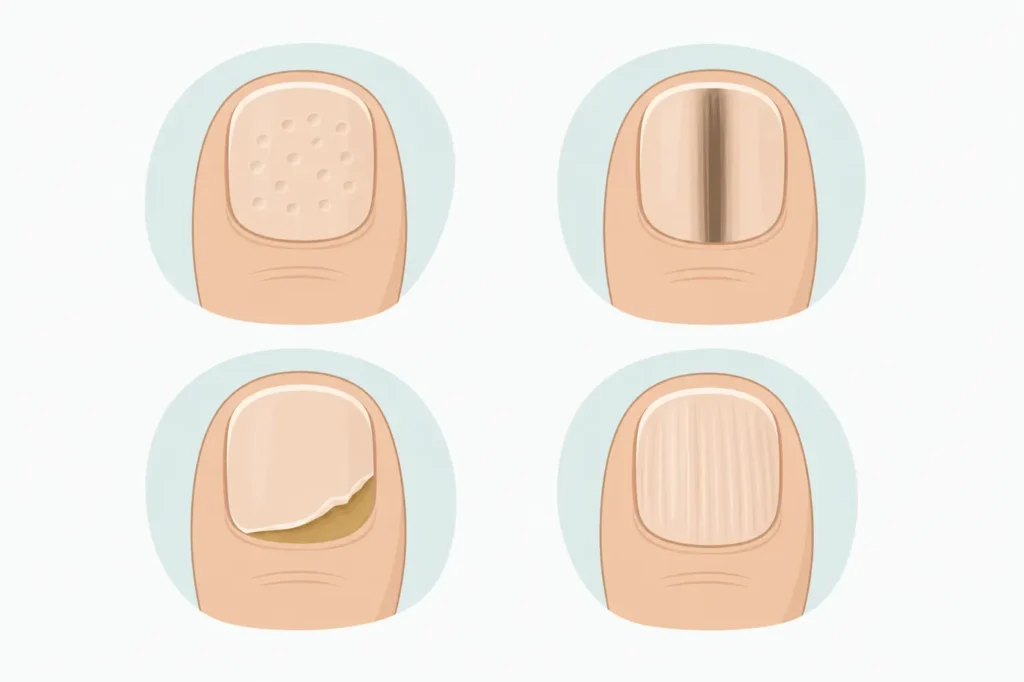
Illustration of four nail conditions that can look like toenail fungus

Nail fungus (onychomycosis)

Nail psoriasis

Nails are involved in up to about 50% of people with psoriasis (Jiaravuthisan MM et al., J Am Acad Dermatol 2007). It can occur without obvious skin psoriasis.

Trauma and subungual haematoma

Onycholysis

Onycholysis is nail separation from the nail bed. It has multiple causes and is a risk factor for secondary infection (bacterial or fungal). Common causes include psoriasis, trauma, overaggressive manicuring, thyroid conditions and certain drugs (tetracyclines, fluoroquinolones, psoralens). It is not a diagnosis — it is a sign that prompts investigation.

Lichen planus (nail involvement)

Nail lichen planus is uncommon but causes distinctive changes: longitudinal ridging, nail thinning, dorsal pterygium (scar tissue forming over the nail) and in severe cases complete nail destruction. It requires a dermatologist to diagnose (clinical examination, sometimes biopsy). Treatment is not antifungal — it typically involves topical or intralesional corticosteroids.

When to see a doctor urgently: If you have any dark streak under a nail — brown, black or dark purple — see a dermatologist promptly. This can indicate subungual melanoma, a form of skin cancer. Do not self-diagnose dark nail streaks as fungus or bruising without medical evaluation.

Side-by-Side: Nail Conditions That Resemble Fungus

Key features that separate each condition from nail fungus:

Why Lab Testing Matters Before Toenail Fungus Treatment

Prescription antifungals (oral terbinafine, Jublia, Kerydin) carry side effect profiles and cost. Giving them to someone with nail psoriasis, lichen planus or trauma provides no benefit and delays proper treatment by months.

Even over-the-counter antifungal products are wasted on a non-fungal nail condition. The KOH prep is a simple, fast office test. Some podiatrists and dermatologists will treat empirically if the clinical picture is very clear, but the standard of care for uncertain cases is to test first.

When to see a doctor urgently: If you have any dark streak under a nail — brown, black or dark purple — see a dermatologist promptly. This can indicate subungual melanoma, a form of skin cancer. Do not self-diagnose dark nail streaks as fungus or bruising without medical evaluation.

What to ask your doctor: “Can we do a KOH prep or nail culture before starting antifungal treatment?” This is a reasonable request and consistent with evidence-based guidelines (AAFP, 2015).

Treatment Differences for Each Nail Condition

Frequently Asked Questions

Nail psoriasis causes nail pitting (tiny dents in the nail surface), oil drops or salmon patches under the nail, nail separation (onycholysis), thickening of nail material under the nail (subungual hyperkeratosis), and sometimes total nail destruction. Associated with psoriasis elsewhere on skin. Differs from fungal infection: KOH test is negative.

Yellow toenails have multiple causes: nail fungus (onychomycosis) is the most common, but nail psoriasis, yellow nail syndrome (associated with lymphedema and respiratory conditions), nail polish staining and certain medications can also cause yellowing. A KOH test distinguishes fungal from non-fungal causes.

Nail fungus can produce an unpleasant odour due to fungal metabolic byproducts and accumulated debris under the nail. However, odour alone does not confirm onychomycosis. Many nail conditions can produce odour, particularly if secondary bacterial colonisation is present.

Onychomycosis is the medical term for nail fungal infection, most commonly caused by Trichophyton rubrum. It affects approximately 10% of the population and causes yellow, white or brown nail discolouration, nail thickening, crumbling and nail separation. Diagnosis requires a lab test (KOH prep or culture).

Sources

Westerberg DP, Voyack MJ. Onychomycosis: current trends in diagnosis and treatment. Am Fam Physician 2013;88(11):762–70.

Langley RG, Daudén E. Treatment and management of psoriasis with nail involvement: a focus on biologic therapy. Dermatology. 2010;221(Suppl 1):29–42. Jiaravuthisan MM, Sasseville D, Vender RB, et al. Psoriasis of the nail: anatomy, pathology, clinical presentation, and a review of the literature on therapy. J Am Acad Dermatol. 2007;57(1):1–27.

Evans EG, Sigurgeirsson B. Double blind, randomised study of continuous terbinafine compared with intermittent itraconazole in treatment of toenail onychomycosis (L.I.ON). BMJ 1999;318(7190):1031–5.

Confirmed It's Nail Fungus? Find the Best Treatment

Once a diagnosis is confirmed, use our treatment finder to compare options by severity, health history and budget.