Home › Toenail Fungus Medication
Toenail Fungus Medication (2026): Prescription, OTC and Home Remedy Options
By Best Toenail Fungus Treatments · Reviewed 15 Nov 2026 · 12 min read
Home › Toenail Fungus Medication
By Best Toenail Fungus Treatments · Reviewed 15 Nov 2026 · 12 min read
Oral terbinafine (Lamisil) is the most effective toenail fungus medication with the strongest evidence: approximately 38% complete cure in the FDA label trials (Lamisil prescribing information). It requires a prescription. Prescription topicals (Jublia, Kerydin, ciclopirox) achieve 6–18% clearance. No OTC product is FDA-approved to treat onychomycosis. Evidence grade for oral terbinafine: Strong Evidence.
Evidence Strength (oral terbinafine)
Strong ✓ModerateLimitedAnecdotal
Side by Side
Key Facts
OTC products
None FDA-approved for onychomycosis
Prescription
Needed for oral and topical drugs
Liver tests
Baseline tests advised in some patients
Grow-out
12–18 months
Toenail fungus (onychomycosis) affects approximately 3–12% of adults, with higher rates in older age groups (AAFP 2015; Am Fam Physician 92(2)). Treatment is challenging because the nail plate is a dense keratin barrier that blocks topical agents, and the nail grows slowly (1–1.5 mm/month), meaning clearance takes 12–18 months even after the fungus is cleared.
Toenail fungus medication falls into four categories:
All treatment decisions should start with a confirmed diagnosis. Many nail conditions mimic onychomycosis. A KOH smear or fungal culture ensures you are treating the right condition. See our complete treatment comparison for a full evidence overview.
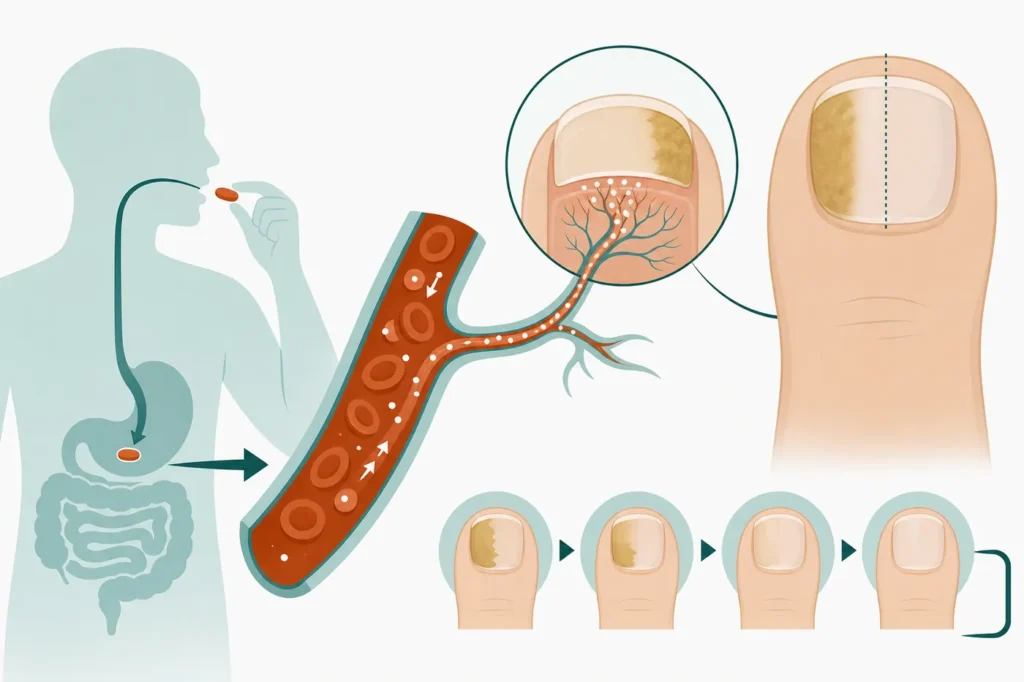
Oral terbinafine is the first-line treatment for toenail onychomycosis. It is delivered via the bloodstream to the nail matrix, where it accumulates in the growing nail and remains active for months after the course ends.
Evidence grade: Strong Evidence
See our detailed Lamisil for toenail fungus guide for dosing, side effects, drug interactions, and cost.
Itraconazole (Sporanox) is an alternative first-line oral antifungal, particularly useful for non-dermatophyte mold infections or in patients who cannot tolerate terbinafine.
Fluconazole is used off-label for onychomycosis. The usual regimen is 150–300 mg once weekly for 6–12 months (toenails). Evidence is weaker than terbinafine or itraconazole. It is sometimes chosen for Candida nail infections or in patients with drug interactions that preclude the other agents.
Prescription topicals are suitable for mild-to-moderate infection without nail matrix involvement, or for patients who cannot tolerate oral antifungals. They are applied daily and require months of treatment.
All three require prescription. The main advantage over oral treatment: no systemic side effects, no liver monitoring required. Main disadvantage: significantly lower cure rates than oral terbinafine.
No OTC product is FDA-approved to treat onychomycosis. Several OTC antifungal products (undecylenic acid, tolnaftate, clotrimazole) are FDA-approved for athlete’s foot and ringworm, but have not demonstrated reliable mycological clearance of established nail infections in clinical trials. See our full OTC toenail fungus treatment guide for detailed reviews.
OTC products may be appropriate as an adjunct to prescription treatment, for maintaining cleared nails, or for treating athlete’s foot to reduce the fungal reservoir that re-seeds nail infections.
Amorolfine 5% nail lacquer (UK): in the UK, amorolfine 5% lacquer (sold as Curanail, formerly Loceryl) can be bought without a prescription. NHS guidance reserves topicals like it for early infection confined to the nail tip and edges, or for superficial white onychomycosis (NHS Scotland formulary). It is not FDA-approved in the US: Drugs@FDA lists no amorolfine product (checked 17 Nov 2026).
All efficacy figures are complete cure (negative KOH smear + negative culture + clear nail) at the timepoints below. Sources: FDA prescribing information for Lamisil and Sporanox (terbinafine/itraconazole); Elewski JAAD 2013 (Jublia); Elewski JAAD 2015 (Kerydin); Gupta JAAD 2000 (Penlac).
| Medication | Type | Grade | Complete Mycological Cure | Course Length |
|---|---|---|---|---|
| OTC antifungals | OTC | Limited Evidence | Not established for nail | Varies |
For reference, the prescription options (information only, not a recommendation; a doctor or podiatrist decides whether one fits you):
Oral terbinafine:
Oral itraconazole:
Prescription topicals (Jublia, Kerydin, Penlac): primarily local reactions—application site irritation, ingrown toenail, dermatitis. No systemic side effects, no liver monitoring required.
Costs vary significantly by insurance coverage, pharmacy, and country. The figures below are approximate US retail prices for uninsured patients (as of late 2026):
Medicare Part D and most commercial insurance plans cover generic terbinafine and itraconazole. Coverage for topical prescription agents (Jublia, Kerydin) varies; prior authorization is often required.
Getting a prescription for toenail fungus medication requires a clinical evaluation to confirm the diagnosis before an antifungal is prescribed. Prescribing antifungals without diagnosis confirmation is poor practice—many conditions look like nail fungus and would not benefit from antifungal treatment.
We can’t prescribe or sell prescription medicine. If you want to start with something you can buy today, these are the best options available without a prescription. They have weaker evidence than prescription treatment, so they suit mild cases or work alongside a doctor’s plan. If you have diabetes, poor circulation or a painful, spreading infection, see a podiatrist first.
The same active ingredient as the prescription pills, as a 1% cream you can buy at any pharmacy. It is labelled for athlete’s foot, not nails: use it on the skin around the nail to stop the fungus spreading back. Limited evidence for nails: its approval data are for skin fungus, and cream penetrates the nail poorly.
An over-the-counter undecylenic acid solution with a brush applicator. Anecdotal evidence as a product (no trial of Fungi-Nail itself); its active, undecylenic acid, has Limited evidence. Cheap, easy to apply daily, and suited to mild cases at the edge of the nail.
A urea and lactic acid gel that softens and improves the look of discoloured, thickened nails. Anecdotal evidence as a product (no trial of Kerasal itself); urea has Limited evidence. It works on appearance, not the fungus, so pair it with an antifungal.
Oral terbinafine (Lamisil) has the strongest clinical evidence: approximately 38% complete cure in the FDA label trials (Lamisil prescribing information). This is significantly higher than prescription topicals (6–18%) or any OTC option. Terbinafine is first-line because it reaches the nail via the bloodstream, bypassing the nail plate barrier. See our detailed Lamisil guide.
Oral terbinafine is taken for 12 weeks, but visual improvement takes much longer. The medication clears the fungus from the growing nail, but the visibly clear nail must grow out from the base: 12–18 months for toenails growing at ~1–1.5 mm per month. Most patients do not see a fully clear nail until 12–18 months after starting treatment.
No OTC product is FDA-approved to treat onychomycosis. OTC antifungals (undecylenic acid, tolnaftate, clotrimazole) are approved for athlete’s foot and ringworm. They may help with very mild nail infections or as a maintenance tool after prescription treatment. For established nail fungus, prescription medication is significantly more effective. See our OTC treatment guide.
Prescription topicals (Jublia, Kerydin, ciclopirox) have no systemic absorption and no liver concern. Among oral agents, terbinafine carries the most published liver safety data. Serious hepatotoxicity is rare (estimated 1 in 50,000–120,000 courses). Patients with pre-existing liver disease should discuss risk with their doctor. Liver function should be tested at baseline for patients at risk.
Approximately 38% complete cure in the FDA label trials (Lamisil prescribing information). Clinical success (which includes partial improvement and negative culture but some residual nail change) is higher—around 65–70% in the same trial. About 20–25% of patients relapse within 1 year of clearance, often due to environmental re-exposure or incomplete initial clearance.
Medical disclaimer: Informational only. Not a substitute for professional medical advice. Consult a qualified healthcare provider before starting any treatment.
Answer 4 quick questions and see evidence-graded picks for your situation.