Home › Home Remedies › Essential Oils for Toenail Fungus

Essential Oils for Toenail Fungus: What the Evidence Actually Says

Medical Disclosure: For informational purposes only. Not a substitute for professional medical advice, diagnosis, or treatment.

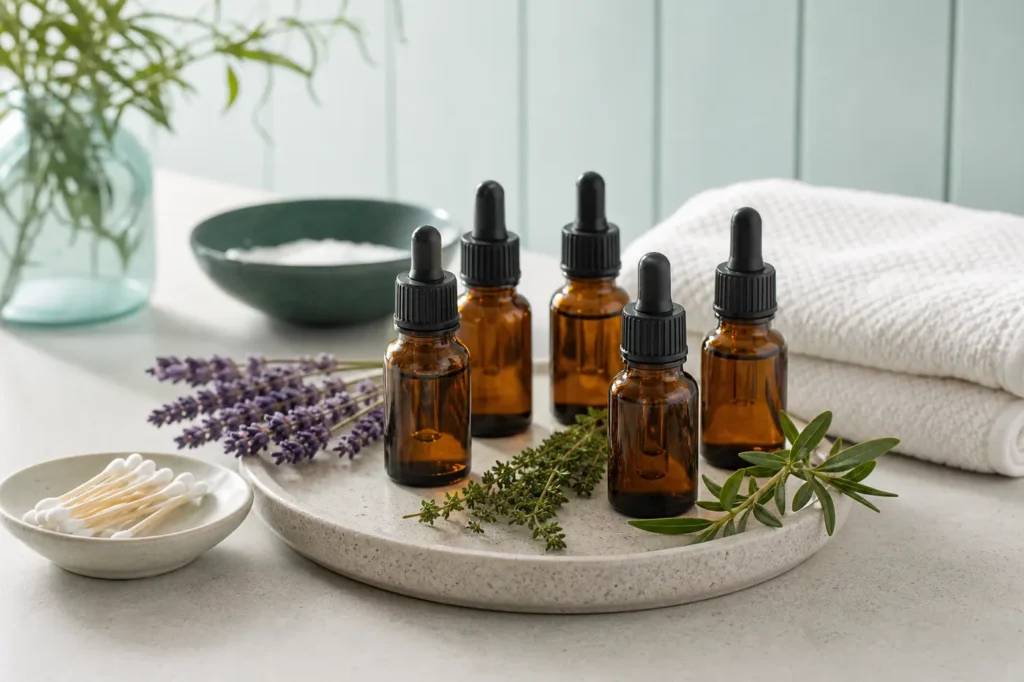
Plain essential oil dropper bottles with lavender and thyme sprigs on a stone tray

The Short Answer

Several essential oils have genuine antifungal compounds demonstrated in laboratory studies. Tea tree oil has the strongest clinical evidence — two randomized controlled trials. Others (oregano, thyme, cinnamon, clove, lavender) have promising in-vitro data but lack rigorous human trials specifically for nail fungus. All essential oils fall in the limited evidence category as standalone nail treatments. That said, they represent a low-cost, low-risk option worth understanding accurately — without the exaggeration common in this topic area.

At a Glance

Evidence Strength (as standalone nail treatments)

StrongModerateLimited ✓Anecdotal

How we grade evidence

Time to Results

2–3 mo6+ mo12–18 mo
Check the nail base for improvementConsistency matters more than which oilFull clearance as the nail grows out

Key Facts

Start with

Tea tree oil, neat, twice daily

Human trials

Tea tree: 2 RCTs; others lab only

Tea tree RCT (6 mo)

18% mycological cure vs 11% clotrimazole

Caution

Clove and cinnamon irritate skin

Understanding In-Vitro vs. Clinical Evidence

In-vitro evidence (lab dishes, petri plates) shows that an oil inhibits fungal growth in controlled conditions. This is real and meaningful — it confirms the compound has activity. Clinical evidence (randomized controlled trials in humans) shows whether it works against nail fungus in a real nail, which must be penetrated by the oil to reach the infection. Most essential oils have in-vitro evidence; only tea tree oil has two clinical trials for nail fungus. In-vitro data does not automatically predict clinical effectiveness.

How Essential Oils Exert Antifungal Activity

Diagram of essential oil droplets disrupting a fungal cell membrane and the nail barrier they must cross

Most antimicrobial essential oils work through one or more of these mechanisms:

The challenge for nail applications: the nail plate is a dense keratin barrier ~0.5–0.75 mm thick. The active compounds must penetrate this barrier in sufficient concentration to reach the nail bed. Most laboratory studies determine minimum inhibitory concentrations (MICs) in liquid media — concentrations achievable in a lab dish are not automatically achievable within a nail bed through topical application. Source: Murdan S. J Pharm Pharmacol. 2016;68(1):3–14. PMID: 26337014.

Limited Evidence as standalone nail treatments; Strong Evidence for in-vitro antifungal activity.

Essential Oils with Antifungal Evidence

1. Tea Tree Oil (Melaleuca alternifolia)

Active compounds: Terpinen-4-ol (primary), alpha-terpineol, 1,8-cineole.

Clinical evidence (strongest of any oil): A 1994 randomized controlled trial (n=117) compared 100% tea tree oil solution versus clotrimazole 1% solution (a prescription topical antifungal). At 6 months, both groups had similar rates of nail appearance improvement (61% vs 60%) and mycological cure (18% vs 11%) — not significantly different. Tea tree performed similarly to a prescription antifungal in this trial. Source: Buck DS, Nidorf DM. J Fam Pract. 1994. PMID: 8195735.

A 1999 study (n=60) tested 100% tea tree oil vs 1% butenafine in a cream base for 16 weeks. The butenafine group had significantly higher cure rates, but tea tree showed partial clearing in some participants. Source: Syed TA, Qureshi ZA. Trop Med Int Health. 1999. PMID: 10357864.

In-vitro evidence: Tea tree oil inhibited all 14 clinical isolates of Trichophyton species at concentrations of 0.03–1.0% in a 1998 study. Source: Hammer KA, Carson CF. J Antimicrob Chemother. 1998. PMID: 9848442.

Application: Apply 1–2 drops of 100% tea tree oil directly to the infected nail and surrounding skin, twice daily. Allow to dry completely before putting on socks. Tea tree oil can be used undiluted on nails — dilute to 25–50% if applying to surrounding skin to avoid irritation in sensitive individuals.

Moderate Evidence — the only essential oil with randomized clinical trial data for nail fungus.

2. Oil of Oregano (Origanum vulgare)

Active compounds: Carvacrol (40–80% of oil), thymol (3–14%).

In-vitro evidence: Oregano oil and its major constituent carvacrol show potent antifungal activity against Candida species and dermatophytes in multiple in-vitro studies. A 2018 review found oregano oil exhibited MIC values in the range of 0.03–0.25% against Candida albicans — concentrations achievable in topical application.

No clinical trials for toenail fungus specifically. Carvacrol can cause skin sensitization in some individuals — perform a patch test on forearm skin before applying to nail areas.

Application: Dilute to 1% (1 drop in 1 teaspoon of carrier oil). Apply to the nail twice daily with a cotton swab. Do not take internally — oregano oil can irritate the GI tract and interact with anticoagulants.

Limited Evidence — in-vitro evidence; no clinical trial for nail fungus.

3. Thyme Oil (Thymus vulgaris)

Active compounds: Thymol (20–54% in thymol-chemotype thyme), carvacrol, linalool.

In-vitro evidence: Thymol demonstrated antifungal activity against Trichophyton rubrum, T. mentagrophytes, and Candida species in multiple studies. A 2006 study found that thyme oil inhibited dermatophyte growth at concentrations of 0.5–1.0% and inhibited ergosterol synthesis — the same target as azole antifungals. Source: Pinto E, Pina-Vaz C. J Med Microbiol. 2006. PMID: 17005785.

Thymol is a component of some commercially available nail antifungal preparations (e.g., ProClearz, certain Vicks VapoRub studies). A single small study (n=18) found that Vicks VapoRub — which contains thymol as one of its ingredients — showed nail appearance improvement in 27.8% of patients; however, this product also contains other compounds (camphor, eucalyptus oil), making it impossible to attribute the effect to thymol alone.

Limited Evidence — in-vitro evidence; limited human data.

4. Cinnamon Bark Oil (Cinnamomum verum)

Active compounds: Cinnamaldehyde (60–90%), eugenol.

In-vitro evidence: Cinnamon bark oil shows broad antifungal activity in vitro, with cinnamaldehyde the primary active component. Lab studies demonstrate activity against T. rubrum, T. mentagrophytes, and Candida species. Source: Pinheiro de Deus I et al., J Med Microbiol. 2019;68(10):1468–1475.

Important caution: Cinnamon bark oil is a potent skin sensitizer. Even at low concentrations, it can cause contact dermatitis in some individuals. Always dilute to 0.5–1% maximum in a carrier oil. Perform a patch test on inner forearm skin 24 hours before applying near nails. Cinnamon leaf oil (a different product, dominated by eugenol rather than cinnamaldehyde) is considerably gentler but has weaker antifungal data.

Limited Evidence — lab evidence only; skin sensitizer requiring careful dilution.

5. Clove Oil (Syzygium aromaticum)

Active compounds: Eugenol (70–90% of clove bud oil), beta-caryophyllene.

In-vitro evidence: Eugenol inhibits dermatophyte and Candida species through cell membrane disruption and ergosterol pathway interference. A 2003 study found clove oil effective against T. rubrum and T. mentagrophytes at concentrations of 0.25–1.0%. Source: Ramsewak RS, Nair MG. Phytother Res. 2003. PMID: 12722144.

Eugenol is a skin sensitizer — dilute to 0.5–1% in carrier oil for topical use. Do not apply to broken skin. Clove oil is toxic if ingested.

Limited Evidence — in-vitro evidence; requires dilution.

6. Lavender Oil (Lavandula angustifolia)

Active compounds: Linalool (30–40%), linalyl acetate, camphor.

In-vitro evidence: Lavender oil inhibited growth of T. rubrum, T. mentagrophytes, and Microsporum canis in a 2003 study, with MIC values comparable to those of ciclopirox. Source: Hammer KA et al., Mycoses. 2003;46(11–12):479–83. PMID: 14641626.

Lavender oil is the gentlest oil in this list — well-tolerated, non-sensitizing at normal concentrations, and can be used as the carrier oil for blends. A tea tree/lavender blend is a commonly recommended combination. No clinical trials for nail fungus.

Limited Evidence — in-vitro evidence; safest option for sensitive skin.
Using Essential Oils Alongside Prescription Treatments

Essential oils can complement — but not replace — prescription antifungal therapy for moderate or severe nail fungal infections. Potential synergistic uses:

No known interactions between topically applied essential oils and oral antifungals (terbinafine, itraconazole, fluconazole) have been documented. Topical application of essential oils near a prescription topical antifungal application site may theoretically compete for skin penetration — apply prescription topical first, allow 15–20 minutes, then apply the essential oil to surrounding skin if desired.

Which Oil to Try First

If you are going to try an essential oil for toenail fungus, here is a practical ranking based on available evidence and tolerability:

For most people, the practical starting point is: 100% tea tree oil on the nail twice daily, with optional lavender oil blended in (50/50) if full-strength tea tree irritates the skin. Consistency for 6+ months is more predictive of outcome than which oil you choose.

Carrier Oils, Dilution, and Application Guide

Steps for diluting and applying essential oil to a toenail with a cotton swab

Carrier oils dilute essential oils and improve skin adherence. Best choices for nail application:

Standard dilution rates:

Application technique:

Safety notes: Never apply essential oils near eyes or mucous membranes. Most essential oils are safe for external use when properly diluted, but are toxic if ingested — keep out of reach of children. Consult a pharmacist if you are pregnant, nursing, or taking anticoagulants (eugenol in clove oil has mild antiplatelet activity). If skin redness, blistering, or irritation develops, discontinue use immediately.

Frequently Asked Questions

No standardized timeline data exists for essential oils specifically. The two tea tree oil clinical trials ran 6–8 months. Because results are only visible as new, healthy nail grows out (toenails grow ~1–2 mm per month), expect 12–18 months before seeing full clearance. Monitor for improvement in the nail base area after 2–3 months of consistent use — if none is apparent, prescription evaluation is warranted.

Reasonable preventive application: after completing prescription antifungal treatment, applying tea tree oil to the nail 2–3 times per week (not necessarily twice daily) as ongoing maintenance has theoretical support but no specific trial data. The more evidence-based prevention strategy is antifungal powder in shoes, clean moisture-wicking socks, and avoiding barefoot walking in communal areas.

Yes — a tea tree and lavender blend (1:1) is frequently used and well-tolerated. Avoid combining potent sensitizers (cinnamon bark + clove) in the same application. More is not necessarily better: a focused blend of two or three oils at appropriate dilution is preferable to a complex blend where sensitization risk accumulates.

Earlier-stage infections (affecting only the nail tip, with less than 50% nail involvement) are more accessible to topical treatment — the infection has not yet reached the nail base. Severe infections (thick, fully discolored nails with nail base involvement) are unlikely to respond adequately to topical treatment of any kind, including essential oils. Prescription oral antifungals are the standard of care for severe or widespread infection.

Several oils commonly marketed for nail fungus have little to no antifungal evidence: peppermint oil (some in-vitro data, but not specific to dermatophytes), frankincense oil (anti-inflammatory properties, minimal antifungal evidence), and lemon oil (antifungal activity in vitro is modest). The oils with the best evidence are listed in this article. Do not use oils that are designed for aromatherapy inhalers — these may contain synthetic fragrance components and are not suitable for skin application.

People with eczema, psoriasis, or sensitive skin should proceed cautiously. Lavender oil is the gentlest option and is least likely to cause sensitization. Always perform a 24-hour patch test on inner forearm skin before applying any new essential oil to the nail and surrounding area. If you have nail psoriasis (which can look identical to nail fungus), confirm the diagnosis with a dermatologist — essential oils have no role in psoriatic nail disease and some (particularly those with phenols) may worsen inflammation.