Home › Best Treatment › Severe Toenail Fungus

Best Treatment for Severe Toenail Fungus (2026): Evidence-Graded Options

Affiliate Disclosure: This page contains affiliate links. If you buy through our links we may earn a commission at no extra cost to you. Evaluations are independent and evidence-based. Full disclosure →
Podiatry clinic trolley with nail tools and a prescription bottle for severe toenail fungus treatment

What Works for Severe Toenail Fungus

Severe toenail fungus — involving more than 50% of the nail, significant thickening or multiple nails — requires prescription-level treatment in most cases. Oral terbinafine Strong Evidence achieves the highest published cure rate (~38% complete cure in the FDA label trials; Lamisil prescribing information). OTC products (Fungi-Nail, Kerasal) are weak adjuncts at best for severe cases. See a podiatrist or dermatologist to confirm diagnosis and get the right treatment level.

At a Glance

Evidence Strength (most-studied option)

Strong ✓ModerateLimitedAnecdotal

How we grade evidence

Key Facts

Most-studied option

Oral terbinafine (Rx), first-line

Evidence

~38% complete cure (FDA label)

Price range

~$10–$40 (terbinafine) to $200–$1,000+ (laser)

Options compared

6 treatments, each graded

What Is Severe Toenail Fungus?

Clinicians use a scoring system (SCIO or Onychomycosis Severity Index) to gauge severity. In practical terms, severe nail fungus typically means:

At this severity level, OTC products are rarely sufficient alone. Clinical guidelines list prescription oral antifungals as first-line treatment at this stage; a doctor or podiatrist decides whether they fit you. Review the full symptoms guide →

Best Treatment for Severe Toenail Fungus: Treatments at a Glance

TreatmentGradeCure rateRx needed?Notes
OTC (undecylenic acid)Limited EvidenceNot established for severeNoAdjunct use; insufficient alone for severe cases.
Laser therapyLimited EvidenceVariable; no FDA-approval for cureNoMay improve appearance; no published complete cure data.

For reference, the prescription options (information only, not a recommendation; a doctor or podiatrist decides whether one fits you):

  • Oral terbinafine: grade: Strong Evidence; cure rate: ~38% complete cure at 48 wks (FDA label); Rx needed: Yes; notes: First-line; liver check required. FDA Lamisil label.
  • Oral itraconazole: grade: Strong Evidence; cure rate: ~14–27% complete cure; Rx needed: Yes; notes: Pulse dosing. More drug interactions than terbinafine.
  • Efinaconazole 10% (Jublia): grade: Moderate Evidence; cure rate: 15–18% complete cure; Rx needed: Yes; notes: Topical; better suited for mild–moderate. Elewski 2013.
  • Ciclopirox lacquer: grade: Moderate Evidence; cure rate: 5–10% complete cure; Rx needed: Yes; notes: Adjunct for mild. 48-week course. Poor for severe alone.

Oral Antifungals: First-Line for Severe Toenail Fungus

Strong Evidence — Oral terbinafine (Lamisil) is the best-evidenced treatment for severe toenail fungus. It showed ~38% complete cure in the FDA label trials (Lamisil prescribing information) — the highest published cure rate for any approved onychomycosis treatment. Full terbinafine guide →

Terbinafine (Lamisil)

Itraconazole (Sporanox)

Important for older adults: Drug interactions and liver function must be checked before prescribing. Toenail fungus treatment for seniors →

Prescription Topical Antifungals for Severe Toenail Fungus

Moderate Evidence — Prescription topicals (efinaconazole 10%, tavaborole 5%) are FDA-approved for onychomycosis but achieve lower cure rates than oral therapy. They are most useful for mild to moderate infection, or as adjuncts when oral therapy is contraindicated.

OTC Options as Adjuncts for Severe Toenail Fungus

Anecdotal Evidence for the products (their actives rate Limited) — OTC products including Fungi-Nail (undecylenic acid) and Kerasal Fungal Nail Renewal (keratolytic) are not recommended as primary treatment for severe toenail fungus. However, they can serve useful adjunct roles while prescription treatment works:

Fungi-Nail (undecylenic acid 25%)

An FDA-approved antifungal for skin. May help with surface-level or periungual (around-the-nail) fungal involvement. Not FDA-approved for onychomycosis and insufficient alone for severe cases. Reasonable as a supplemental topical.

Kerasal Fungal Nail Renewal (keratolytic)

Contains urea 10%, lactic acid and propylene glycol. No antifungal action. Softens thick nails, making them easier to trim and improving penetration for any topical antifungal applied alongside it. Useful for severe nail thickening.

Laser Treatment for Severe Toenail Fungus

Limited Evidence — Laser therapy (Nd:YAG and other wavelengths) has been marketed for onychomycosis. The FDA has cleared some devices for temporary increases in clear nail growth, but no laser device is FDA-approved to treat nail fungus. Published randomized trial results are inconsistent, and no head-to-head trial has shown laser to match oral terbinafine for complete cure.

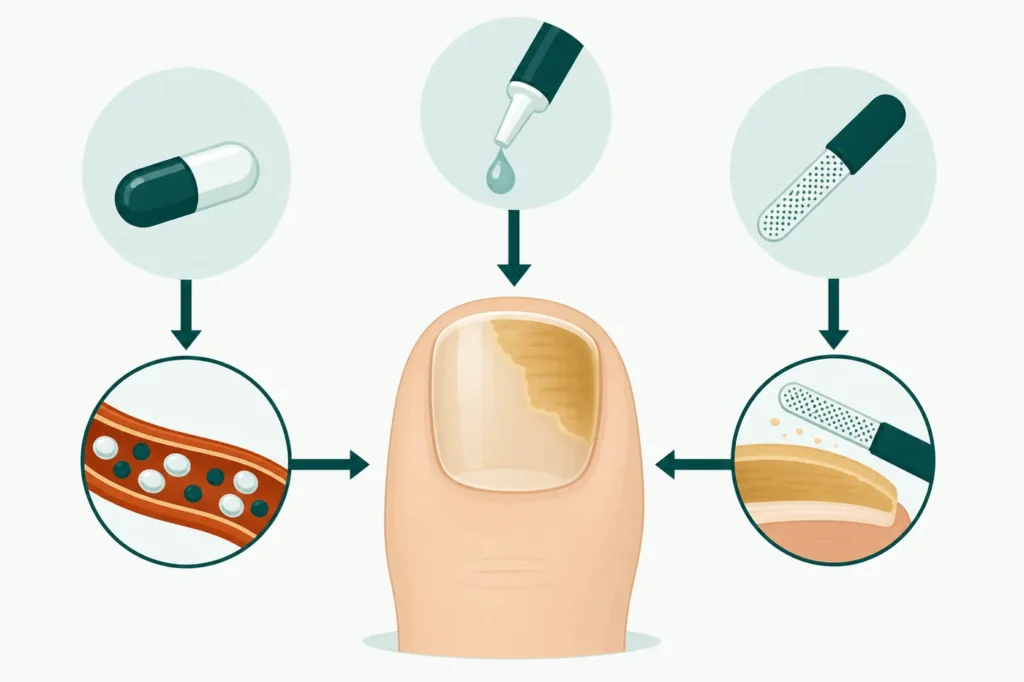
Combination Approach for the Hardest Cases

For severe or recalcitrant toenail fungus, combination therapy generally outperforms any single treatment. A podiatrist may recommend:

Illustration of combining an oral pill, a topical and nail thinning for severe toenail fungus

When Nothing Over-the-Counter Works for Severe Toenail Fungus

When to See a Podiatrist for Severe Toenail Fungus

Total nail avulsion (surgical removal) is a last-resort option for dystrophic nails causing ongoing pain when oral antifungals have failed. Chemical avulsion using high-dose urea (40%) is a less invasive option sometimes used by podiatrists.

Best Treatment for Severe Toenail Fungus: Common Questions

Oral terbinafine is the most effective evidence-based treatment for severe toenail fungus. It showed approximately 38% complete cure in the FDA label trials (Lamisil prescribing information) — the highest published rate for any approved treatment. A podiatrist or dermatologist should confirm the diagnosis with lab tests (KOH smear or culture) and check for contraindications before prescribing.

OTC products alone are not recommended for severe toenail fungus. Products containing undecylenic acid (Fungi-Nail) or keratolytics (Kerasal) can serve as adjuncts while prescription treatment is used, but they lack the nail penetration needed for severe cases. No OTC toenail product is FDA-approved to treat onychomycosis.

Severe toenail fungus requires a 12-week course of oral terbinafine, followed by 12–18 months of nail regrowth to see the full cosmetic result. Lab tests (KOH smear) can confirm mycological clearance before regrowth is complete. Recurrence is common (up to 50% within 3 years) without prevention measures. Full timeline guide →

Yes. Severe toenail fungus (>50% nail involvement, nail matrix affected, multiple nails) almost always requires prescription treatment. A doctor visit also ensures the diagnosis is confirmed — roughly half of suspected nail fungus cases test negative on lab culture. People with diabetes or circulatory issues need professional care regardless of severity.

Sources

  1. L.I.ON. study. Terbinafine vs itraconazole for toenail onychomycosis. BMJ 1999;318:1031–1035.
  2. Elewski BE et al. Efinaconazole 10% solution. JAAD 2013;68(4):600–608.
  3. FDA. Onychomycosis: approved drugs. fda.gov (accessed Nov 2026).
  4. Ferrari J. Fungal toenail infections. Am Fam Physician 2015;92(2):132–133.
  5. Gupta AK, Versteeg SG, Shear NH. Onychomycosis in the 21st century: an update on diagnosis, epidemiology, and treatment. J Cutan Med Surg 2017;21(6):525–39.
  6. AAD. Nail fungus: tips for managing. aad.org (accessed Nov 2026).

Medical disclaimer: This content is for informational purposes only and is not a substitute for professional medical advice, diagnosis or treatment. Always consult a qualified healthcare provider before starting any treatment.

Not sure which treatment fits your case?

Answer 4 quick questions and get a recommendation matched to your nails.