Home › Toenail Fungus Symptoms & Conditions › Hand Nail Fungus Treatment

Hand Nail Fungus Treatment: Causes, Symptoms, Diagnosis, and What Works

Medical Disclosure: For informational purposes only. Not a substitute for professional medical advice, diagnosis, or treatment.
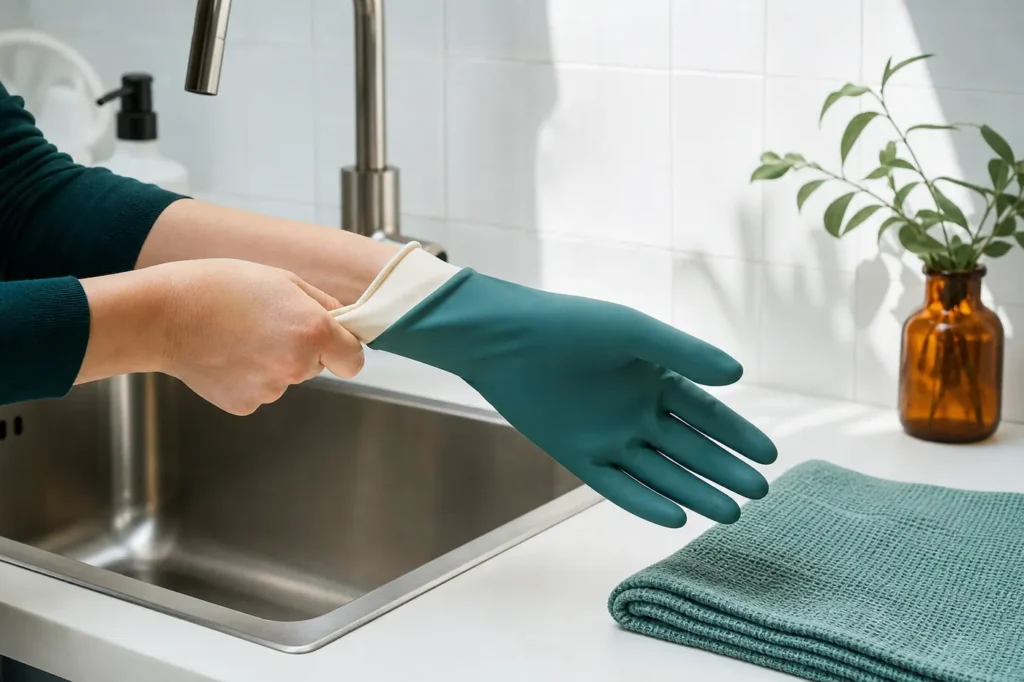
Hands pulling on gloves for wet work to help prevent fingernail fungus

The Short Answer

Fungal infection of the fingernails (onychomycosis of the hand) is less common than toenail fungus but follows different patterns — Candida species are involved more often in fingernails, and certain occupations and activities significantly raise risk. Treatment requires accurate diagnosis first: prescription antifungals for fingernails are highly effective, but the choice between oral and topical therapy depends on the causative organism, number of nails involved, and severity of infection.

At a Glance

Fingernails vs Toenails

FingernailsToenails
Candida causes 70–80% of cases; grow ~3 mm/monthCandida ~10%, dermatophytes 80–90%; grow ~1–2 mm/month

Key Facts

Visible response

6–9 months (vs 12–18 for toenails)

Key risk

Prolonged wet work (healthcare, dishwashing)

Lab test first

KOH prep or culture before oral antifungals

Dermatophyte Rx

Terbinafine 250 mg daily for 6 weeks

How Fingernail Fungal Infection Develops

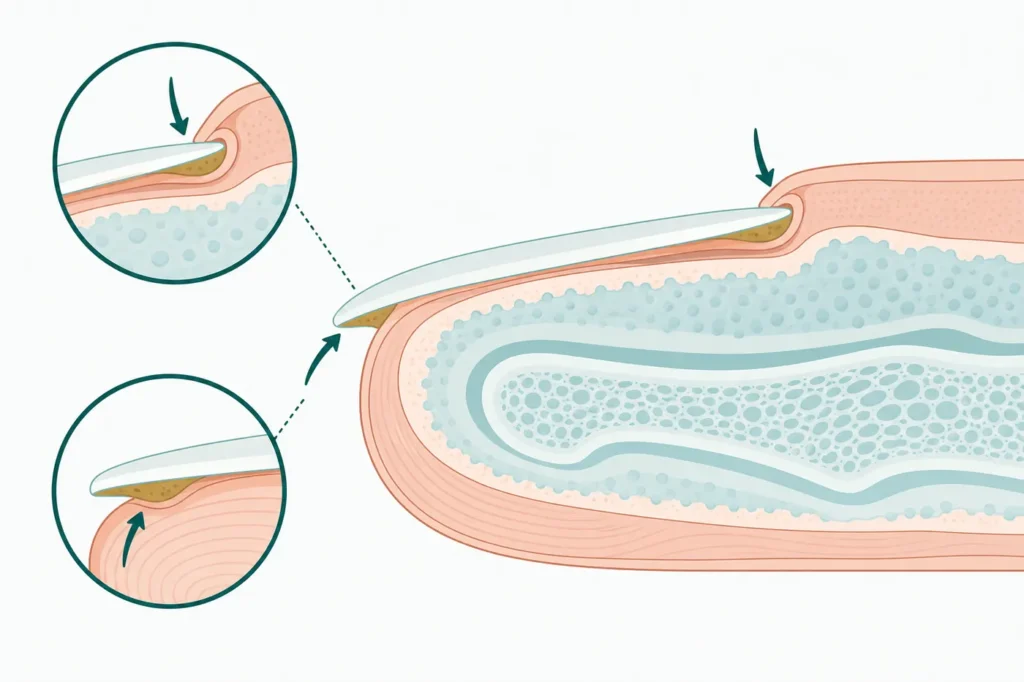
Diagram of how fungus enters a fingernail under the tip or through the cuticle

The fingernail is composed of three main layers of keratin forming the nail plate, which sits on the nail bed and is bounded by the proximal nail fold (cuticle area), the lateral nail folds, and extends to the free edge. Fungal organisms gain entry through several routes:

Once inside the nail plate, the fungus colonizes the keratin matrix. The nail plate becomes a physical barrier that reduces antifungal drug penetration — this is why nail infections require prolonged treatment even with effective drugs. The fungus does not typically invade the bloodstream or deeper tissues in immunocompetent adults.

Source: Hay RJ, Baran R. J Am Acad Dermatol. 2011;65(6):1219–27. PMID: 22015326.

Causative Organisms: Why Fingernails Are Different From Toenails

The organism causing the infection determines which treatment will work. Getting this wrong leads to treatment failure.

Dermatophytes

Dermatophytes — primarily Trichophyton rubrum and T. interdigitale — account for approximately 80–90% of toenail onychomycosis but only about 20–30% of fingernail cases. They feed on keratin and spread from foot skin or toenails to the fingernails via hand-to-foot contact. Terbinafine is the drug of choice for dermatophyte fingernail infections.

Candida Species

Candida albicans and other Candida species account for approximately 70–80% of fingernail onychomycosis — a dramatic difference from toenails where Candida causes only ~10% of cases. Candida nail infections are strongly associated with:

Terbinafine has poor activity against Candida. Fluconazole 150–300 mg weekly for 6–9 months or itraconazole are preferred for Candida fingernail infections. This is why confirming the organism before prescribing is critical. Source: Gupta AK et al., J Am Acad Dermatol. 2004;51(5):785–96. PMID: 15523360.

Non-Dermatophyte Molds

Non-dermatophyte molds (Fusarium, Aspergillus, Scopulariopsis brevicaulis) account for a small percentage of nail infections but are important because they are often resistant to terbinafine. If culture identifies a non-dermatophyte mold, an antifungal with mold coverage (itraconazole, voriconazole) may be needed.

Who Is at Risk for Fingernail Fungal Infection?

Fingernail onychomycosis is an occupational disease in certain fields. The key risk factor is chronic wet work — defined as contact with water or wet materials for more than 2 hours per day, or more than 20 hand washings per day. This breaks down the natural barrier of the cuticle and nail fold, allowing Candida entry.

Additional risk factors include: age over 60 (slower nail growth, reduced immunity), diabetes, peripheral vascular disease, immunosuppressive therapy, and HIV infection (all increase Candida risk). Source: Lipner SR, Scher RK. J Am Acad Dermatol. 2019. PMID: 29959962.

Symptoms of Fingernail Fungal Infection

Distal subungual onychomycosis (most common type, dermatophyte):

Proximal subungual / Candida-type onychomycosis:

Note: nail psoriasis, lichen planus, alopecia areata, and trauma can all cause nail changes that closely resemble nail fungus. Lab confirmation before treatment is best practice — treating nail psoriasis with immunosuppressants can worsen a concurrent fungal infection, and treating fungus as psoriasis means continued infection and nail damage.

How Fingernail Fungus Is Diagnosed

A dermatologist or primary care physician will collect a nail clipping or scraping from the most infected part of the nail. Two laboratory tests are commonly used:

KOH Preparation (Potassium Hydroxide)

The nail sample is placed on a microscope slide, treated with KOH solution, and examined under a microscope for fungal hyphae or yeast forms. KOH prep gives a rapid result (within hours) but cannot identify the specific organism — it only confirms whether fungus is present. Sensitivity ranges from 60–80% depending on technique and infection stage. Source: Lilly KK et al., Arch Dermatol. 2006;142(2):155–60. PMID: 16490840.

Fungal Culture

The nail sample is placed on fungal growth medium and incubated for 2–4 weeks. Culture identifies the specific organism (dermatophyte species, Candida species, or non-dermatophyte mold), which directly informs treatment choice. Sensitivity of culture alone is approximately 50–60% — combining KOH and culture improves accuracy. Some institutions add PCR-based testing for faster organism identification.

Your provider may recommend a biopsy in atypical cases or when multiple tests are inconclusive. Even if clinical appearance is classic, oral antifungal prescribing is best supported by lab confirmation per American Academy of Dermatology guidelines.

Preventing Fingernail Fungal Infection

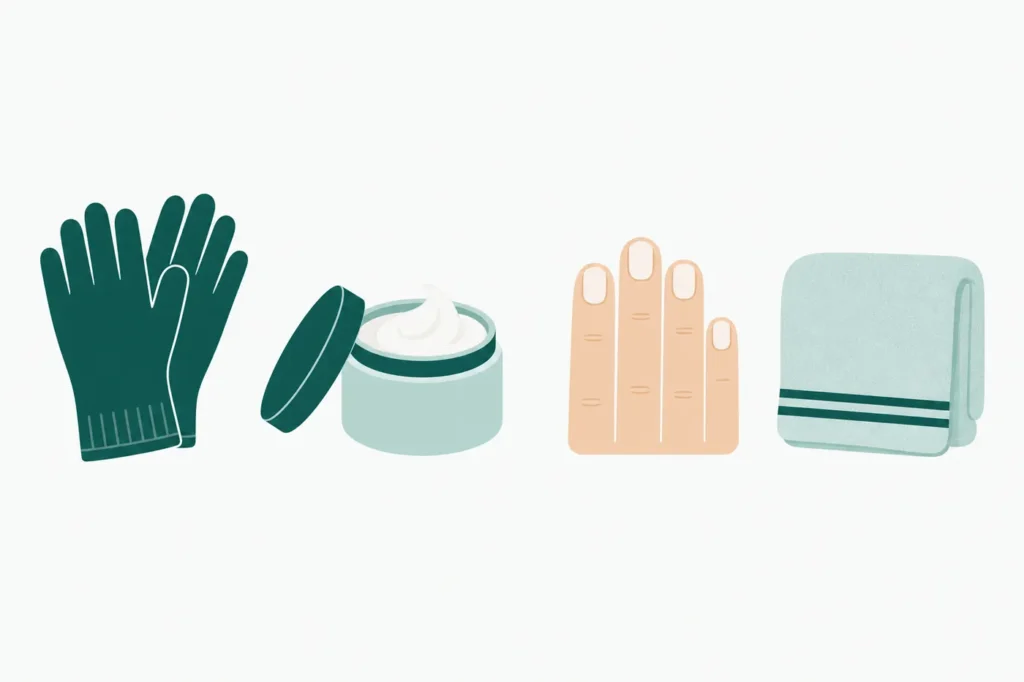
Icons for preventing fingernail fungus: gloves, moisturizer, short nails, dry hands

Treatment Options for Fingernail Fungal Infection

Oral Prescription Antifungals

For dermatophytes: Terbinafine 250 mg daily for 6 weeks (fingernails require shorter treatment than toenails). Mycological cure rates: approximately 76–89% for fingernail dermatophyte infections — higher than toenail outcomes, partly because faster nail growth means quicker clearance. Source: Gupta AK, Cooper EA. Mycopathologia. 2008. PMID: 18478357.

Strong Evidence

For Candida: Fluconazole 150–300 mg once weekly for 6–9 months. Itraconazole 200 mg daily for 6 weeks (or 400 mg daily for 1 week per month × 3 cycles) is an alternative. Both require a prescription. Discuss potential drug interactions with your pharmacist and prescriber — itraconazole interacts with numerous common medications.

Strong Evidence

Topical Prescription Antifungals

Efinaconazole 10% solution and ciclopirox 8% nail lacquer can be used for mild infections where less than 50% of the nail is involved and the nail base (lunula) is not affected. Complete cure rates for fingernail infections are approximately 20–25% with efinaconazole and 10–15% with ciclopirox — still substantially lower than oral therapy, but appropriate when oral medications are contraindicated. Topical treatment of Candida paronychia also includes addressing the skin fold component: antifungal/anti-inflammatory preparations or barrier creams may be prescribed.

Moderate Evidence

OTC and Home Approaches

Tea tree oil (100% or 25–50% solution) has the most clinical trial support among home remedies. OTC undecylenic acid products are available for skin fungal infections but have limited data for nail infections. For moderate or severe fingernail fungal infections, home remedies are unlikely to be curative — prescription treatment is the standard of care. For mild, early-stage infection in someone who declines prescription treatment, OTC options with consistent daily use may be tried with the understanding that complete cure is uncommon.

Limited Evidence for OTC monotherapy in nail infections.

What to Expect During Treatment

Even after the antifungal kills the fungus (mycological cure, usually within 6–12 weeks of starting treatment), the nail must grow out for its appearance to fully normalize. Fingernails grow approximately 3 mm per month; complete regrowth takes 6–9 months from base to tip. You may see a clear, healthy nail growing from the base while the old infected nail is still at the tip — this is a good sign. Your provider may confirm mycological cure with a follow-up nail sample at 6 months post-treatment.

Lifestyle and Maintenance During Treatment

Several practical measures improve treatment outcomes and reduce recurrence risk:

When to See a Doctor

Seek medical evaluation if:

Frequently Asked Questions

Both are onychomycosis, but the causative organisms differ significantly. Toenail fungus is predominantly caused by dermatophytes (90%); fingernail fungus is predominantly caused by Candida (70–80%). Treatment choice depends on the organism — terbinafine works for dermatophytes but has poor activity against Candida. Lab identification first is important.

Yes, but the direction of spread is usually toenail → fingernail, not the reverse. The hands touch infected toenails during nail trimming, drying feet, or putting on shoes — this transfers the fungus from toenails to fingernails. If you have both infections, treat both simultaneously to avoid re-infection.

Standard nail polish traps moisture and reduces topical antifungal penetration. Avoid conventional polish during treatment. If cosmetic cover is essential, some clinicians allow a single coat on healthy-appearing portions of the nail (where the topical antifungal is not needed), but check with your prescriber first.

Chronic paronychia is inflammation of the nail fold (the skin beside and behind the nail base) that persists for 6+ weeks. It is frequently caused by Candida, though the primary trigger is often repetitive wet work, irritants, or contact allergens that break down the nail fold barrier. The nail itself may show secondary changes (ridging, discoloration) due to interrupted growth from the inflamed nail fold. Treatment differs from straightforward nail fungus and often includes barrier cream, anti-inflammatory agents, and antifungal therapy — all applied to the skin fold, not just the nail.

Oral antifungal treatment clears the infection (mycological cure) in 6–12 weeks. The nail requires 6–9 months to grow out fully and appear healthy. Recurrence rates reach 10–25% within 3 years — ongoing preventive hygiene is important after cure.

Yes — especially with itraconazole, which inhibits a liver enzyme (CYP3A4) that metabolizes many common medications, including certain antihistamines, statins, anti-arrhythmics, and HIV medications. Drug interactions can be serious. Terbinafine also interacts with certain antidepressants and antipsychotics. Bring a full medication list to your appointment.