Home › Toenail Fungus vs Nail Psoriasis
Toenail Fungus vs Nail Psoriasis: How to Tell the Difference
By Best Toenail Fungus Treatments · Reviewed 15 Nov 2026 · 11 min read
Home › Toenail Fungus vs Nail Psoriasis
By Best Toenail Fungus Treatments · Reviewed 15 Nov 2026 · 11 min read
Toenail fungus and nail psoriasis can look nearly identical. Both cause discolouration, nail separation (onycholysis), and nail thickening. Some appearance-based clues can help narrow the diagnosis, but they overlap too much to rely on alone — and up to 30% of people with nail psoriasis also have a co-existing fungal infection. Lab testing is the only reliable way to confirm onychomycosis. Treating for fungus when the problem is psoriasis will not help the nail. Treating for psoriasis while missing a fungal co-infection can worsen both.
Side by Side
| Toenail fungus | Nail psoriasis |
|---|---|
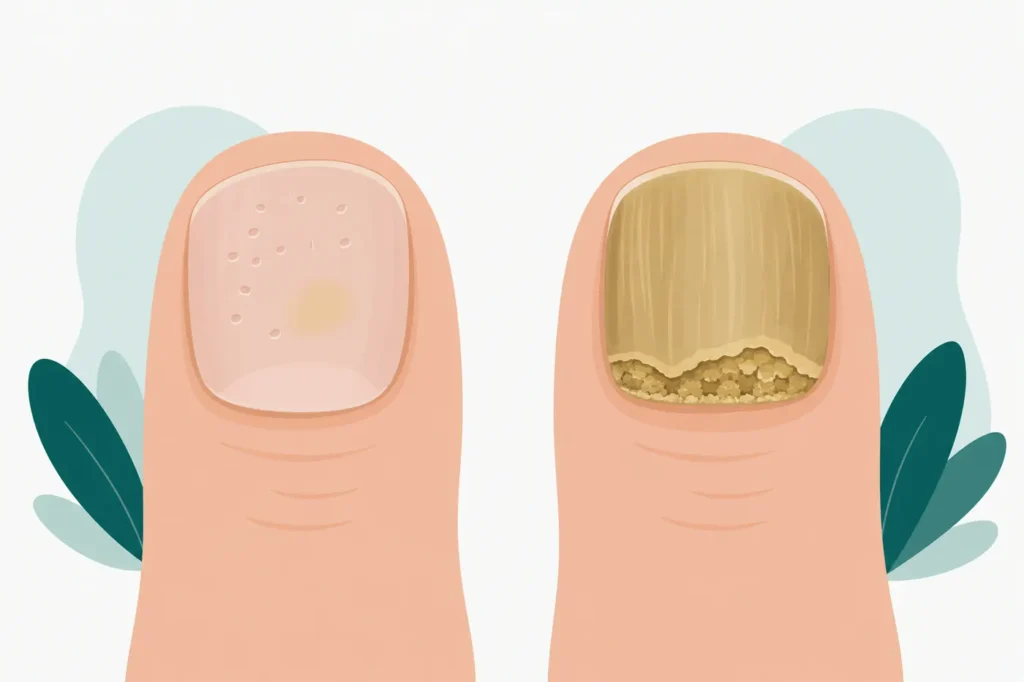
| Starts at the free edge; crumbly, chalky debris; often with athlete’s foot | Pitting and oil-drop sign; skin plaques or joint symptoms elsewhere |
Key Facts
Overlap
Up to 30% with nail psoriasis also have fungus
Confirm fungus
KOH, culture, PAS stain or PCR
Nail pitting
Points more toward psoriasis
Chalky debris
Points more toward fungus
| Feature | Fungal infection (onychomycosis) | Nail psoriasis |
|---|---|---|
| Nail colour | Yellow-white-brown; often starts at free edge | Yellow-brown oil-drop sign; white patches |
| Pitting | Absent (or very rare) | Present; small, shallow, random depressions |
| Nail separation | Common (distal to proximal spread) | Common; often oil-drop border |
| Subungual debris | Often present (crumbling, chalky) | Minimal or absent |
| Nail thickening | Common | Less common; can occur |
| Nails affected | Often multiple; may affect fingernails too | Any nail; often multiple |
| Skin findings | Associated athlete’s foot (tinea pedis) | Skin plaques, scalp involvement, joint symptoms |
| Confirm by | KOH, culture, PAS, PCR | Skin biopsy or clinical diagnosis by dermatologist |
Important: None of these features are diagnostic on their own. Nail psoriasis cannot be confirmed by appearance alone — biopsy or clinical evaluation by a dermatologist is needed.
Up to 30% of patients with nail psoriasis also have a concurrent fungal infection (Jiaravuthisan MM et al., JAAD 2007). This co-existence is clinically important for two reasons:
This is why lab testing before treatment decisions matters, not just for diagnosis but for ruling out co-infection.
A clinician can order lab tests that definitively confirm or rule out fungal infection. Full guide to diagnosis methods →
If nail psoriasis is suspected alongside a negative fungal test, a dermatologist can evaluate the nails and skin for psoriasis and may refer for a nail biopsy in uncertain cases.
Yes. Up to 30% of people with nail psoriasis also have a co-existing fungal infection (onychomycosis). This is clinically important because immunosuppressive treatments for psoriasis can worsen an untreated fungal infection. Lab testing for fungal infection should be done before starting systemic psoriasis treatments.
Oral antifungal drugs are generally safe. If the nail problem is entirely due to psoriasis (no fungal infection), antifungal treatment will not worsen the psoriasis or the nail appearance, but it also will not help. Correctly diagnosing the problem first avoids unnecessary treatment.
There are some distinguishing features: nail pitting and the oil-drop sign are more characteristic of psoriasis, while subungual debris and distal nail thickening are more characteristic of fungal infection. However, these findings overlap considerably, and the two conditions frequently co-exist. Clinical appearance alone is unreliable for diagnosis.
Nail pitting (small depressions in the nail surface) is a classic feature of nail psoriasis and is not typical of fungal nail infection. If you have nail pitting, it is more likely psoriasis than onychomycosis. However, lab testing for fungal infection is still appropriate, particularly if you are considering systemic psoriasis treatment.
Medical disclaimer: This page is informational only and not medical advice. Consult a licensed dermatologist or podiatrist for diagnosis and treatment.
Sources: Jiaravuthisan MM et al. J Am Acad Dermatol 2007;57(1):1–27 (nail psoriasis review); Elewski BE. Clin Microbiol Rev 1998;11(3):415–429 (onychomycosis); AAFP 2015 (prevalence 3–12%).
Use our finder to understand your options and when to see a clinician.