Home › Best Toenail Fungus Treatments › Best Treatment for Thick Toenails

Best Treatment for Thick Toenails (2026): Evidence-Graded Guide

Affiliate disclosure: Some links on this page are affiliate links. If you buy through them we may earn a commission at no extra cost to you. See our disclosure policy →

Nail nippers, file and softening cream laid out for thick toenails

The Short Answer

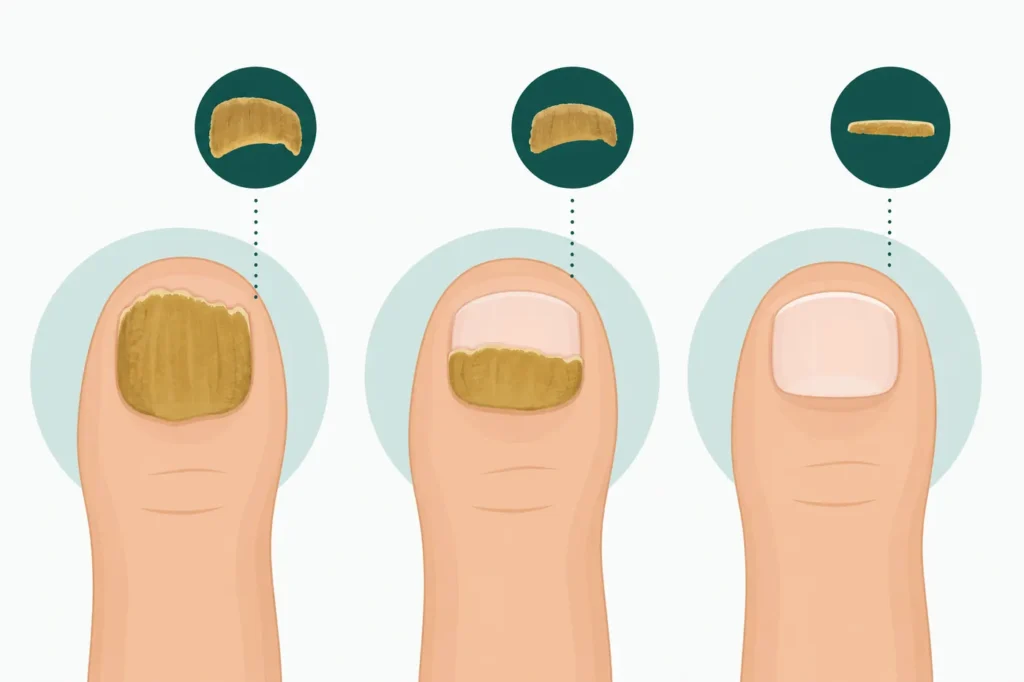
The best treatment for thick toenails depends on the cause. Fungal infection (onychomycosis), which affects roughly 3–12% of adults (AAFP, 2015), is the most common cause — treat it with prescription oral terbinafine (Strong evidence) or OTC undecylenic acid for mild cases. If thickening is from aging (onychauxis) or trauma, urea cream softens the nail while antifungals treat any underlying infection. Thickening can also come from nail psoriasis or slow nail growth, and the cause is not always obvious from appearance alone.

At a Glance

Evidence Strength (top pick)

Strong ✓ModerateLimitedAnecdotal

How we grade evidence

Key Facts

Top pick

Oral terbinafine (when the cause is fungal)

Evidence

Strong for terbinafine; OTC options Limited

Price range

Under $15 OTC to $65–$830+ Rx topical

Options compared

6 treatments

Best Treatment for Thick Toenails: Our Top Picks at a Glance

These picks cover the main treatment categories, from prescription antifungals to cosmetic softeners. The right starting point depends on whether thickening is fungal, age-related, or caused by trauma — a distinction covered in the “Which Fits Your Case” section below.

Best Treatment for Thick Toenails: At a Glance
Terbinafine (oral Rx)Strong EvidenceBest for fungal-caused thickening; highest cure rates~$10–$40/mo
Kerasal Fungal Nail RenewalLimited EvidenceCosmetic softening; visible improvement in 2–8 weeks~$12–$24
Undecylenic acid OTC (Fungi-Nail)Limited EvidenceOTC antifungal for mild early casesUnder $15
Urea cream 20–40%Limited EvidenceSoftening agent only; use alongside antifungal~$5–$20

How We Graded Each Treatment for Thick Toenails Pick

Each pick is graded on two dimensions:

  1. Antifungal clinical evidence: randomised controlled trials and systematic reviews, not in-vitro or anecdotal reports. For fungal-caused thick nails, this is the primary criterion.
  2. Nail softening efficacy: for products primarily designed to soften or cosmetically improve thickened nails, evidence of visible improvement in controlled or observational studies.

Grade scale: Strong Evidence = multiple high-quality RCTs  |  Moderate Evidence = at least one RCT or strong cohort  |  Limited Evidence = small studies or expert opinion  |  Anecdotal Evidence = no controlled evidence

Read our full grading methodology →

Our Treatment for Thick Toenails Picks, Reviewed One by One

Product image

Terbinafine (Lamisil)

Oral prescription antifungal — Best for fungal-caused thick nails

Strong Evidence

When thick nails are caused by onychomycosis — which is the most common cause — oral terbinafine is the strongest evidence-based option available. It achieves approximately 38% complete cure in the FDA label trials (Lamisil prescribing information). The nail thickening improves as new, healthy nail grows in over 12–18 months. Generic terbinafine is available from $10–$40 per month. Requires a prescription.

Pros

Cons

Best for

Fungal-caused thick nails, moderate to severe

Active ingredient

Terbinafine

Evidence

Strong Evidence

Est. price

~$10–$40/month (generic)

Product image

Kerasal Fungal Nail Renewal

OTC cosmetic nail softener — Visible improvement in weeks

Limited Evidence

Kerasal contains urea and lactic acid, which soften and exfoliate discoloured, thickened nail material. It improves cosmetic appearance — nails appear less thick and discolored within 2–8 weeks of consistent use. Important: it is not an antifungal and does not treat the underlying fungal infection. Use it alongside a real antifungal if the thickening is fungal in origin. No prescription needed; available at most pharmacies.

Pros

Cons

Best for

Discoloured, thickened nails; cosmetic management alongside antifungal

Active ingredient

Urea + lactic acid

Evidence

Limited Evidence

Est. price

~$12–$24

Product image

Fungi-Nail Anti-Fungal

OTC undecylenic acid — OTC antifungal for mild cases

Limited Evidence

Undecylenic acid (25%) is an over-the-counter antifungal with FDA approval for topical skin fungal infections. Evidence for penetrating the hard nail plate is limited, making it most appropriate for mild, early-stage nail infections where the thickening is minimal and discoloration is surface-level. No systemic side effects; no prescription needed. No OTC product is FDA-approved to treat onychomycosis.

Pros

Cons

Best for

Mild, early-stage fungal thickening

Active ingredient

Undecylenic acid 25%

Evidence

Limited Evidence

Est. price

Under $15

Product image

Urea Cream 20–40%

Nail softening agent — Pairs with antifungal

Limited Evidence

Urea cream is not an antifungal, but it is a standard part of professional nail management for severely thickened nails. At 20–40% concentration, urea dissolves excess keratin, softening the nail so it can be safely trimmed and so that topical antifungals can better penetrate. Used daily for 2–4 weeks before trimming. Available OTC under several brand names. Avoid on cracked skin; not for diabetics without clinician guidance.

Pros

Cons

Best for

Very thick, hardened nails; use alongside an antifungal

Active ingredient

Urea 20–40%

Evidence

Limited Evidence

Est. price

~$5–$20

Best Treatment for Thick Toenails Comparison Table

TreatmentPrimary useEvidenceTime to see changeEst. cost
Terbinafine (oral Rx)Treat fungal infectionStrong Evidence12–18 months (nail growth)~$10–$40/mo
Efinaconazole (Jublia, Rx)Treat fungal infection (topical)Moderate Evidence24–48 weeks$65–$830+
Kerasal (urea + lactic acid)Cosmetic softeningLimited Evidence2–8 weeks (cosmetic)~$12–$24
Undecylenic acid OTC (Fungi-Nail)OTC antifungalLimited Evidence6–12+ monthsUnder $15
Urea cream 20–40%Nail softeningLimited Evidence2–4 weeks (softening)~$5–$20
Vicks VapoRubHome remedyAnecdotal EvidenceNo proven timeline~$5–$10

No OTC product is FDA-approved to treat onychomycosis. Vicks VapoRub contains thymol and camphor, which have some in-vitro antifungal properties, but no large clinical trial supports it as a primary treatment for thick nails. Prices as of November 2026.

Which Treatment for Thick Toenails Fits Your Case

The right treatment depends on what is causing the thickening:

If thickening is from onychomycosis (fungal infection): Look for yellow, brown, or white discoloration alongside the thickening, with crumbling or lifting edges. This requires antifungal treatment. For mild cases: OTC undecylenic acid. For moderate–severe: prescription oral terbinafine. Add Kerasal or urea cream to manage the cosmetic appearance while the antifungal works.

If thickening is from aging (onychauxis): Nails grow thicker naturally as we age because cell turnover slows and keratin builds up. No antifungal is needed. Urea cream softens the nail for safer trimming. If you are unsure whether the cause is fungal or age-related, see a clinician — a KOH test or nail culture can confirm.

If thickening is from trauma: Repeated pressure from shoes, sports, or injury can cause the nail matrix to produce thicker nail. This does not respond to antifungals. Properly fitted footwear is the main intervention.

If thickening is from nail psoriasis: Psoriatic nail changes — pitting, onycholysis, oil-drop spots — require dermatological evaluation. Antifungals will not help unless fungal co-infection is confirmed by lab test.

Diabetics or people with circulation issues: See a podiatrist before attempting any treatment at home. See our guide: Best Toenail Fungus Treatment for Diabetics.

Active Ingredients That Matter in a Treatment for Thick Toenails (Terbinafine, Undecylenic Acid, Tolnaftate, Tea Tree Oil)

Terbinafine Strong Evidence

Allylamine antifungal that stops ergosterol synthesis in the fungal cell membrane. Oral terbinafine accumulates in the nail plate for months after the treatment course. Complete cure approximately 38% in the FDA label trials (Lamisil prescribing information). The only treatment with Strong-grade evidence for onychomycosis.

Urea (20–40%) Limited Evidence

A keratolytic agent — it breaks down and softens the protein structure of thick nails. At 40%, used under occlusion, it can dissolve infected nail material entirely (chemical avulsion). At lower concentrations, it softens nails for trimming and improves penetration of topical antifungals applied afterward. Found in Kerasal and standalone urea creams.

Undecylenic acid Limited Evidence

A fatty acid antifungal, FDA-approved for topical skin fungal infections. Limited evidence for nail-plate penetration, but no systemic side effects. The active ingredient in Fungi-Nail.

Efinaconazole (Jublia, Rx) Moderate Evidence

Prescription topical with better nail-plate penetration than older lacquers like ciclopirox. Complete cure rate 15–18% (Elewski et al., JAAD 2013). Lower systemic exposure than oral antifungals.

Tea tree oil Limited Evidence

Some in-vitro antifungal activity. Very limited evidence for thick nail treatment. Not recommended as a primary treatment for established onychomycosis.
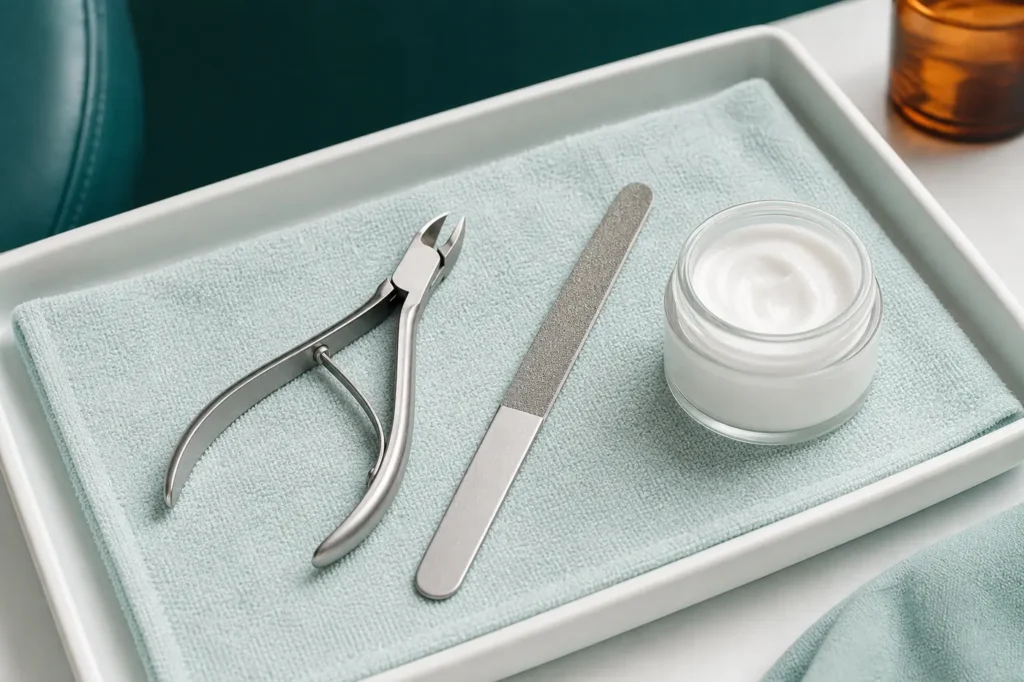
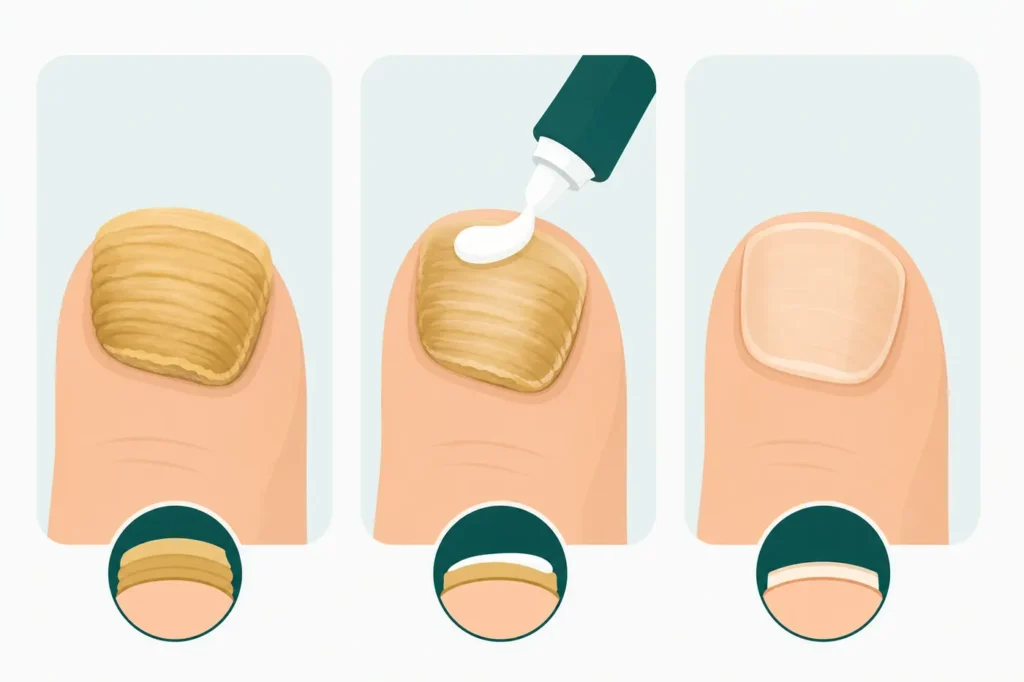
Illustration of urea cream softening a thick toenail over time

How Long a Treatment for Thick Toenails Takes to Work (Nail Growth Timeline)

No treatment changes a thickened nail immediately. For fungal-caused thickening, the timeline has two phases: the treatment phase (when the medication acts on the fungus) and the nail-growth phase (when new, healthy nail grows in to replace infected nail). A big toenail takes 12 to 18 months to grow from the matrix to the tip.

For cosmetic softeners, results are faster:

  • Kerasal (urea + lactic acid): Cosmetic improvement in 2–8 weeks of consistent daily use. This is not nail regrowth — it is softening and exfoliation of the existing nail surface.
  • Urea cream 20–40%: Significant nail softening in 2–4 weeks of daily use. After this, the nail can be trimmed safely.
  • Oral terbinafine (12 weeks): The active treatment course is 12 weeks. Full nail clearance and normal nail appearance takes 12–18 months from treatment start.
  • OTC topicals (undecylenic acid): No well-defined timeline. Consistent daily use for at least 6–12 months needed for any visible change in mild cases.

Applying more product does not speed up nail growth. The growth rate is determined by biology, not treatment intensity.

Nail growth timeline for a thick toenail after treatment

Treatment for Thick Toenails Side Effects and Safety Checks

Terbinafine (oral): Most common side effects are gastrointestinal. Rare but serious: hepatotoxicity; pre-treatment liver function testing is standard. Drug interactions include warfarin and some SSRIs. Tell your prescribing clinician about all current medications before starting.

Urea products (Kerasal, urea cream): Local stinging or irritation possible, especially on cracked skin. Do not apply to broken skin or open wounds. People with diabetes should check with their clinician before using urea products on feet, as neuropathy may mask irritation.

OTC topicals (undecylenic acid, tolnaftate): Generally well tolerated. Local irritation is possible. No systemic effects.

Tea tree oil: Contact dermatitis in some individuals. Dilute before application.

When to see a podiatrist: if nails are extremely thick, painful, or if you have diabetes, cardiovascular disease, or any immune condition. Self-trimming very thick nails without softening first risks nail-bed injury.

When a Prescription Beats Any Treatment for Thick Toenails

OTC products are Limited-evidence options suitable only for mild cases. In many thick-nail scenarios, prescription options are clearly superior:

  • More than 2 nails affected or nail bed involved: Prescription oral terbinafine is indicated. OTC topicals will not reach the nail bed.
  • Nails that have not improved after 3–6 months of OTC treatment: Step up to prescription. This is a common pattern — OTC topicals have limited penetration, and established infections need stronger intervention.
  • Severe thickening or complete nail involvement: Podiatrist visit first for mechanical debridement, possibly combined with oral antifungal.
  • Thickening with unknown cause: See a clinician for a KOH test or nail culture to confirm fungal infection before committing to months of antifungal treatment.

See Toenail Fungus Treatment Comparison for a full evidence table across all treatment categories.

Best Treatment for Thick Toenails: Common Questions

First confirm the cause: fungal infection (yellow/brown discoloration, crumbling edges), aging (onychauxis), trauma, or psoriasis. For fungal-caused thick nails, prescription oral terbinafine has the strongest evidence. For all types, soften the nail with urea cream for 2–4 weeks before attempting to trim. For moderate or severe thickening, see a podiatrist for professional debridement.
Vicks VapoRub contains thymol and camphor, which have some in-vitro antifungal properties. A small pilot study in the Journal of the American Board of Family Medicine (2011) found improvement in some participants who applied it daily. However, it is not a proven treatment for established nail fungus or nail thickening, and no large controlled trial supports it. It is not recommended as a primary treatment.
If the cause is fungal infection and the nail matrix (the growth center) has not been permanently damaged, new healthy nail can grow in after effective antifungal treatment. This takes 12–18 months. If thickening is from aging or severe matrix damage, the nail may not fully return to its previous appearance. A podiatrist can assess the extent of matrix involvement at examination.
A warm water soak for 10–15 minutes softens the nail enough to make trimming easier. Adding Epsom salt (magnesium sulfate) may help further, though evidence is limited. After soaking, dry feet thoroughly — moisture trapped between toes promotes fungal growth. Foot soaking alone does not treat the underlying infection; it is a preparatory step before trimming or applying topical treatment.

Sources

  • Evans EG et al. Double blind, randomised study of continuous terbinafine compared with intermittent itraconazole in treatment of toenail onychomycosis. The L.I.ON. Study. BMJ. 1999;318(7190):1031–1035.
  • Harvard Health Publishing. Dealing with thick, discolored toenails. 2023.
  • Mayo Clinic. Nail health: tips for keeping your nails healthy. 2023.
  • Lipner SR. Pharmacotherapy for onychomycosis: new and emerging treatments. Expert Opin Pharmacother 2019;20(6):725–35.
  • Westerberg DP, Voyack MJ. Onychomycosis: current trends in diagnosis and treatment. Am Fam Physician 2013;88(11):762–70.

Medical disclaimer: This content is for informational purposes only and is not a substitute for professional medical advice, diagnosis or treatment. Always consult a qualified healthcare provider before starting any treatment.

Not sure which treatment fits your case?

See our full evidence-graded treatment comparison or find the right starting point.