Kerydin for Toenail Fungus (2026): Cure Rates, Side Effects and Cost

Disclosure: This page does not contain affiliate product links. Our evidence grades are based on published clinical data only. See how we review →
Pharmacist handing over a plain prescription bag and dropper bottle, for a guide to the Rx topical Kerydin

Quick Answer

Kerydin (tavaborole 5%) is an FDA-approved prescription topical for toenail fungus. In Phase III trials, complete cure was achieved in 6.5–9.1% of patients after 48 weeks of daily application. It is best suited to mild-to-moderate nail involvement where oral antifungals are not appropriate. A prescription is required.

At a Glance

Evidence Strength

StrongModerate ✓LimitedAnecdotal

How we grade evidence

Time to Results

Day 148 wk52 wk12–18 mo
Apply once daily to the whole nailDaily course endsTrials: 6.5–9.1% complete cureFull nail grow-out

Key Facts

Status

Prescription only (FDA-approved 2014)

Cost

Brand Kerydin discontinued; generic tavaborole available (Drugs@FDA, checked Nov 2026)

Best for

Mild–moderate; oral not appropriate

Applied

Once daily, 48-week course

Kerydin for Toenail Fungus: How It Works

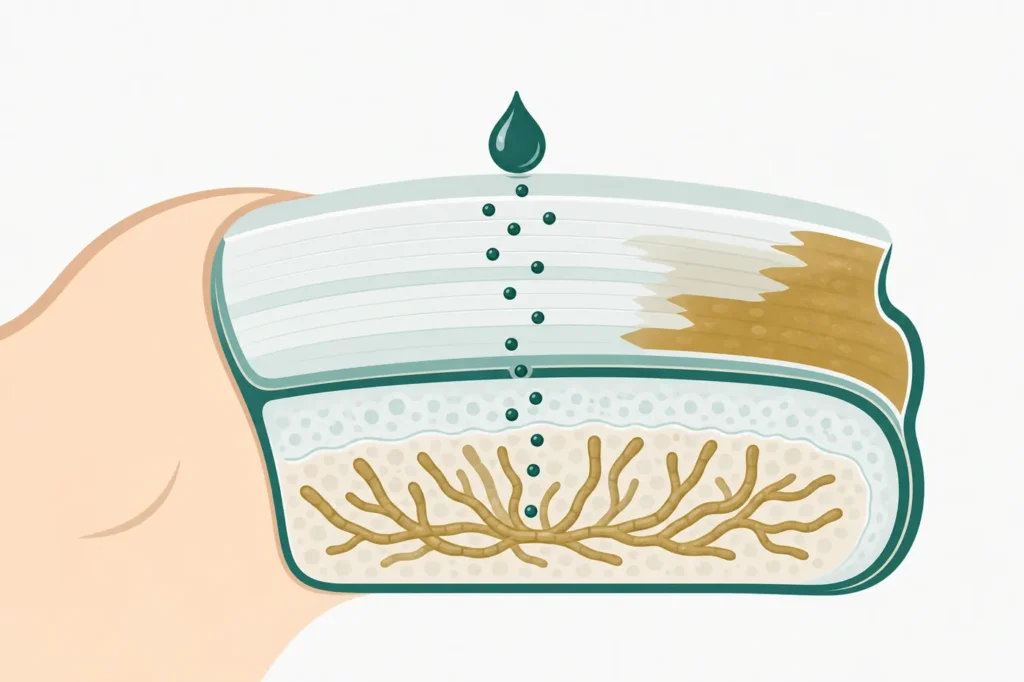
Tavaborole is an oxaborole antifungal that works by inhibiting fungal cytoplasmic leucyl-tRNA synthetase — an enzyme needed to make fungal proteins. This is a different mechanism from older topicals (azole antifungals and ciclopirox), and it was specifically chosen because the small oxaborole molecule can penetrate the nail plate more effectively than many larger compounds.

Kerydin was FDA-approved in July 2014 (NDA 204427) for the topical treatment of onychomycosis of the toenails caused by Trichophyton rubrum or T. mentagrophytes. It is available as a 5% solution applied with a dropper.

Diagram of a small-molecule topical antifungal passing through the nail plate to the nail bed

Evidence grade: Moderate Evidence — Phase III randomised controlled trials in over 1,000 patients.

Does Kerydin Work on Toenail Fungus? Cure Rates and Studies

The Phase III data for Kerydin comes from two randomised, double-blind, vehicle-controlled trials (N=1,194 total) reported in the FDA label (NDA 204427, updated 2018). After 52 weeks of treatment (48 weeks application + 4-week follow-up):

Why is complete cure so low even for an FDA-approved treatment? Topical antifungals face a fundamental challenge: delivering therapeutic drug concentrations through the full thickness of the nail plate to reach the nail bed where the fungus lives. Even with tavaborole’s improved penetration, the nail matrix limits drug delivery in severe infections. Oral antifungals bypass this barrier by reaching the nail bed through the bloodstream.

Compare: Jublia (efinaconazole 10%, also topical) achieved 15–18% complete cure in its Phase III trials. Oral terbinafine achieves approximately 38% complete cure in the FDA label trials (Lamisil prescribing information).

How to Use Kerydin for Toenail Fungus (Course Length)

Kerydin is applied once daily for 48 weeks. This is a 12-month commitment. Missing doses or stopping early reduces efficacy.

Kerydin Side Effects and Warnings

In Phase III clinical trials, side effects were primarily local and mild. Kerydin has minimal systemic absorption, so systemic side effects are uncommon.

Kerydin has minimal systemic absorption. No clinically significant drug interactions have been identified. The prescribing information notes insufficient data in pregnancy — discuss with your prescriber if applicable.

Who Should Not Use Kerydin

Kerydin Cost, Generics and How to Get It

Kerydin is a brand-name prescription medication with no widely available generic as of November 2026. The brand-name cost is substantial without insurance coverage.

Kerydin vs Other Toenail Fungus Treatments

Topical options (Kerydin, Jublia) are generally preferred when oral antifungals are contraindicated due to liver conditions, drug interactions or patient preference. For mild-to-moderate involvement without nail matrix disease, topicals are a reasonable first choice. Severe onychomycosis (more than 50% nail involvement, nail matrix affected) responds better to oral terbinafine.

Frequently Asked Questions

Kerydin (tavaborole 5% topical solution) is an FDA-approved prescription antifungal used to treat onychomycosis (toenail fungus) caused by Trichophyton rubrum or Trichophyton mentagrophytes. It is applied once daily for 48 weeks and requires a doctor’s prescription.

Kerydin must be applied daily for 48 weeks (approximately 12 months). Because toenails grow slowly, any new clear nail growth will only appear gradually from the base. Complete cure — meaning both a clear nail and negative fungal cultures — was achieved in 6.5–9.1% of patients in Phase III clinical trials at week 52.

Both are FDA-approved prescription topicals for nail fungus with similar application regimens (once daily, 48 weeks). Jublia (efinaconazole 10%) achieved higher complete cure rates in clinical trials (15–18%) compared to Kerydin (6.5–9.1%). The choice depends on your prescriber’s recommendation, insurance coverage and cost.

No. Kerydin (tavaborole) is a prescription-only medication in the United States. It requires a valid prescription from a licensed healthcare provider. Telehealth services can provide prescriptions after an online consultation.

Sources

FDA. Kerydin (tavaborole) prescribing information. NDA 204427, updated 2018.

Evans EG, Sigurgeirsson B. Double blind, randomised study of continuous terbinafine compared with intermittent itraconazole in treatment of toenail onychomycosis (L.I.ON). BMJ 1999;318(7190):1031–5.

Westerberg DP, Voyack MJ. Onychomycosis: current trends in diagnosis and treatment. Am Fam Physician 2013;88(11):762–70.

Need a Prescription for Kerydin?

Compare Kerydin to other prescription and OTC options, or find a telehealth service that can evaluate your nail and prescribe online.