Home › Treatments › CVS / Walgreens / Walmart

Toenail Fungus Treatment at CVS, Walgreens and Walmart (2026): Active Ingredients Explained

Disclosure: This page contains affiliate links. If you buy through a link on this page we may earn a small commission at no extra cost to you. Our evidence grades are based on published clinical data only. See how we review →

Pharmacy shelf of generic nail-care products for toenail fungus

Quick Answer

Store shelves at CVS, Walgreens and Walmart carry OTC nail-care products for mild fungal symptoms and appearance improvement. The most evidence-backed active ingredient category is undecylenic acid (approved by the FDA for OTC antifungal use on nails and surrounding skin). No OTC topical sold in pharmacies is FDA-approved to treat established nail onychomycosis — that requires a prescription.

This guide grades every active ingredient you will find on store shelves so you can choose the right product for your situation.

At a Glance

Evidence Strength (top pick)

StrongModerateLimited ✓Anecdotal

How we grade evidence

Key Facts

Top pick

Undecylenic acid (e.g. Fungi-Nail)

Evidence

Limited; best of the OTC actives

FDA status

No OTC is approved for nail onychomycosis

Options compared

5 store-shelf active ingredients

Toenail Fungus Treatment at CVS, Walgreens and Walmart: Our Top Picks at a Glance

Three product categories cover most of what you will find in the nail-care aisle at major pharmacy chains. Here is what each one does and does not do.

Fungi-Nail (Undecylenic Acid)

FDA-approved OTC antifungal active. Targets skin and mild nail involvement. Best OTC evidence for antifungal use.

Kerasal Fungal Nail Renewal

Urea + lactic acid. Improves the appearance of thickened, discoloured nails. No antifungal active — cosmetic category.

How We Graded Each Store-Bought Toenail Fungus Treatment Pick

Each active ingredient is graded on a four-level scale based on the type and quality of available evidence. See our full grading methodology →

Strong Evidence  Randomised controlled trials (RCTs) with consistent results.

Moderate Evidence  RCTs with limitations or smaller trials.

Limited Evidence  In vitro data, case reports or small pilots.

Anecdotal Evidence  Manufacturer claims or folk use only; no published trial.

Our Store-Bought Toenail Fungus Treatment Picks, Reviewed One by One

1. Undecylenic Acid Products (e.g. Fungi-Nail)

Evidence grade: Limited Evidence

Active ingredient: Undecylenic acid 25%

FDA OTC status: Approved for skin and nails (antifungal use)

Undecylenic acid is derived from castor oil and has demonstrated antifungal activity against dermatophytes in laboratory studies. The FDA recognises it as a safe and effective OTC antifungal for the skin area around the nail and nails themselves. For mild, early fungal involvement confined to the nail edge, it is the strongest evidence-backed option available without a prescription.

It will not clear an established subungual (under-the-nail) infection on its own because OTC topicals cannot adequately penetrate the nail plate to reach the fungus.

2. Urea / Cosmetic Nail Renewal Products (e.g. Kerasal)

Evidence grade: Limited Evidence

Active ingredient: Urea (10–40%) + lactic acid

FDA OTC status: Cosmetic / nail appearance category (no antifungal active)

Urea at higher concentrations (40%+) is a keratolytic: it softens and breaks down the thickened, hardened nail material characteristic of fungal infection. This makes it easier to debride the nail and allows other topical treatments to penetrate more deeply.

Kerasal-type products are classified as cosmetics, not drugs. They improve appearance and can relieve discomfort from thickening but do not kill or inhibit fungal organisms. Use them alongside an antifungal, not instead of one.

3. Tea Tree Oil Blends

Evidence grade: Limited Evidence

Active ingredient: Melaleuca alternifolia oil (tea tree oil)

FDA OTC status: Not an approved OTC antifungal drug

Tea tree oil shows antifungal activity against Trichophyton species in laboratory tests. Small pilot studies suggest cosmetic improvement with consistent use, but no large randomised trial has confirmed efficacy for nail onychomycosis. Tea tree oil blends are widely available in pharmacy chains but are sold as cosmetics or general wellness products, not as drugs.

No affiliate link is available for a specific tea tree oil product. See our best OTC picks guide for current options.

Toenail Fungus Treatments at CVS vs Walgreens vs Walmart: Price Check

Prices for OTC nail products vary by retailer, region and package size. The ranges below are approximate as of November 2026 and are based on general market knowledge — always check current prices at your local store or online before purchasing.

Medical disclaimer: This page is for informational purposes only and does not constitute medical advice. Toenail fungus can mimic other conditions. See a podiatrist or dermatologist for diagnosis and treatment.

Toenail Fungus Treatment at CVS, Walgreens and Walmart Comparison Table

Prices approximate as of Nov 2026. Verify at time of purchase. No OTC topical is FDA-approved to treat established nail onychomycosis.

Which Store-Bought Toenail Fungus Treatment Fits Your Case: Mild, Moderate or Severe

Moderate to severe infection? An online telehealth visit can get you a prescription quickly. See online prescription options →

Active Ingredients That Matter in a Store-Bought Toenail Fungus Treatment

Understanding what each ingredient actually does — and what it cannot do — is the most important factor when choosing an OTC product.

Undecylenic Acid

Evidence grade: Limited Evidence

FDA-approved OTC antifungal for nails and surrounding skin. Disrupts fungal cell membranes. Best evidence of the OTC actives for direct antifungal use on nails. Penetration is still limited compared to prescription alternatives.

Terbinafine 1% (OTC cream/solution)

Evidence grade: Moderate Evidence (for skin fungal infections) / Anecdotal Evidence (for nail onychomycosis OTC use)

Terbinafine is an allylamine antifungal with strong evidence for skin fungal infections (athlete’s foot, ringworm). The FDA-approved OTC indication is skin infections, not nail onychomycosis. The 1% cream does not achieve the nail concentrations needed to clear subungual fungus. Do not confuse OTC terbinafine 1% cream with prescription oral terbinafine tablets, which have Strong evidence for nail fungus.

Tolnaftate 1%

Evidence grade: Limited Evidence (for nail)

FDA-approved OTC for athlete’s foot and similar skin fungal infections. Minimal data on nail penetration. Use is primarily for perionychial skin involvement.

Urea (10–40%)

Evidence grade: Limited Evidence (as keratolytic adjunct)

Not an antifungal. Keratolytic (softens and exfoliates nail tissue). Useful for debridement of thickened nails and may improve penetration of co-applied antifungals. Classified as cosmetic at lower concentrations.

Tea Tree Oil (Melaleuca alternifolia)

Evidence grade: Limited Evidence

In vitro antifungal activity. No large RCT for nail onychomycosis. Not an FDA-approved antifungal. Available in pharmacy blends as a cosmetic/wellness product.

How Long a Store-Bought Toenail Fungus Treatment Takes to Work (Nail Growth Timeline)

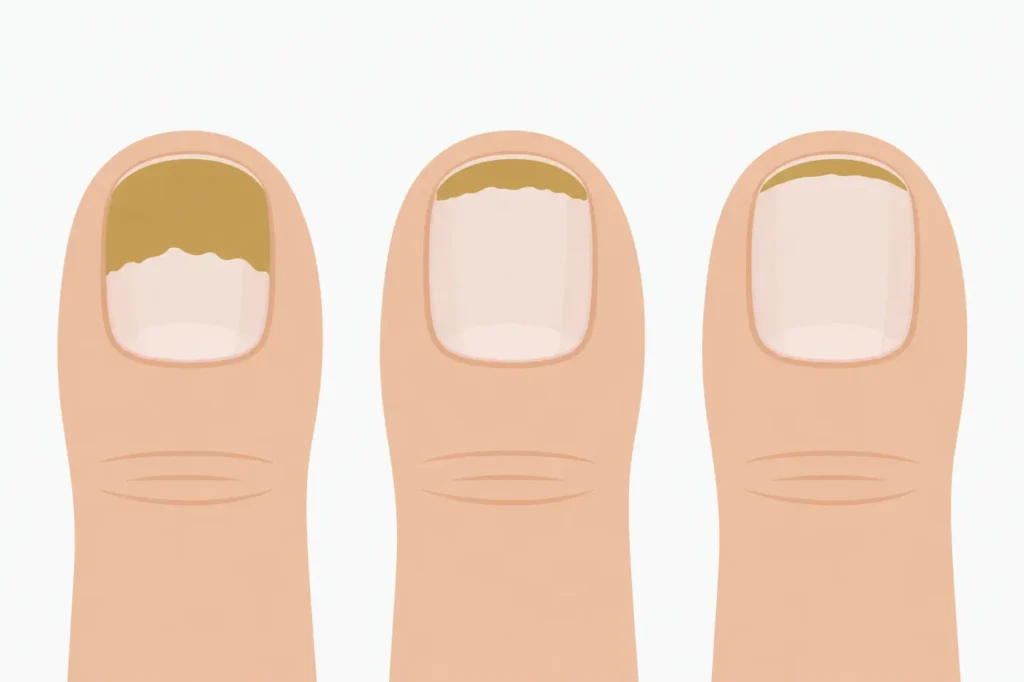
Toenails grow approximately 1–2 mm per month. A toenail takes 12–18 months to fully grow out from base to tip. This growth rate is the same regardless of which treatment you use.

What this means for OTC products:

Nail growth timeline showing a clear toenail slowly replacing the infected tip

Important: OTC topicals cannot adequately penetrate the nail plate to reach the fungus in an established subungual infection. They work best for mild, superficial or perionychial involvement. For moderate to severe cases, a prescription is required. Online prescriptions are available without a clinic visit →

Store-Bought Toenail Fungus Treatment Side Effects and Safety Checks

When a Prescription Beats Any Store-Bought Toenail Fungus Treatment

OTC products have real limits. A prescription is likely needed when:

Prescription topicals like Jublia (efinaconazole) and Kerydin (tavaborole) are FDA-approved specifically for nail onychomycosis. Oral terbinafine achieves approximately 38% complete cure in the FDA label trials — the highest rate of any available treatment.

See online prescription options for nail fungus →

Toenail Fungus Treatment at CVS, Walgreens and Walmart: Common Questions

Topical fluconazole products are not FDA-approved for nail fungus in the US. Oral fluconazole is used off-label for onychomycosis in some cases but requires a prescription and physician supervision due to drug interactions and the need for liver monitoring.

Japanese dermatology uses the same prescription antifungals as Western medicine: oral terbinafine, itraconazole and prescription topicals. Traditional folk accounts include warm vinegar soaks, though these are not supported by clinical trial evidence for nail onychomycosis.

Folk accounts describe apple cider vinegar soaks and herbal oil applications. No clinical trials support these for onychomycosis. They may have mild antimicrobial surface effects but cannot penetrate the nail plate to reach the fungal organisms.

Vicks contains camphor, eucalyptus oil and menthol, which show mild antifungal properties in laboratory tests. A small pilot study reported cosmetic improvement in some nails. Evidence is very limited; it is not an FDA-approved antifungal and cannot substitute for prescription treatment in confirmed infection.

Medical disclaimer: This page is for informational purposes only and does not constitute medical advice. Toenail fungus can mimic other conditions. See a podiatrist or dermatologist for diagnosis and treatment.

Sources

All factual claims on this page are based on the following sources:

  • FDA OTC Monograph: Antifungal Drug Products for Over-the-Counter Human Use. U.S. Food & Drug Administration.
  • Westerberg DP, Voyack MJ. Onychomycosis: current trends in diagnosis and treatment. Am Fam Physician 2013;88(11):762–70. (AAFP prevalence and treatment review)
  • Price information: approximate as of November 2026. Verify at time of purchase.
  • FTC Health Products Compliance Guidance: ftc.gov/business-guidance/resources/health-products-compliance-guidance

Not sure which treatment fits your case?

Our finder covers mild through severe cases — including diabetes and special situations.