Home › Treatments › Tolnaftate for Toenail Fungus

Tolnaftate for Toenail Fungus: What It Does (and Doesn't Do)

Affiliate disclosure: Some links on this page are affiliate links. If you buy through them, we may earn a commission at no extra cost to you. See our disclosure policy →

Plain antifungal cream tube and powder on a bathroom counter, as used for tolnaftate

The Short Answer

Tolnaftate (brand: Tinactin, plus many store-brand generics) is one of the original OTC antifungal ingredients, approved by the FDA for athlete’s foot and ringworm — but it is not FDA-approved to treat toenail fungus (onychomycosis). No OTC product is. Tolnaftate cannot penetrate the nail plate to reach the fungus at the nail bed. Evidence grade for nail use: Limited. For established nail fungus, prescription oral antifungals have far stronger evidence. Tolnaftate may help prevent athlete’s foot from spreading to nails. Talk to your doctor or pharmacist if you have confirmed nail infection.

At a Glance

Evidence Strength (nail use)

StrongModerateLimited ✓Anecdotal

How we grade evidence

Time to Results

4–8 wkMonthlyOngoing12–18 mo
No improvement? Get a diagnosisNails grow ~1–1.5 mmUse on surrounding skin as directedFull toenail grow-out

Key Facts

Status

OTC; not FDA-approved for nails

Cost

~$8–$20 per product

Best for

Athlete’s foot near the nail

Not for

Candida (yeast) or moderate–severe cases

Tolnaftate for Toenail Fungus: How It Works

Tolnaftate is a synthetic antifungal compound first approved by the FDA in the 1960s. It works by distorting fungal hyphae and disrupting the ergosterol biosynthesis pathway — essentially interfering with the building of the fungal cell membrane. It is active against dermatophytes (Trichophyton rubrum, T. mentagrophytes) but not against Candida species. If your nail infection is caused by yeast rather than a dermatophyte, tolnaftate will not address it.

Under the FDA OTC drug monograph for antifungal products (Title 21 CFR Part 333, Subpart C), tolnaftate is an approved active ingredient for athlete’s foot (tinea pedis), ringworm (tinea corporis), and jock itch (tinea cruris). Onychomycosis — fungal nail infection — is not listed in the monograph. No OTC topical antifungal is FDA-approved to treat onychomycosis.

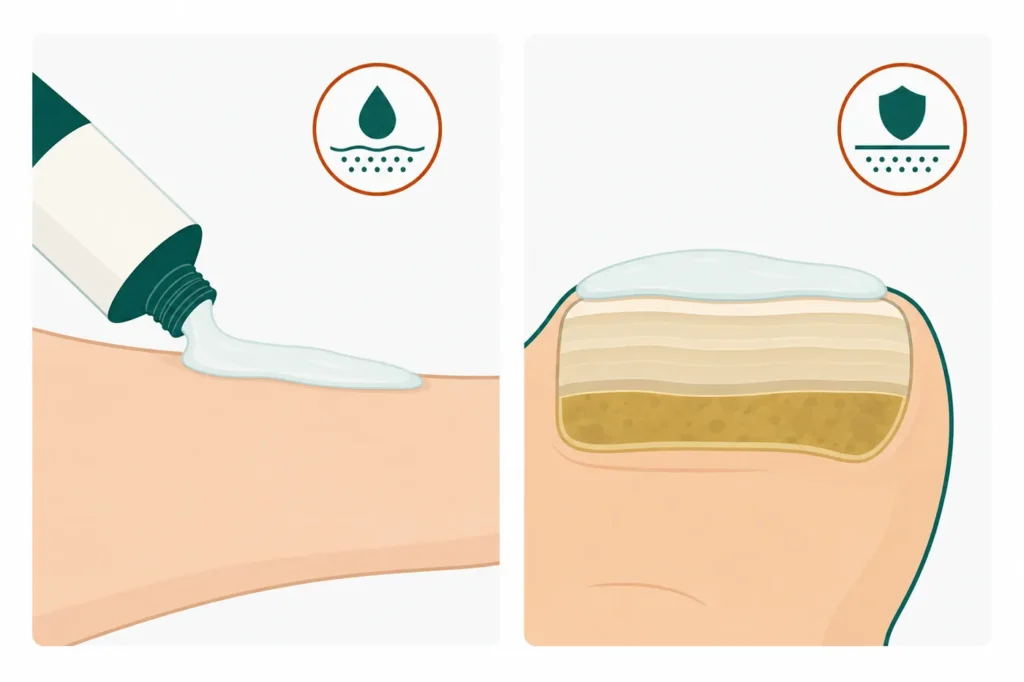
The core limitation for nails is penetration. The toenail plate is dense keratin, 0.5–1.0 mm thick. Tolnaftate 1% solutions and creams are formulated for skin, not for penetrating nail plates. Meaningful drug concentrations at the nail bed — where the fungus lives — are not reliably achieved with standard topical formulations.

Diagram of tolnaftate cream working on skin but blocked by the toenail plate

Does Tolnaftate Work on Toenail Fungus? The Evidence

Limited Evidence   Evidence grade: Limited

No rigorous randomized controlled trial has tested tolnaftate specifically for onychomycosis. The clinical evidence for tolnaftate on nail fungus is limited, consisting of:

  • Athlete’s foot studies: Strong evidence for skin fungal infections where it is indicated. Nail fungus is a structurally different problem.
  • OTC topicals review (PMC7073424): A review of OTC topical antifungals for onychomycosis concluded that nail penetration is the primary barrier; topicals including tolnaftate show limited efficacy for established nail infections.
  • What is missing: No nail-specific RCT, no mycological cure data for onychomycosis, no nail penetration pharmacokinetics for standard tolnaftate formulations.

Where tolnaftate may have a role:

  • Prevention: Applying tolnaftate to skin around nails may help prevent athlete’s foot from spreading to the nail — a reasonable use within its labeled indications.
  • Very early or superficial infections: White superficial onychomycosis affects only the nail surface layer; topicals may have more impact here than in deeper infections. Even so, evidence is not established.
  • Adjunct therapy: Some clinicians suggest OTC topicals alongside prescription oral antifungals, though data are limited.

Bottom line: Tolnaftate is not recommended as a standalone treatment for established toenail fungus. It is a reasonable product for athlete’s foot prevention and skin infections, but does not replace prescription options for confirmed onychomycosis.

How to Use Tolnaftate for Toenail Fungus

If you use tolnaftate around an affected nail — for example, to control athlete’s foot that may be spreading toward the nail — here is how it is typically applied. Note: this is not a proven treatment for established onychomycosis.

Why clearing the skin protects the nail from re-infection is explained in athlete’s foot and toenail fungus.

Important limits: Tolnaftate is not an FDA-approved treatment for onychomycosis. If your primary goal is clearing the nail infection, see a clinician for a confirmed diagnosis and discuss prescription options. Do not delay treatment of an established nail infection by relying on OTC topicals alone.

Tolnaftate Side Effects and Warnings

Tolnaftate is generally well tolerated. Its side effect profile is minimal:

  • Local skin irritation: Mild redness, stinging, or itching at the application site occurs in a small number of users. Usually resolves on stopping use.
  • Contact dermatitis: Rare; discontinue if skin becomes inflamed or blistered.
  • Systemic absorption: Very low with topical use; no significant systemic side effects are reported from topical application.
  • No liver effects: Unlike oral antifungals, tolnaftate does not carry a liver monitoring requirement.

Important warning: Tolnaftate does not cover Candida species. If a nail culture shows yeast (Candida), tolnaftate is the wrong drug. A clinician can identify the organism with a KOH scraping or nail culture, which guides the right choice of treatment.

Who Should Not Use Tolnaftate for Toenail Fungus

If you are unsure whether your nail problem is a fungal infection, see a clinician. Up to half of nails that look like fungus turn out to be nail psoriasis, nail trauma, or another condition — none of which responds to antifungals. A KOH scraping or PAS stain can confirm the diagnosis before you invest in long-term treatment.

Tolnaftate Cost, Generics and Where to Get It

Tolnaftate is widely available OTC without a prescription. Price range is approximately $8–$20 for a standard-sized product.

  • Brand name: Tinactin (tolnaftate 1% cream, powder, spray, solution)
  • Generics: Many store-brand versions are identical in active ingredient and bioequivalent; they cost less.
  • Where to buy: Pharmacies, grocery stores, online retailers.

Important: buying a “nail fungus” OTC product containing tolnaftate does not make it FDA-approved for onychomycosis — the FDA monograph for tolnaftate covers skin infections only. The packaging may describe nail use, but the clinical evidence for established nail infections remains limited.

Tolnaftate vs Other Toenail Fungus Treatments

TreatmentEvidence GradeComplete Cure RateFDA-Approved for Nails
Tolnaftate (OTC)LimitedNot established for onychomycosisNo (approved for athlete’s foot only)
Undecylenic acid (OTC)LimitedNot established for onychomycosisNo (approved for athlete’s foot only)

Prescription treatments, for information only (a doctor or podiatrist can prescribe these):

  • Ciclopirox 8% (Penlac): Evidence Grade: Moderate; Complete Cure Rate: 5.5–8.5% complete mycological cure (FDA label, 48 wks); FDA-Approved for Nails: Yes
  • Terbinafine oral (generic Lamisil): Evidence Grade: Strong; Complete Cure Rate: ~38% at 48 wks (FDA label); FDA-Approved for Nails: Yes
  • Jublia (efinaconazole 10%): Evidence Grade: Moderate; Complete Cure Rate: ~15–18% (JAAD 2013); FDA-Approved for Nails: Yes

No OTC product is FDA-approved to treat onychomycosis. Cure rates are for complete mycological cure; partial improvement rates differ.

How Long Toenail Treatment Takes

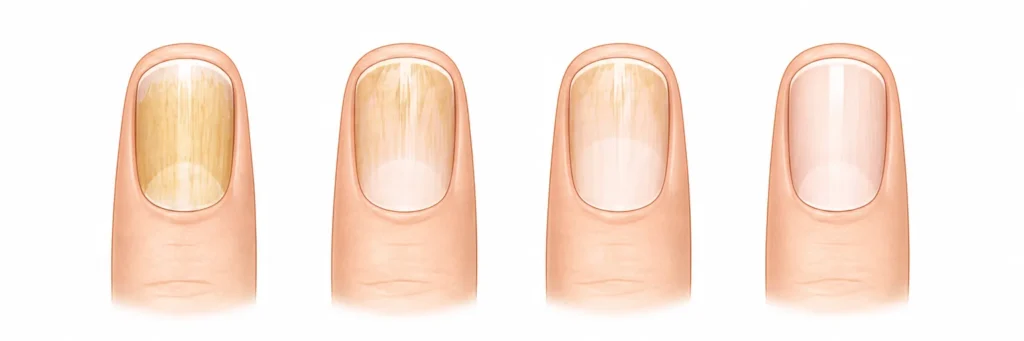
Toenails grow roughly 1–1.5 mm per month. A full toenail takes 12–18 months to grow from base to tip. Any improvement — with any treatment — requires this biology to play out. You will not see a clear nail in weeks regardless of what you apply.

Four toenails showing fungus progression from infected to clear

If you are applying tolnaftate to the nail area and see no sign of improvement after 4–8 weeks, that is a signal to pursue a confirmed diagnosis and prescription treatment.

When to See a Doctor

See a podiatrist or dermatologist if: the nail is thickened, crumbling, or lifting from the bed; more than one nail is affected; you have diabetes, peripheral artery disease, or a weakened immune system; OTC products have not helped after 4–8 weeks on the surrounding skin; or you are unsure whether the problem is fungal. A lab test (KOH scraping or PAS stain) can confirm the diagnosis. Prescription options — oral terbinafine, itraconazole, or FDA-approved topicals — have significantly stronger evidence for established onychomycosis.

Talk to your doctor or pharmacist before starting any antifungal if you are pregnant, breastfeeding, or taking other medications.

Neither tolnaftate nor clotrimazole is a good treatment for established toenail fungus (onychomycosis). Both are OTC topicals approved for skin infections (athlete’s foot, ringworm) — not for nail infections. The key difference is antifungal spectrum: tolnaftate covers only dermatophytes, while clotrimazole also covers Candida. If a nail culture shows Candida, clotrimazole has broader coverage. For confirmed dermatophyte nail infections, prescription oral antifungals have far stronger evidence for both. See all treatment options with evidence grades →

Oral terbinafine requires a liver function test before starting because it can rarely cause liver damage (hepatotoxicity). Doctors also review a patient’s full medication list, since terbinafine interacts with several drugs (including certain antidepressants and beta-blockers via CYP2D6 inhibition). Most healthy adults tolerate it well — it remains the highest-evidence oral treatment for onychomycosis. The hesitancy is about appropriate screening, not about the drug being unusually dangerous for typical candidates. How online prescription services work.

No unique Amish remedy is clinically validated for toenail fungus. Ads and social media posts claiming an “Amish secret” for nail fungus are not supported by evidence. The same antifungal principles apply regardless of origin: for mild skin infections, OTC topicals; for established nail infections, prescription oral antifungals have the strongest evidence.

No treatment eliminates toenail fungus in every patient. Oral terbinafine has the strongest clinical evidence — approximately 38% complete cure in the FDA label trials (Lamisil prescribing information). Itraconazole pulse dosing is an alternative for patients who cannot take terbinafine. Prescription topicals (ciclopirox, Jublia) work for some patients with mild-to-moderate infection. Recurrence is common with any treatment because the same exposure conditions often remain. Prevention — keeping feet dry, changing shoes, treating athlete’s foot promptly — reduces relapse risk.

Medical disclaimer: This page is informational only and not medical advice. Consult a licensed clinician before treating onychomycosis. If you have diabetes or circulatory disease, see a podiatrist before applying any foot treatment.

Sources: FDA Title 21 CFR Part 333 (OTC antifungal drug products monograph); Mayo Clinic, Tolnaftate topical route (drg-20068886, accessed Nov 2026); PMC7073424 (OTC topicals for onychomycosis review); FDA Lamisil (terbinafine tablets) prescribing information, NDA 020539 (~38% complete cure at week 48); Elewski et al., JAAD 2013 (Jublia 15–18%); AAFP 2015 (onychomycosis prevalence 3–12%).

Looking for a treatment with stronger evidence?

Use our finder to match your case to the right option.