Home › What Causes Toenail Fungus
What Causes Toenail Fungus (2026): Risk Factors, Fungi and Prevention
By Best Toenail Fungus Treatments · Reviewed 15 Nov 2026 · 7 min read

Home › What Causes Toenail Fungus
By Best Toenail Fungus Treatments · Reviewed 15 Nov 2026 · 7 min read
Toenail fungus (onychomycosis) is caused by dermatophyte fungi—mainly Trichophyton rubrum—that enter through small cracks in the nail or skin. Warm, moist conditions (shoes, public showers) favor growth. Risk rises with age, diabetes, poor circulation, and immune suppression. It affects 3–12% of adults (AAFP 2015).
How It Takes Hold
| Exposure | Entry | Spread | Return |
|---|---|---|---|
| Warm, moist shoes and public showers | Small cracks in the nail or skin | Often from athlete’s foot to the nail | 20–25% recur within 1 year |
Key Facts
Prevalence
3–12% of adults (AAFP 2015)
Main cause
Trichophyton rubrum (a dermatophyte)
Risk rises with
Age, diabetes, poor circulation
Recurrence
Over 50% at 5 years
Toenail fungus is caused by microscopic fungi that do not require sunlight to survive. The main culprits are dermatophytes—a group that feeds on keratin, the protein that makes up your nails and skin. Trichophyton rubrum accounts for approximately 70–80% of cases. T. mentagrophytes and Epidermophyton floccosum cause most of the rest.
In a minority of cases (roughly 5–10%), onychomycosis is caused by non-dermatophyte molds (Scopulariopsis brevicaulis, Aspergillus) or yeasts (Candida), particularly in patients with diabetes or immune suppression. This distinction matters for treatment: terbinafine works well against dermatophytes but less so against non-dermatophyte molds. Lab confirmation (KOH smear or culture) is essential before starting oral treatment.
Fungi enter through tiny gaps between the nail plate and nail bed, through micro-trauma at the nail edges, or through small skin cracks near the base of the nail. Once established, they digest nail keratin and multiply inside the nail structure. See our full onychomycosis explainer for the clinical detail.
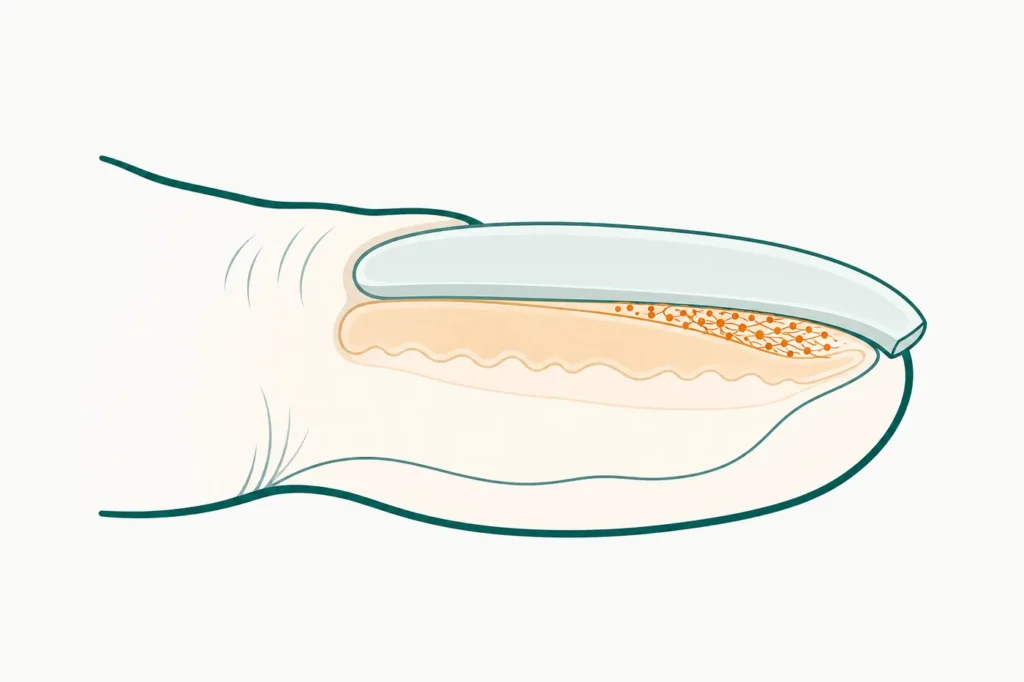
Several factors increase the probability that dermatophytes will establish a nail infection. Understanding your personal risk profile helps direct prevention and early treatment.
Accurate diagnosis matters: several other conditions look like nail fungus, including psoriasis, lichen planus, contact dermatitis, nail bed tumor, and eczema. A potassium hydroxide (KOH) smear or fungal culture from nail scrapings is the standard for confirmation before starting treatment.
Tinea pedis (athlete’s foot) and toenail onychomycosis are caused by the same dermatophytes. Athlete’s foot is frequently the source from which the infection spreads to the toenails—the fungus colonizes the skin of the foot first, then migrates under the free edge of the nail.
The overlap is well documented: in a survey of 2,761 people with toenail fungus, 33.8% also had confirmed athlete’s foot (Szepietowski et al., Arch Dermatol 2006, PMID 17043182). A figure of 30–40% of people with chronic, untreated athlete’s foot going on to develop nail involvement is also widely quoted, but we could not trace it to a primary study, so treat it as a rough clinical estimate. The reverse can also happen: an infected nail reservoir re-seeds athlete’s foot, creating a cycle of reinfection.
Practical implication: treating active athlete’s foot is an essential part of any toenail fungus management plan. OTC antifungal creams (terbinafine 1%, clotrimazole, tolnaftate) applied consistently for 2–4 weeks per label directions will clear most cases of tinea pedis.
We cover the two-way link, how to tell the two apart and how to treat them together in our athlete’s foot and toenail fungus guide.
Environmental exposure is a major factor. Dermatophytes are hardy organisms: they survive on surfaces for weeks and infect through direct contact with contaminated floors, towels, or nail tools.
Any trauma that disrupts the tight seal between the nail plate and nail bed creates an entry route for fungi. Common injury types that increase nail fungus risk:
Toenail fungus has one of the highest recurrence rates of any superficial fungal infection—estimates range from 20–25% at 1 year after apparent clearance to over 50% at 5 years. Several factors drive recurrence:
For treatment options with the strongest evidence, see our complete toenail fungus treatment guide. For home-based prevention approaches, see home remedies for toenail fungus.
No strategy eliminates risk entirely, but consistent hygiene and footwear practices significantly reduce it:
Oral terbinafine (Lamisil) has the strongest evidence: approximately 38% complete cure in the FDA label trials (Lamisil prescribing information). It is a 12-week prescription course. No OTC or home remedy has been shown to match this clearance rate. See our complete treatment guide for a full comparison.
Vicks VapoRub contains thymol and camphor, which have antifungal activity in laboratory tests. A small pilot study (Derby 2011, 25 participants) reported positive response in 18 of 25 participants with daily application—but this was an uncontrolled open-label study. Vicks does not penetrate the nail plate well enough to clear established infection reliably. It may help with very early or superficial infections.
Rarely on its own without treatment. Very mild infections in young, immunocompetent people occasionally self-resolve, but most cases persist and worsen without treatment. The fungus is living inside the nail structure and has no reason to leave without antifungal intervention. Treatment duration is long (12 weeks of medication plus 12–18 months for the nail to grow out) but the infection is curable with appropriate treatment.
Among home remedies for athlete’s foot (not nail fungus), tea tree oil and ACV soaks have some limited evidence. For nail fungus, no natural remedy has demonstrated reliable clearance in a large RCT. Snakeroot extract has the most human data among natural options (small Mexican RCTs vs ciclopirox) but still shows only about 8.6% complete mycological clearance. See home remedies for toenail fungus for the full evidence breakdown.
Medical disclaimer: Informational only. Not a substitute for professional medical advice. Consult a qualified healthcare provider before starting any treatment.
Answer 4 quick questions and see evidence-graded picks for your situation.