Home › Product Reviews › DiabetiDerm Review

DiabetiDerm Toenail and Foot Antifungal Cream Review (2026): FDA Advisory and Honest Verdict

Disclosure: This page contains affiliate links. If you buy through a link on this page we may earn a small commission at no extra cost to you. Our evidence grades are based on published clinical data only. See how we review →

Diabetes foot-care kit with glucose meter, socks and a plain cream tube

FDA Advisory Notice: The FDA has listed Diabeti-Derm Antifungal Cream (by Health Care Products / Hi-Tech Pharmacal) under its warning on illegally sold diabetes treatments. In that letter, the FDA stated that the product, as formulated, labeled and promoted, was an unapproved new drug and was misbranded under federal law. Source: FDA.gov — Illegally Sold Diabetes Treatments, which lists the product under FDA Warning Letter NYK 2013-23 (July 15, 2013) to Health Care Products, Diabetes Care Division, Hi-Tech Pharmacal Co., Inc.. We have included this information as required for accurate review.

Current availability (Nov 2026): DiabetiDerm Toenail & Foot Fungus Antifungal Cream (1.5 oz) is listed by U.S. retailers including H-E-B, Instacart and DoorDash as of November 2026; we have not confirmed stock at each store. The original review dates from 2011–2012. The Amazon search link below may show third-party sellers or no results. If unavailable, see the alternatives section.

Our Verdict

Diabeti-Derm Antifungal Cream was marketed as a cream for people with diabetes who develop nail and foot fungal infections. Current retail labels list its active ingredient as undecylenic acid 10%, an FDA-monograph OTC antifungal for skin fungal conditions (athlete’s foot, ringworm). An earlier version of this review said miconazole nitrate (2%); we could not verify that and have corrected it.

Evidence grade: Anecdotal for the product. Anecdotal for the product itself: no study has tested DiabetiDerm. Its active ingredient, undecylenic acid (10%), has Limited evidence (skin-fungus data, no nail trial). Undecylenic acid 10% is an OTC monograph antifungal for skin conditions, not for subungual onychomycosis. For people with diabetes, the stakes of untreated nail and foot infections are higher — a professional assessment is strongly advised, and a doctor or podiatrist can decide whether prescription treatment is needed.

At a Glance

Evidence Strength (nail-plate infection)

StrongModerateLimitedAnecdotal ✓

How we grade evidence

The Claim vs. the Evidence

The marketing claimWhat the evidence says
Antifungal cream for people with diabetesUndecylenic acid 10% is for skin fungus, not nail-plate infection

Key Facts

FDA

Named in a 2013 FDA warning letter

Active

Undecylenic acid 10%

Availability

Not confirmed (Nov 2026)

With diabetes

See a podiatrist or dermatologist

What Was DiabetiDerm Antifungal Cream?

Diabeti-Derm was a product line marketed specifically at people with diabetes managing skin and nail conditions common in diabetic patients. Current retail labels (H-E-B listing; NDC 61787-558-15 record, November 2026) list the antifungal cream’s active ingredient as undecylenic acid 10%, in a 1.5 oz tube; retailer descriptions also mention tea tree oil and aloe vera. Our earlier description of miconazole nitrate (2%) could not be verified and has been corrected.

The original review (2011–2012) described this as a product that addressed both athlete’s foot and toenail fungus in one product, and that its diabetic-specific marketing positioned it as appropriate for people managing foot care with diabetes.

Diabetiderm Antifungal Cream → Search on Amazon • Buy At Amazon: Diabetiderm Toenail and Foot Anti-Fungal Cream

It was also listed for sale at website (American Diabetes Wholesale).

FDA Advisory: What It Says and What It Means

The FDA has listed Diabeti-Derm Antifungal Cream on its page of illegally sold diabetes treatments. The page links to FDA Warning Letter NYK 2013-23 (July 15, 2013) to Health Care Products, Diabetes Care Division, Hi-Tech Pharmacal Co., Inc.. In that letter, the FDA stated that Diabeti-Derm Antifungal Cream (and two Zostrix diabetic creams), as formulated, labeled and promoted, were unapproved new drugs under section 505(a) of the Federal Food, Drug, and Cosmetic Act, and that Diabeti-Derm was also misbranded.

What this means for consumers:

  • The antifungal active ingredient (undecylenic acid 10%) is a legitimate OTC monograph ingredient for skin fungal conditions
  • The issue is with marketing claims that imply treatment of diabetes complications
  • People with diabetes who have nail or foot fungal infections should see a podiatrist or dermatologist for diagnosis and treatment guidance
  • OTC topicals have limited evidence for established nail infections regardless of underlying health conditions

Source: FDA.gov — Illegally Sold Diabetes Treatments (page content current as of 09/30/2020); FDA Warning Letter NYK 2013-23 (July 15, 2013) to Health Care Products, Diabetes Care Division, Hi-Tech Pharmacal Co., Inc..

Evidence Grade for Undecylenic Acid 10% (DiabetiDerm) for Nail Fungus

Limited Evidence Undecylenic acid 10% is an OTC monograph antifungal for skin conditions (tinea pedis, tinea corporis). Monograph labels must state the product is “not effective on the scalp or nails” (21 CFR 333.250). It is not FDA-approved to treat subungual onychomycosis (nail-plate fungal infection). The nail plate is a dense keratin barrier that limits topical penetration.

People with diabetes and nail/foot fungal infections face higher stakes: peripheral neuropathy can mask pain, and poor circulation slows healing. Professional assessment by a podiatrist or dermatologist is strongly recommended rather than relying on OTC products alone.

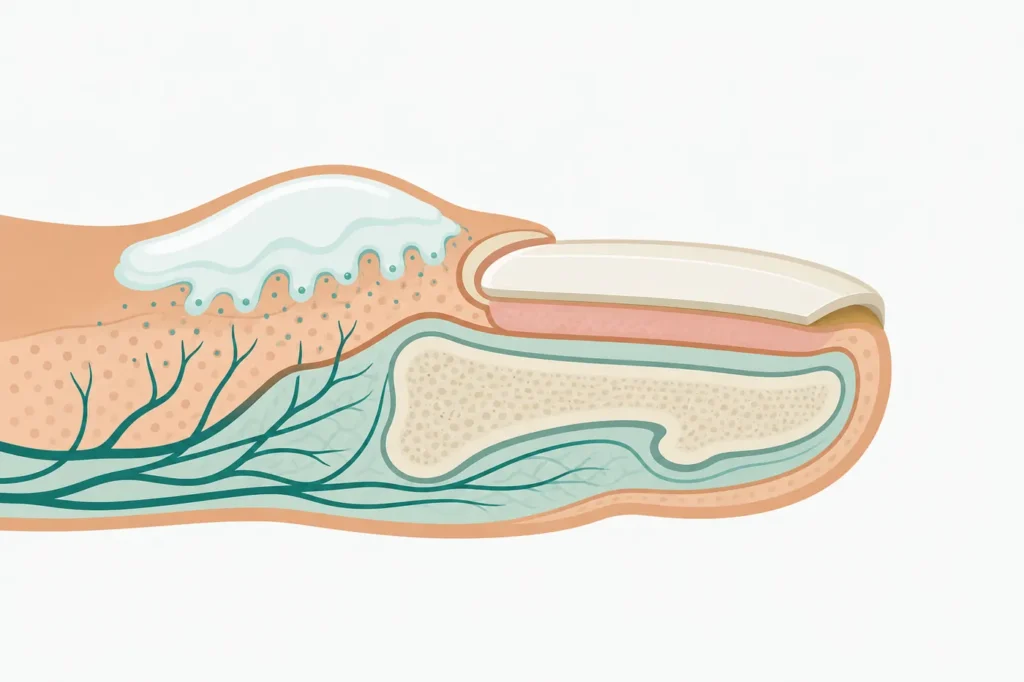
Diagram of an antifungal cream treating skin but not the nail bed

Toenail Fungus and Diabetes: Foot Care That Matters More Than Any Cream

Toenail fungus is more common with diabetes (one survey found 26% of people with diabetes had it; AAFP, 2015), and thick, sharp nails can injure skin you may not feel. The American Diabetes Association’s 2026 Standards of Care recommend a comprehensive foot evaluation at least once a year (Rec. 12.23) and include daily foot inspection in first-line foot care advice. In practice:

  • Look at your feet every day, including between the toes; use a mirror if needed.
  • Ask for a full foot exam at least yearly, and sooner if a nail is thick, lifting or painful.
  • Don’t cut thick nails, ingrown nails or calluses yourself; a podiatrist can trim them safely.
  • Keep feet dry and moisturise dry skin, but not between the toes.
  • Get any redness, swelling, drainage or a new sore checked promptly.

An OTC cream can help athlete’s foot on the skin, but it will not clear an infection inside the nail. Clinicians usually confirm the diagnosis with a lab test and then weigh prescription options. Compare them in our best toenail fungus treatment for diabetics guide and the main best toenail fungus treatment rankings.

Alternatives for Diabetic Patients with Nail Fungus

Important: People with diabetes who have nail or foot infections should consult a podiatrist before self-treating. Prescription antifungals have significantly stronger evidence for clearing established nail infections.

DiabetiDerm Antifungal Cream: Common Questions

Diabeti-Derm was marketed specifically at diabetic patients for foot and nail care. However, the FDA listed it among illegally sold diabetes treatments due to marketing claims that exceeded what an OTC antifungal is approved to do (source: fda.gov/consumers/health-fraud-scams/illegally-sold-diabetes-treatments, as of approx. 2013). People with diabetes who have nail or foot fungal infections should see a podiatrist or dermatologist for assessment and treatment guidance.

Current labels list undecylenic acid 10% as the active antifungal ingredient (H-E-B listing; NDC 61787-558-15, November 2026). Undecylenic acid is an OTC monograph antifungal for skin fungal conditions but is not approved to treat established nail-plate onychomycosis.

Yes. In November 2026 the DiabetiDerm Toenail & Foot Fungus Antifungal Cream (1.5 oz) was listed by retailers including H-E-B, Instacart and DoorDash. The separate DiabetiDerm Foot Rejuvenating Cream is a moisturiser, not an antifungal.

The evidence is limited. Its active ingredient, undecylenic acid 10%, is an OTC antifungal for skin, and OTC antifungal labels state they are not effective on nails (21 CFR 333.250). It may help athlete’s foot around the nail, but an infection in the nail plate usually needs a prescription.

Start with a foot exam and a lab test to confirm it is fungus. Clinicians weigh oral terbinafine or a prescription topical against your other medicines, liver health and circulation. See our diabetic treatment guide.

Medical disclaimer: This page is for informational purposes only and does not constitute medical advice. See a podiatrist or dermatologist for diagnosis and treatment.

Sources

  • FDA.gov. Illegally Sold Diabetes Treatments. https://www.fda.gov/consumers/health-fraud-scams/illegally-sold-diabetes-treatments (content current as of 09/30/2020). FDA Warning Letter NYK 2013-23 (July 15, 2013) to Health Care Products, Diabetes Care Division, Hi-Tech Pharmacal Co., Inc..
  • FDA OTC Antifungal Monograph M005, accessdata.fda.gov (2021)
  • American Diabetes Association Standards of Medical Care in Diabetes (2023)
  • Westerberg DP, Voyack MJ. Onychomycosis: current trends in diagnosis and treatment. Am Fam Physician 2013;88(11):762–70.
  • H-E-B retailer listing. DiabetiDerm Toenail & Foot Fungus Antifungal Cream: active ingredient undecylenic acid 10% (accessed 17 Nov 2026). heb.com
  • NDC 61787-558-15 record (Health Care Products): antifungal cream, undecylenic acid 10%, 1.5 oz (42 g), OTC monograph. pharmacompass.com
  • U.S. FDA photo record, “Illegally Sold Diabetes Treatments – Diabeti-Derm Antifungal Cream”. flickr.com/photos/fdaphotos
  • American Diabetes Association. 12. Retinopathy, Neuropathy, and Foot Care: Standards of Care in Diabetes—2026. Diabetes Care 2026;49(Suppl 1):S261–S276 (Rec. 12.23). pmc.ncbi.nlm.nih.gov
  • 21 CFR 333.250, Labeling of topical antifungal drug products (directions: twice daily; “not effective on the scalp or nails”). ecfr.gov
  • Ferrari J. Fungal toenail infections. Am Fam Physician 2015;92(2):132–133.

Not sure which treatment fits your case?

Our finder covers mild through severe cases — including diabetes and special situations.