Home › Laser Treatment › Best Home Laser Device

Best Home Laser Device for Toenail Fungus (2026): What to Know Before You Buy

Affiliate disclosure: Some links on this page are affiliate links. If you buy through them, we may earn a commission at no extra cost to you. See our disclosure policy →
Podiatry clinic laser device beside an exam chair, used for laser treatment of toenail fungus

The Short Answer

At-home laser and LED light devices offer a drug-free, convenient option for mild toenail fungus, but the clinical evidence is Limited, and marketing claims range from “clears nails in weeks” to “FDA-cleared treatment.” Consumer devices use low-level laser or LED light (typically 460–470 nm blue and 905–930 nm infrared). None are FDA-cleared to treat onychomycosis. The only device FDA-cleared for “temporary increase of clear nail” in onychomycosis patients is the professional Lunula Laser (Erchonia, 510(k) K153164, June 2016) — an in-office device. Home devices have lower power output than professional units. No home device has completed the same level of clinical trial. For established infection, prescription oral terbinafine has far stronger evidence.

At a Glance

Top Pick Evidence

StrongModerateLimited ✓Anecdotal

How we grade evidence

Key Facts

Top pick

None qualifies (Nov 2026)

FDA status

No home device cleared for nail fungus

Price range

$50–$300 (consumer devices)

Options compared

Home device, in-office laser, oral Rx

Best Home Laser Device for Toenail Fungus: Our Top Picks at a Glance

Honest note before you buy: No consumer home laser device has FDA clearance to treat onychomycosis. The clinical evidence for home devices is Limited. As of 16 Nov 2026 no home device we reviewed qualifies as a pick (see the update below); results are not guaranteed and no comparison to prescription antifungals has been conducted.

PickDeviceWavelengthEvidencePrice
No pick (Nov 2026)Home toenail laser devices on Amazon (search; none endorsed)VariesLimitedVaries
Browse more optionsHome laser devices on AmazonVariesLimitedVaries

These are affiliate links. We may earn a commission at no extra cost to you. No consumer home laser is FDA-cleared to treat onychomycosis. Prices change; check current pricing on Amazon.

How We Graded Each Home Laser Pick

We evaluated devices on the following criteria. We did not conduct hands-on testing. We do not have independent lab results for any device.

Our Home Laser Picks, Reviewed One by One

Why We No Longer Name a Home Laser Device (Nov 2026)

Limited Evidence   Evidence grade: Limited

Wavelengths: 470 nm blue light + 905 nm infrared. The 470 nm blue wavelength targets surface-level photobiomodulation; 905 nm near-infrared penetrates deeper tissue. This wavelength combination is similar to the approach used in professional low-level laser systems, but at consumer power levels, which are significantly lower than clinical devices.

FDA status: Not FDA-cleared for onychomycosis. Consumer devices in this category are typically registered as general wellness products, not as Class II medical devices with 510(k) clearance for nail fungus.

Manufacturer claims: Claims include “noticeable improvements within 4–6 weeks” and thermal nail heating to 43–51°C. These are seller claims; no independent clinical trial supports them specifically for this device.

Who it may suit: Individuals with mild, early-stage superficial discoloration who prefer drug-free options and understand the evidence limitations. Not a substitute for prescription treatment in established infection.

Who should skip it: Anyone with moderate to severe onychomycosis, diabetics without medical guidance, or anyone expecting reliable mycological cure.

Update, 16 Nov 2026: The easheal device we previously listed (ASIN B0DMWCF37C) is no longer available on Amazon. A search that day found only unbranded “nail care light” listings with small review counts and no FDA clearance shown on the listing, so no home laser device we reviewed currently qualifies as a pick. For laser with better evidence, see in-clinic options such as the Lunula laser, or prescription treatment. If you still want to browse, here are home toenail laser devices on Amazon (we do not endorse any of them).

Best Home Laser Device for Toenail Fungus: Comparison Table

Device typeFDA statusEvidenceTypical costWho it suits
Consumer home laser/LED (clip-on, handheld)Not FDA-cleared for onychomycosisLimitedCheck current price ($50–$300 range)Mild superficial cases; drug-averse patients
Lunula Laser (in-office, Erchonia)FDA-cleared K153164: “temporary increase of clear nail”Limited$500–$1,500 per course (in clinic)Patients who cannot tolerate oral antifungals
Prescription oral terbinafineFDA-approved for onychomycosis (oral)Strong$10–$40 / month (generic, discount card)Moderate to severe onychomycosis; best cure rate

FDA-cleared and FDA-approved are different standards. FDA clearance = substantial equivalence to a predicate device. FDA approval = demonstrated safety and efficacy through clinical trials. No consumer home laser is cleared OR approved for onychomycosis.

Features to Compare When Buying a Home Laser

How Long a Home Laser Takes to Work (Nail Growth Timeline)

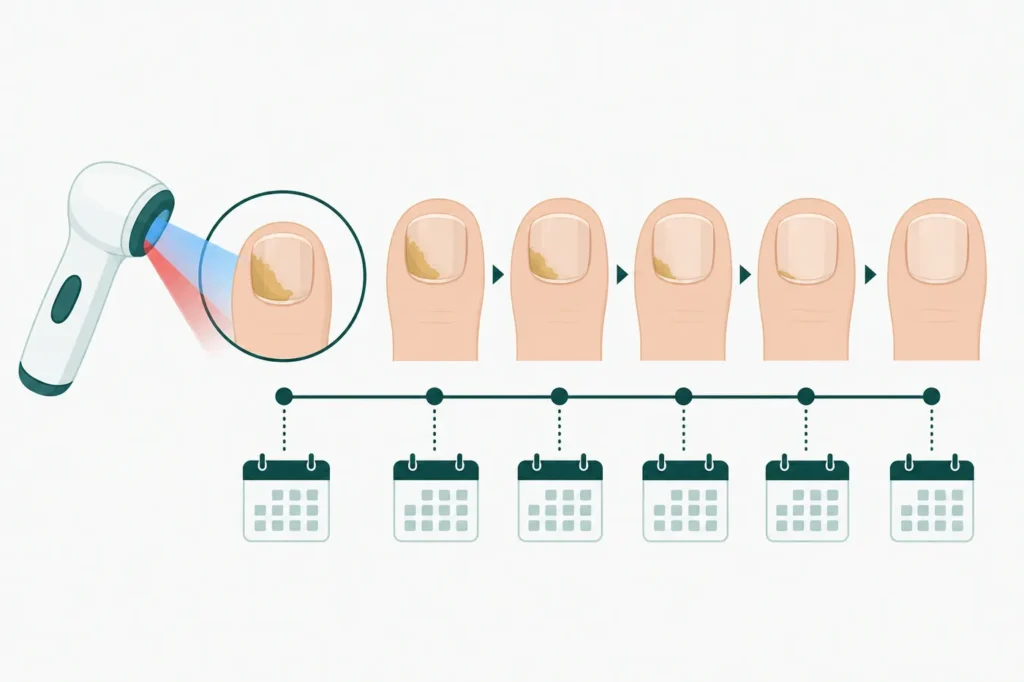
Toenails grow roughly 1–1.5 mm per month. A full toenail takes 12–18 months to grow from base to tip. Any genuine treatment must wait for biology to clear the visible infection. You will not see a fully clear nail in 4–6 weeks regardless of the device or treatment. Look for new clear nail growing at the base of the nail as a sign of progress.

Illustration of a home light device and the slow grow-out timeline of a treated toenail
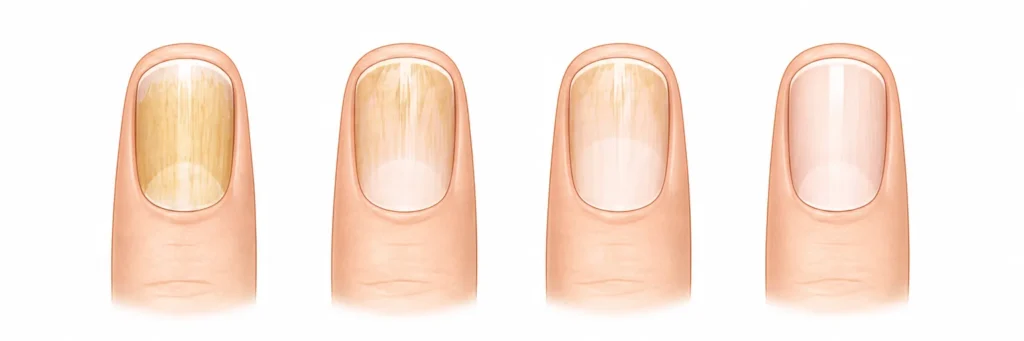
Four toenails showing fungus progression from infected to clear

If you see no new clear nail growth after 3 months of consistent use, that is a signal to pursue a prescription option.

Home Laser Side Effects and Safety Checks

  • Eye safety: Do not look directly at the laser diode. Most consumer devices are low-power enough to be safe with normal use, but protect your eyes from direct exposure.
  • Skin sensitivity: Some users report mild warmth or redness. Stop use if you experience pain or burns.
  • Contraindications: Do not use over open wounds, inflamed skin, or cancerous lesions. Not for use in pregnancy. Patients with photosensitizing conditions should consult a clinician first.
  • Diabetics: Any foot treatment in diabetic patients requires medical supervision. Do not self-treat without clinician guidance.
  • No effect on systemic infection: Light devices treat the nail surface area only. If you have a systemic fungal condition, see a clinician.

When a Prescription Beats Any Home Laser

Home laser devices are a reasonable experiment for mild, superficial discoloration with no confirmed infection. For anything more, a prescription antifungal is superior.

When to See a Doctor

See a podiatrist or dermatologist before buying a device if: you have diabetes or vascular disease, you have not confirmed the diagnosis with a lab test, the nail is painful, lifting, or separating, or more than three nails are affected. A KOH scraping or culture rules out psoriasis and trauma, both of which will not respond to antifungal or laser treatment.

Consumer home laser and LED devices have Limited clinical evidence for onychomycosis. No consumer device has FDA clearance for treating nail fungus. The only FDA-cleared device for “temporary increase of clear nail” is the professional Lunula Laser (in-office). Home devices may offer modest cosmetic improvement for mild cases but cannot be expected to achieve mycological cure in established infection.

The Lunula Laser (Erchonia) is a professional in-office low-level laser system. It holds FDA 510(k) clearance K153164 (June 2016) for “temporary increase of clear nail” in onychomycosis patients. It is not available as a consumer home device. The clearance is for temporary nail improvement, not a cure for onychomycosis.

Professional in-office laser (Nd:YAG, diode, Lunula) heats and disrupts fungal cells beneath the nail plate. Courses typically require 3–4 sessions at $200–$500 each. Clinical evidence shows modest benefit; cure rates vary widely (0–74% across studies). Most clinical guidelines do not list laser as first-line. For home devices, clinical evidence is Limited and no device is FDA-cleared for the indication. Full laser treatment guide →

No single treatment guarantees 100% eradication. The highest clinical cure rate belongs to oral terbinafine (~38% complete cure in the FDA label trials; Lamisil prescribing information). No OTC product, home laser, or home remedy matches this evidence. Nothing kills toenail fungus instantly — plan 12–18 months for the nail to regrow clear.

Medical disclaimer: This page is informational only and not medical advice. Consult a licensed clinician before treating onychomycosis. If you have diabetes or circulatory disease, see a podiatrist before any foot treatment.

Sources: FDA 510(k) K153164 — Erchonia Lunula Laser clearance, June 2016 (temporary increase of clear nail, not cure); FDA Lamisil (terbinafine tablets) prescribing information, NDA 020539 (~38% complete cure at week 48); PMC11151181 (2024 laser systematic review, 0–74% reported cure rates); Footnanklecenters.com (clinical context, 2026).

Ready to match your case to the right treatment?

Use our finder to get a personalized recommendation.