Amorolfine 5% nail lacquer, sold as Loceryl and Curanail, is the antifungal nail paint UK pharmacists most often suggest for a mild fungal nail infection. You paint it on once a week for 6 to 12 months. It is easy to use and rarely causes side effects, but the evidence that it clears an established toenail infection on its own is weak. It is also not FDA-approved, so it isn’t sold in US pharmacies. Here is what the trials show and how it compares with the US options.
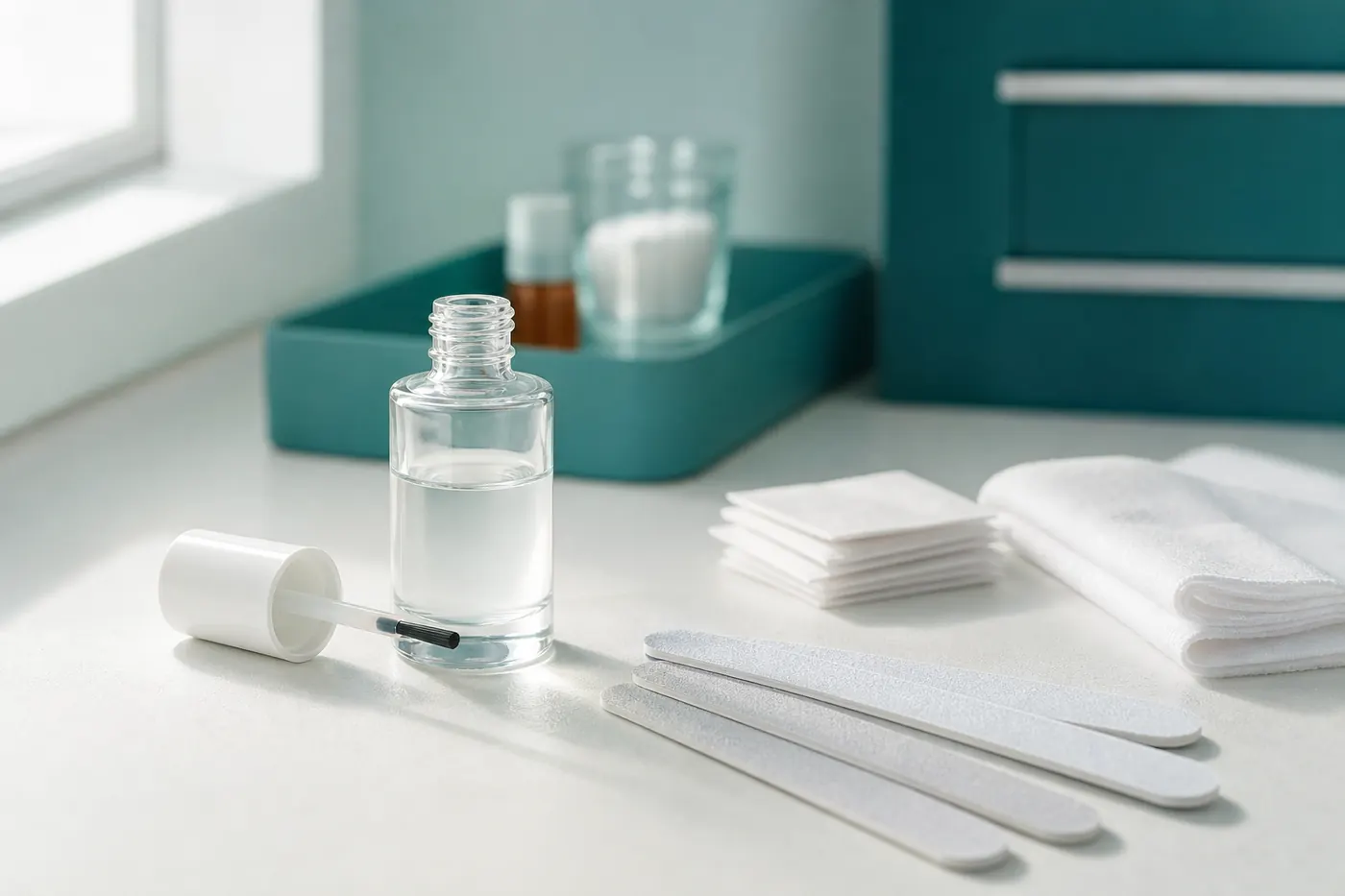
Amorolfine at a Glance
Amorolfine at a glance (information only):
- What it is: Amorolfine 5%, a morpholine antifungal in a quick-drying nail lacquer
- Brand names: Loceryl, Curanail (UK and much of Europe)
- How often: Once a week; twice a week “may prove beneficial in some cases” (Loceryl SmPC)
- How long: In general about 6 months for fingernails and 9 to 12 months for toenails (Loceryl SmPC)
- US status: Not approved by the FDA for onychomycosis (DrugBank)
- Evidence: Limited for toenails: 2.92% complete cure at week 60 in the amorolfine arm of a 2022 randomised trial
What Is Amorolfine and How Does It Work?
Amorolfine belongs to the phenylpropyl morpholine class of antifungals. It works against the dermatophytes, yeasts and moulds that cause most nail infections (Reinel & Clarke 1992; PMID: 1458665). The UK product licence lists onychomycosis caused by dermatophytes, yeasts and moulds as its use.
The lacquer forms a film on the nail. According to the Loceryl Summary of Product Characteristics (SmPC), amorolfine “penetrates into and diffuses through the nail plate” toward the nail bed, and very little reaches the bloodstream. In one early trial, blood levels measured in 19 patients were all below the test’s detection limit of 0.5 ng/ml (Reinel 1992; PMID: 1532336). That low absorption is the main reason it is so well tolerated.
Is Amorolfine the NHS Recommendation for Fungal Nails?
In the UK it is the usual first step for a mild infection. The NHS says a pharmacist may suggest “an antifungal nail medicine that you brush onto the affected nail”, used daily or weekly depending on the type, for 6 to 12 months. A GP can prescribe antifungal tablets if pharmacy treatments haven’t worked.
So amorolfine is the first-line pharmacy option, not the first-line treatment overall. UK primary-care guidance based on NICE Clinical Knowledge Summaries offers oral terbinafine for a confirmed infection when self-care and topical treatment aren’t successful or appropriate (NHS Forth Valley antimicrobial guidance). UK online pharmacies list the 3 ml Curanail pack as a pharmacy medicine for adults with a mild infection of one or two nails (The Independent Pharmacy, Curanail product page, as of November 2026). If more nails are involved, see a GP instead.
For how US and UK guidance compare, see what doctors and podiatrists recommend for toenail fungus.
How Well Does Amorolfine Work on Toenails?
The answer depends heavily on which study you read and how “success” was defined.
The amorolfine studies, in brief:
- Reinel 1992 (PMID: 1532336): what was tested: Open, randomised; 456 patients (fingernails and toenails); once vs twice weekly for up to 6 months; result: Overall cure (the study’s own definition) 46.0% once weekly vs 54.2% twice weekly; mycological cure 70.6% vs 76.1%
- Blume-Peytavi 2022 (PMID: 34752667): what was tested: Open-label amorolfine arm (137 patients) in a trial of mild-to-moderate toenail infection; 48 weeks; result: Complete cure (clear nail plus negative lab tests) 2.92% at week 60
- Cochrane review, Foley 2020 (PMID: 31978269): what was tested: 56 trials of topical and device treatments for toenails; result: A ciclopirox hydrolacquer was probably more effective than ciclopirox 8% lacquer or amorolfine 5% for complete cure (RR 2.43); no difference in mycological cure
- Baran 2000 (PMID: 10848743): what was tested: Severe toenail infection involving the matrix; weekly amorolfine plus oral terbinafine vs terbinafine alone; result: Combined clinical and mycological response at 18 months: 72.3% with amorolfine plus 12 weeks of terbinafine vs 37.5% with terbinafine alone
The older 1992 results look impressive, but that study was open-label, mixed fingernails with toenails, and used looser endpoints than modern trials. The 2022 trial used the strict “complete cure” endpoint that US regulators require, and amorolfine reached under 3%. A 2015 review concluded that amorolfine and ciclopirox lacquers are useful, but that “their usage in monotherapy should be limited”, and that adding a lacquer to oral terbinafine or itraconazole improves results (Tabara 2015; PMID: 25821426).
Our reading: amorolfine is a reasonable choice for an early infection near the tip of one or two nails, or as an add-on to tablets. It is a poor bet on its own for a thick nail or one where the infection reaches the base.
Amorolfine vs Ciclopirox vs Jublia vs Tavaborole
These figures come from different trials with different patients, so treat them as a rough guide rather than a head-to-head ranking.
How the nail lacquers and prescription topicals compare (information only, not a recommendation; trials differ, so treat this as a rough guide):
- Amorolfine 5% (Loceryl, Curanail): how it’s used: Once weekly, 9 to 12 months for toenails; US status: Not FDA-approved; complete cure in key trials: 2.92% at week 60 (Blume-Peytavi 2022)
- Ciclopirox 8% (Penlac and generics): how it’s used: Daily; layers removed weekly; up to 48 weeks; US status: Prescription; complete cure in key trials: 5.5% and 8.5% at week 48 (FDA label)
- Efinaconazole 10% (Jublia and generics): how it’s used: Daily for 48 weeks; US status: Prescription; complete cure in key trials: 17.8% and 15.2% at week 52 (FDA label)
- Tavaborole 5% (generic; Kerydin brand discontinued): how it’s used: Daily for 48 weeks; US status: Prescription; complete cure in key trials: 6.5% and 9.1% at week 52 (FDA label)
The practical difference is the routine: amorolfine is once a week, while the US prescription topicals are daily. Read more in our guides to ciclopirox, Jublia, Kerydin (tavaborole) and Jublia vs Kerydin.
Can You Buy Amorolfine in the US?
Not from a US pharmacy. Amorolfine nail lacquer is not approved for onychomycosis in the United States or Canada (DrugBank). Some overseas online pharmacies will ship it, but bringing in an unapproved medicine falls under the FDA’s personal importation rules, so read the FDA guidance on personal importation first. Buying from an unregulated seller also means you can’t be sure what’s in the bottle.
The US options that fill the same role are the prescription lacquers and solutions above. A doctor or a telehealth service can prescribe them. No over-the-counter product is FDA-approved to treat nail fungus. If you want to compare OTC nail products anyway, see our antifungal nail polish and best OTC treatments guides.
How to Apply Amorolfine Nail Lacquer
These steps follow the Loceryl SmPC.
- File first. Before the first coat, file down the affected areas of the nail, especially the surface, as thoroughly as you can.
- Clean and degrease. Wipe the nail with the cleaning pad or an alcohol swab.
- Paint the whole nail. Use the applicator to cover the entire affected nail and let it dry. Clean the applicator afterwards.
- Repeat weekly. Before each new coat, remove any remaining lacquer with an alcohol swab and file again as needed.
- Keep files separate. Never use the file from an infected nail on healthy nails.
- Cosmetic polish is allowed. Wait at least 10 minutes after the lacquer. Don’t use artificial nails during treatment.
- Keep it off the skin. The lacquer shouldn’t be applied to the skin around the nail. Treat any athlete’s foot on the skin with a suitable antifungal cream.
- Don’t stop early. Continue without interruption until the nail has grown back healthy, with a review about every 3 months.
A toenail takes about 12 to 18 months to grow out completely, so judge progress by clear nail growing in at the base. Our guide on trimming fungal toenails shows how to thin a thick nail safely.
Side Effects and Who Shouldn’t Use It
- Side effects are rare. The SmPC lists nail discoloration and broken or brittle nails (which can also come from the infection), very rarely a burning feeling, and occasional allergic skin reactions.
- Children: the SmPC says children shouldn’t be treated because of a lack of clinical experience.
- Pregnancy and breastfeeding: experience is limited, and the SmPC says amorolfine shouldn’t be used “unless clearly necessary”. See toenail fungus treatment during pregnancy and breastfeeding.
- Diabetes or poor circulation: see a clinician before self-treating any foot problem.
When to See a Doctor Instead
Get a nail test before months of treatment. Only about half of abnormal-looking nails are actually fungal; psoriasis and injury can look the same (Gupta, Drugs Aging 2000; PMID: 10939306). See how toenail fungus is diagnosed. You should also see a doctor or podiatrist if more than two nails are affected, the infection reaches the base of the nail, the nail is painful, or amorolfine hasn’t helped after several months. For every option ranked by evidence, see our best toenail fungus treatment guide.
Options You Can Buy Without a Prescription
Amorolfine is not sold in the US, and we can’t prescribe or sell prescription medicine. If you want to start with something you can buy today, these are the best options available without a prescription. They have weaker evidence than prescription treatment, so they suit mild cases or work alongside a doctor’s plan. If you have diabetes, poor circulation or a painful, spreading infection, see a podiatrist first.
- Fungi-Nail (undecylenic acid solution with a brush): Anecdotal evidence as a product; its active, undecylenic acid, has Limited evidence. The closest US shelf option to a brush-on lacquer routine.
- Lamisil AT cream (terbinafine 1%, OTC): Limited evidence for nails, since its approval data are for skin fungus. Use it on the skin around the nail to stop the infection spreading back.
- Kerasal Nail Renewal (urea and lactic acid): Anecdotal evidence as a product; urea has Limited evidence. It improves the look of thick, discoloured nails; pair it with an antifungal.
Frequently Asked Questions
Is amorolfine effective for toenail fungus?
It can help an early infection near the tip of the nail, but the evidence for toenails is weak. In a 2022 randomised trial, 2.92% of people using amorolfine for 48 weeks had a complete cure (clear nail and negative lab tests) at week 60. It works better as an add-on to oral terbinafine.
Can I buy amorolfine over the counter?
In the UK, yes: small packs such as Curanail 3 ml are pharmacy medicines for adults with a mild infection of one or two nails. In the US, amorolfine is not FDA-approved, so it isn’t sold in pharmacies.
Is Curanail the same as Loceryl?
Both contain amorolfine 5% as a nail lacquer. They are different brands of the same active ingredient.
Can I wear nail polish over amorolfine?
Yes. The Loceryl product information allows cosmetic polish at least 10 minutes after applying the lacquer. Remove both before the next weekly coat. Don’t wear artificial nails during treatment.
How long does amorolfine take to work?
Expect 6 months for fingernails and 9 to 12 months for toenails. The NHS says it may take several months before you see an improvement. Look for clear, healthy nail growing in at the base.
Sources
- Galderma (U.K.) Ltd. Loceryl 5% w/v Medicated Nail Lacquer: Summary of Product Characteristics (emc).
- NHS. Fungal nail infection.
- NHS Forth Valley. Fungal nail infection: primary care antimicrobial guidance (based on NICE CKS).
- Reinel D, Clarke C. Comparative efficacy and safety of amorolfine nail lacquer 5% in onychomycosis, once-weekly versus twice-weekly. Clin Exp Dermatol. 1992;17 Suppl 1:44–9. PMID: 1458665
- Reinel D. Topical treatment of onychomycosis with amorolfine 5% nail lacquer: comparative efficacy and tolerability of once and twice weekly use. Dermatology. 1992;184 Suppl 1:21–4. PMID: 1532336
- Blume-Peytavi U, et al. A multicentre, randomised… study (versus amorolfine 5%) to evaluate the efficacy and safety of terbinafine 10% nail lacquer in the treatment of onychomycosis. Mycoses. 2022;65(4):392–401. PMID: 34752667
- Foley K, et al. Topical and device-based treatments for fungal infections of the toenails. Cochrane Database Syst Rev. 2020;1:CD012093. PMID: 31978269
- Baran R, et al. A randomized trial of amorolfine 5% solution nail lacquer combined with oral terbinafine compared with terbinafine alone… Br J Dermatol. 2000;142(6):1177–83. PMID: 10848743
- Tabara K, et al. Amorolfine vs. ciclopirox: lacquers for the treatment of onychomycosis. Postepy Dermatol Alergol. 2015;32(1):40–5. PMID: 25821426
- Gupta AK. Onychomycosis in the elderly. Drugs Aging. 2000;16(6):397–407. PMID: 10939306
- DrugBank. Amorolfine (DB09056).
- FDA labels (DailyMed): ciclopirox topical solution 8%; JUBLIA (efinaconazole) topical solution 10%; tavaborole topical solution 5%, Clinical Studies sections.
- The Independent Pharmacy. Curanail (accessed November 2026).
See also: Ciclopirox for Toenail Fungus | Oral vs Topical Treatment | All Treatment Options
This article is for information only and is not medical advice.