Home › Product Reviews › NONYX vs Kerasal

NONYX Nail Gel vs Kerasal (2026): Which OTC Product Actually Helps?

Affiliate disclosure: Some links on this page are affiliate links. If you buy through them, we may earn a commission at no extra cost to you. See our disclosure policy →
Two plain unbranded nail treatment bottles side by side on a bathroom counter, comparing two OTC options

The Short Answer

Both NONYX Nail Gel and Kerasal Fungal Nail Renewal are widely sold OTC topical products, stocked at major pharmacies, designed to improve the appearance of thick, discolored, or fungus-damaged toenails. Neither is FDA-approved to treat onychomycosis (nail fungus). No OTC product is. NONYX uses ethanoic acid (acetic acid) — evidence grade: Anecdotal for the product (no product study; cosmetic data only). Kerasal uses urea and lactic acid — evidence grade: Anecdotal for the product (urea: Limited). If you have confirmed nail fungus, prescription options have significantly stronger clinical evidence.

At a Glance

Side by Side

NONYX Nail GelKerasal Fungal Nail Renewal
Ethanoic (acetic) acid; Anecdotal (no product study; cosmetic data only); ~$15–$30Urea 10% + lactic acid; Anecdotal (urea: Limited); ~$15–$25

Key Facts

Thick, brittle nails

Kerasal (urea softens)

Cosmetic clarifying

NONYX (pH reduction)

Stronger evidence

Tie: both Anecdotal as products (cosmetic endpoints)

Confirmed infection

Neither; oral terbinafine ~38% complete cure

Evidence for nail use: NONYX Anecdotal, Kerasal Anecdotal (no product trials; Kerasal’s urea is Limited for appearance). How we grade evidence

NONYX Nail Gel vs Kerasal: Side-by-Side Comparison Table

NONYX Nail GelKerasal Fungal Nail Renewal
Active ingredientEthanoic acid (acetic acid)Urea 10% + undecylenic acid (antifungal version) OR urea + salicylic acid (cosmetic version)
MechanismpH reduction; inhibits fungal environment; cosmetic nail clarificationNail softening (urea); antifungal action (undecylenic acid, where present)
FDA-approved for nail fungusNoNo
Evidence grade (nail use)LimitedLimited
Primary benefitCosmetic nail clarification; nail debris reductionSoftens/thins thick nails; mild antifungal surface action
Typical price~$15–$30~$15–$25
Where to buyAmazon, Walmart, pharmaciesAmazon, CVS, Walgreens, Walmart

No OTC product is FDA-approved to treat onychomycosis. Evidence grades reflect the strength of clinical evidence for nail fungus specifically.

How NONYX Nail Gel Works on Toenail Fungus

Anecdotal Evidence   Evidence grade for nail use: Anecdotal (cosmetic data only)

NONYX Nail Gel’s sole active ingredient is ethanoic acid — the common name for acetic acid, the main component of white vinegar. The proposed mechanism is pH reduction: by lowering the nail’s surface pH, NONYX aims to create an environment less hospitable to dermatophyte fungi, which tend to thrive in a more alkaline environment.

What the evidence shows:

  • Acetic acid (vinegar) has shown antifungal activity against dermatophytes in lab studies at concentrations of 2–5%. However, lab activity does not automatically translate to clinical efficacy in a nail plate.
  • The nail plate is a dense keratin structure. Penetration by any topical — including acetic acid — is very limited without a delivery system designed to break through the keratin barrier.
  • Ethanoic acid is not an FDA-registered antifungal active ingredient and is not covered by any OTC antifungal drug monograph.
  • No randomized controlled trial has tested NONYX Nail Gel against placebo for onychomycosis with mycological confirmation.

NONYX’s most visible effect is cosmetic: regular application clears nail debris and discoloration (the keratolytic breakdown of nail material), making nails appear lighter and cleaner. This can be a useful cosmetic benefit while awaiting proper treatment, but it is not evidence of mycological clearing. See our full NONYX Nail Gel review →

How Kerasal Fungal Nail Renewal Works on Toenail Fungus

Anecdotal Evidence   Evidence grade for nail use: Anecdotal for the product (urea: Limited)

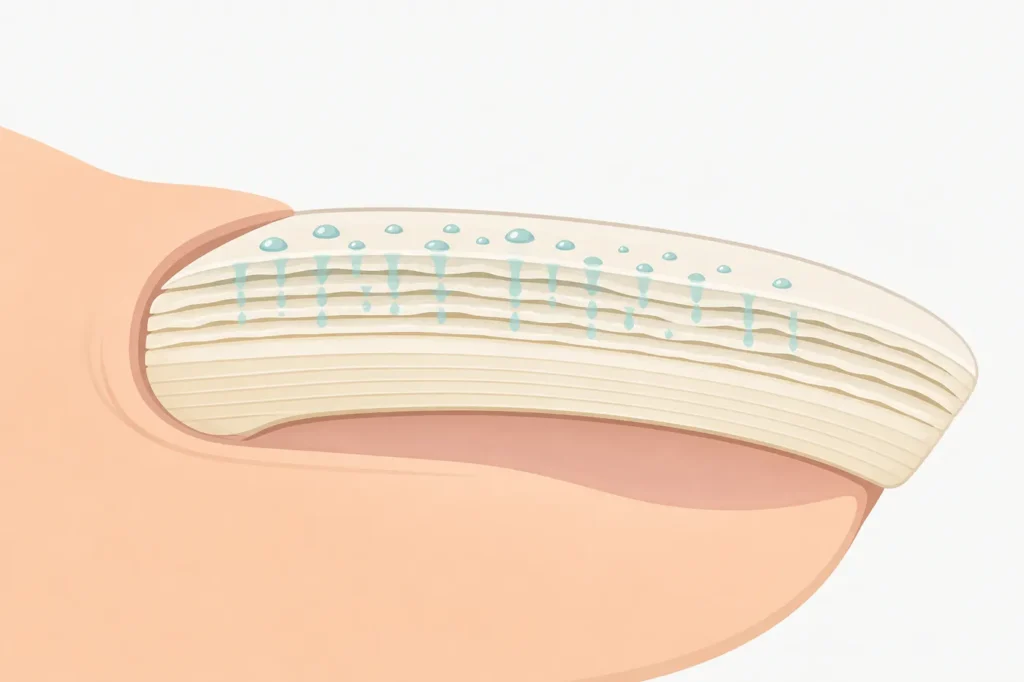
Illustration comparing a thick toenail with a thinner, softened nail after a urea product

Kerasal Fungal Nail Renewal comes in two formulations depending on where and when purchased:

  • Kerasal Fungal Nail Renewal (antifungal version): Contains undecylenic acid 10% + urea 10%. Undecylenic acid is an FDA-registered OTC antifungal active in the monograph for athlete’s foot (tinea pedis) and ringworm (tinea corporis) — not for onychomycosis.
  • Kerasal Nail Renewal (cosmetic version): Contains urea and salicylic acid as keratolytic (nail-softening) ingredients without an antifungal active. This version is a cosmetic nail renovator only.

Mechanism breakdown:

  • Urea 10%: Softens and thins thick, brittle nails by breaking down nail keratin. This can make nails less painful and easier to trim. Urea at higher concentrations (20–40%) is used medically for nail debridement. At 10%, the main benefit is cosmetic softening. Urea itself has no antifungal action.
  • Undecylenic acid 10%: A fatty acid antifungal active against dermatophytes and some Candida species. Well-established in OTC products for athlete’s foot. Poor nail penetration limits its effectiveness for established onychomycosis.
  • Salicylic acid (cosmetic version): A keratolytic that softens and exfoliates nail material. No antifungal action.

Kerasal’s primary benefit for nail fungus sufferers is cosmetic improvement: nails appear thinner, lighter, and less discolored with regular use. The undecylenic acid component may provide modest surface antifungal action but cannot clear established infection. See our full Kerasal review →

NONYX Nail Gel vs Kerasal: Cure Rates and What the Evidence Shows

Neither NONYX nor Kerasal has a randomized controlled trial showing mycological cure (confirmed eradication of fungus by lab test) for onychomycosis. The absence of such a trial is itself the core evidence limitation — it distinguishes these products from prescription options that do have that data.

TreatmentEvidence GradeFDA-Approved for NailsComplete Cure Rate
NONYX Nail Gel (ethanoic acid)Anecdotal (acetic acid: cosmetic data only)NoNot established (no nail RCT)
Kerasal Fungal Nail RenewalAnecdotal (urea: Limited)NoNot established (no nail RCT)

For reference: prescription treatments. These are not sold here and are not among the products we suggest; a doctor or podiatrist decides whether one suits you.

  • Ciclopirox 8% (Penlac): evidence grade: Moderate; fda-approved for nails: Yes; complete cure rate: 5.5–8.5% (FDA label, 48 wks).
  • Jublia (efinaconazole 10%): evidence grade: Moderate; fda-approved for nails: Yes; complete cure rate: ~15–18% (JAAD 2013).
  • Terbinafine oral: evidence grade: Strong; fda-approved for nails: Yes; complete cure rate: ~38% at 48 wks (FDA label).

No OTC product is FDA-approved to treat onychomycosis. Cure rates are for complete mycological cure in controlled trials; partial improvement rates differ.

What user experience shows is that both products can produce visible cosmetic improvement — nails appear lighter, smoother, and less thick — without necessarily clearing the infection. Cosmetic improvement is not mycological cure. A nail can look better externally while fungus persists underneath the plate.

NONYX Nail Gel vs Kerasal: How Long Each Takes

No clinical trial has established a reliable timeline for either product to show improvement in onychomycosis. What we can say is based on nail biology and the timelines of products with established efficacy data:

Illustration of a toenail slowly growing out clear nail from the base over many months
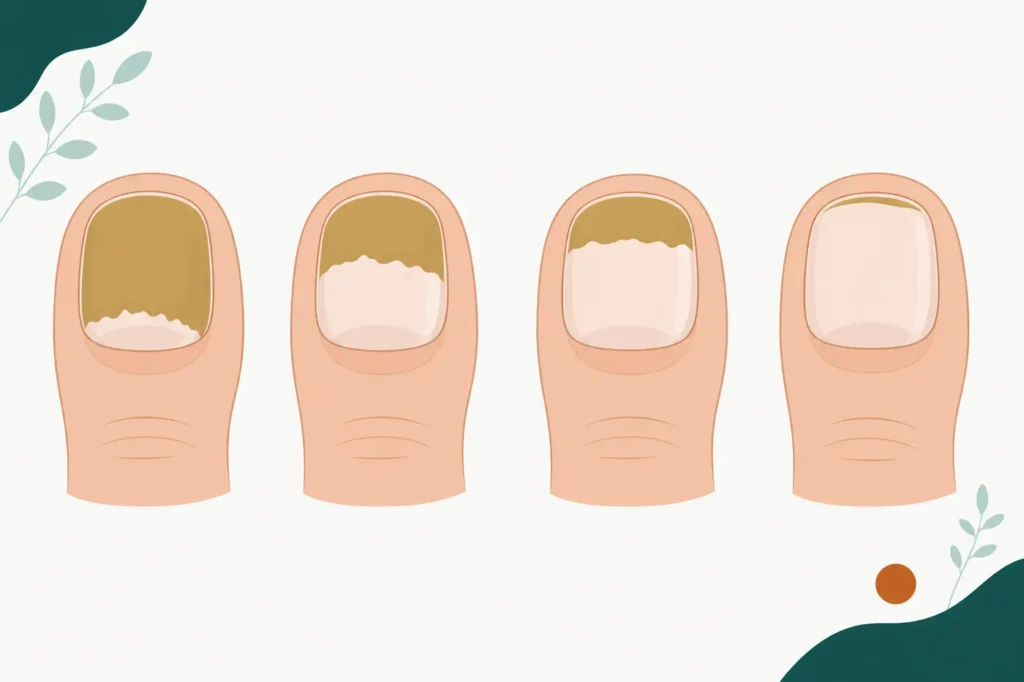
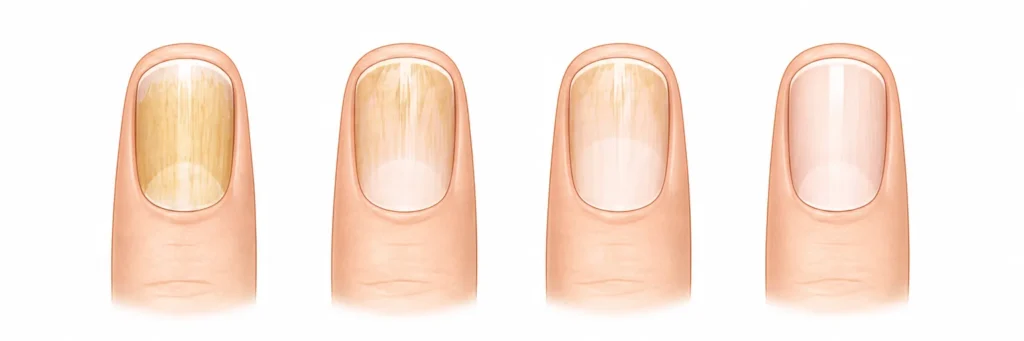
Four toenails showing fungus progression from infected to clear

If you use NONYX or Kerasal and see no new clear nail growth at the base of the nail after 2–3 months of consistent daily application, that is a signal to pursue a confirmed diagnosis and prescription treatment. Some initial improvement in nail appearance (lighter color, less debris) may happen earlier — that is the cosmetic effect of the product, not necessarily fungal clearing.

NONYX Nail Gel vs Kerasal: Side Effects and Safety

Both products have very favorable safety profiles as topical nail treatments:

NONYX Nail Gel:

  • Ethanoic acid at the concentration used in NONYX is generally well-tolerated on nail and surrounding skin.
  • May cause mild stinging or irritation if applied to cracked or broken skin around the nail.
  • No significant systemic absorption reported; no drug interactions.
  • Avoid contact with eyes.

Kerasal Fungal Nail Renewal:

  • Urea 10% is very well-tolerated; can cause mild stinging if skin is broken.
  • Undecylenic acid at 10% has an excellent safety record as an OTC antifungal.
  • Avoid on open wounds or severely inflamed periungual tissue.
  • No significant systemic absorption or drug interactions for either active.

Neither product requires liver monitoring, blood tests, or doctor oversight for healthy adults. Exception: Diabetic patients should not self-treat nail infections without consulting a podiatrist or physician first. Foot infections in diabetes can progress to serious complications.

NONYX Nail Gel vs Kerasal: Cost and Where to Get It

NONYX Nail Gel: Typically $15–$30 depending on bottle size (4 oz standard). Available at Walmart, Amazon, and selected pharmacies. Subscription options sometimes available at a discount.

Kerasal Fungal Nail Renewal: Typically $15–$25. Very widely available — CVS, Walgreens, Walmart, Target, and Amazon. Probably the more accessible of the two for most US consumers.

Both are significantly cheaper than prescription topicals: ciclopirox 8% (Penlac) can cost $60–$200+ per bottle without insurance, and Jublia can exceed $500 per 4 mL bottle without coverage (SingleCare lists about $741 with its coupon and about $1,067 average retail as of Nov 16, 2026; the maker’s Rx Access Program lists $65–$75 per 4 mL for eligible non-Medicare patients).

Affiliate disclosure: the Kerasal and Fungi Nail links above are affiliate links. We earn a small commission if you purchase — at no extra cost to you.

Who Should Choose NONYX Nail Gel and Who Should Choose Kerasal

Neither product is the right choice for treating confirmed onychomycosis. But both can serve a supporting role depending on your situation:

NONYX Nail Gel may suit you if...

Kerasal Fungal Nail Renewal may suit you if...

When you need something stronger:

  • Mild, white superficial onychomycosis: Consider prescription ciclopirox 8% (Penlac) — the only topical FDA-approved for onychomycosis, with 5.5–8.5% complete mycological cure at 48 weeks.
  • Moderate or severe nail involvement (more than half the nail): Prescription oral terbinafine has the strongest evidence (~38% complete cure in the FDA label trials; Lamisil prescribing information). See a doctor for evaluation and prescription.
  • Diabetics and immunocompromised individuals: See a podiatrist before using any nail product. When to see a podiatrist →

Can You Use NONYX Nail Gel and Kerasal Together?

There is no known interaction or contraindication to using both products on the same nail. The acetic acid in NONYX and the urea/undecylenic acid in Kerasal work by different mechanisms and are unlikely to interfere with each other.

That said, there is no clinical evidence that using both together produces better results than using either alone. The main potential benefit of combining them is:

  • NONYX clarifies nail debris and lowers pH
  • Kerasal’s urea softens the nail, potentially improving surface contact for any topical applied afterward

If you use both, apply the softer/wetter product (NONYX) first, allow it to absorb, then apply Kerasal. More important than the order: nail thinning before application — filing down the nail surface consistently improves contact with any topical.

If you are spending money on two OTC products and not seeing improvement after 2–3 months, that budget is better spent on a prescription option with established efficacy.

When to See a Doctor

See a podiatrist or dermatologist if: the infection covers more than half the nail, multiple nails are affected, you have diabetes or vascular disease, the nail is painful or separating, or home treatment has not helped after 3 months. Confirm the diagnosis with a lab test (KOH scraping or PAS stain) — roughly half of nails that look like fungus are another condition. Learn when to see a podiatrist →

NONYX Nail Gel vs Kerasal: Common Questions

Kerasal does not eliminate nail fungus (onychomycosis). It improves the appearance of fungus-damaged nails — softening thick nails, reducing discoloration, and improving texture. The undecylenic acid component has mild surface antifungal activity but cannot penetrate the nail plate deeply enough to clear established infection. It is not FDA-approved to treat onychomycosis. Full Kerasal review →

Onychomycosis is the clinical name for fungal infection of the nail. It affects up to about 1 in 10 adults (3–12%, AAFP 2015) and is caused most often by dermatophyte fungi (Trichophyton rubrum, T. mentagrophytes). Symptoms include nail thickening, yellow/white/brown discoloration, brittleness, nail separation (onycholysis), and sometimes odor. Diagnosis should be confirmed with a KOH scraping, PAS stain, or fungal culture — many look-alike conditions (psoriasis, nail trauma) do not respond to antifungal treatment.

Japan treats onychomycosis with the same evidence-based medications used globally: oral terbinafine and itraconazole are prescribed for established nail fungus. Japan also has a unique FDA-equivalent approval for luliconazole topical and exaconazole. No culturally specific “Japanese trick” for nail fungus has clinical evidence behind it. Social media claims about such remedies are not supported by published studies.

Vicks VapoRub contains thymol and camphor, which have shown antifungal activity in lab studies. One small uncontrolled pilot study (Derby et al., JABFM 2011, n=18) found some improvement in a subset of patients. Evidence grade: Anecdotal. No rigorous RCT has tested it. Vicks does not penetrate the nail plate reliably and is not a recognized antifungal treatment.

No unique “Amish cure” for toenail fungus is clinically validated. Ads and social media posts claiming an Amish secret remedy are not supported by published evidence. Folk remedies typically involve vinegar soaks, essential oils, or herbal applications — ingredients that may have modest lab antifungal activity but lack nail-specific clinical trial data. The same antifungal principles apply to everyone: prescription oral antifungals have the strongest evidence.

No household item has strong clinical evidence for treating established onychomycosis. The most-studied household options are: Vicks VapoRub (one small pilot study, Anecdotal grade), white vinegar / apple cider vinegar soaks (Anecdotal grade, lab data only), and tea tree oil (Limited grade, one small comparative study). None penetrates the nail plate to the nail bed reliably. For a confirmed infection, prescription options have far stronger evidence.

NONYX Nail Gel produces visible cosmetic improvement for many users — nails appear lighter, cleaner, and less discolored with regular use. This is real and may be meaningful cosmetically. However, no clinical trial has shown that NONYX produces mycological cure (confirmed eradication of fungus by lab test) for onychomycosis. Evidence grade: Anecdotal for the product (cosmetic endpoints only). It is not FDA-approved to treat nail fungus.

Hydrogen peroxide has oxidizing and mild antifungal properties in lab conditions. However, no clinical trial has established it as an effective treatment for onychomycosis. At the concentrations safe for skin (3%), nail penetration is minimal. Higher concentrations are caustic and can damage surrounding tissue. Evidence grade for nail use: Anecdotal. It is not a recommended treatment for confirmed nail fungus.

Medical disclaimer: This page is informational only and not medical advice. Consult a licensed clinician before treating onychomycosis. If you have diabetes or circulatory disease, see a podiatrist before applying any foot treatment.

Sources: FDA 21 CFR 333 (OTC antifungal drug monograph); AAFP 2015 (onychomycosis prevalence 3–12%); FDA Lamisil (terbinafine tablets) prescribing information, NDA 020539 (~38% complete cure at week 48); Elewski BE et al., JAAD 2013 (Jublia ~15–18% complete cure); FDA label for ciclopirox nail lacquer (Penlac, 5.5–8.5% complete cure at 48 weeks); Derby R et al., J Am Board Fam Med 2011 (Vicks pilot, n=18); Health.com toenail fungus treatments 2026 (NONYX/Kerasal overview); accessed Nov 2026; SingleCare. Jublia prices (4 mL). singlecare.com/prescription/jublia (prices updated Nov 16, 2026); Ortho Dermatologics. Rx Access Program terms for Jublia. orthorxaccess.com (accessed Nov 16, 2026).

Ready to try a treatment with stronger evidence?

Use our finder to match your case to the right option.