Home › Treatment Comparison › Jublia vs Terbinafine
Jublia vs Terbinafine (2026): Evidence-Graded Prescription Comparison
By Best Toenail Fungus Treatments · Reviewed 15 Nov 2026 · 11 min read
Home › Treatment Comparison › Jublia vs Terbinafine
By Best Toenail Fungus Treatments · Reviewed 15 Nov 2026 · 11 min read
Terbinafine (oral) Strong Evidence — ~38% complete cure in the FDA label trials (Lamisil prescribing information) — is first-line for most healthy adults with toenail fungus. Jublia (efinaconazole 10% topical) Moderate Evidence — 15–18% complete cure (Elewski, JAAD 2013) — is a prescription topical that avoids systemic drug exposure. Oral terbinafine has better efficacy; Jublia is preferred when systemic treatment is not suitable (liver concerns, drug interactions, patient preference for topical).
Both require a prescription. Neither is available OTC.
Side by Side
Key Facts
Most healthy adults
Terbinafine (first-line)
Liver concerns or interactions
Jublia
Lower cost
Terbinafine generic ~$10–$40
Prescription
Both; neither is OTC
Side by side:
Verdict: For efficacy: oral terbinafine (~38% vs 15–18%). For safety profile in liver-sensitive or multi-drug patients: Jublia. Both require a prescription. See your healthcare provider for the right choice for you. Full treatment comparison →
Moderate Evidence — Jublia (efinaconazole 10% solution) is an FDA-approved prescription topical antifungal for toenail onychomycosis. It is a triazole antifungal that inhibits ergosterol synthesis via CYP51A1 (lanosterol 14-alpha-demethylase), disrupting the fungal cell membrane.
Strong Evidence — Oral terbinafine is an allylamine antifungal. It inhibits squalene epoxidase, an enzyme critical to fungal cell membrane synthesis. Unlike azoles (which are fungistatic), terbinafine is fungicidal — it eradicates fungi rather than just inhibiting their growth.
Trial results side by side:
Important context: “Complete cure” in nail fungus trials means negative mycology (culture + KOH) plus normal nail appearance. Even with the best-evidenced treatment (terbinafine), only about 38 in 100 patients achieve this. Cure rates in real-world practice may differ from controlled trial conditions. Our evidence grading methodology →
When Jublia is preferred over terbinafine: Pre-existing liver disease, taking CYP2D6-sensitive medications, patient preference for avoiding systemic drugs, prior adverse reaction to oral antifungals.
Important: This decision should be made with your prescribing physician. Both are prescription-only drugs. Confirm your diagnosis with a lab test (KOH smear or culture) before starting either treatment — about half of suspected nail fungus cases test negative.
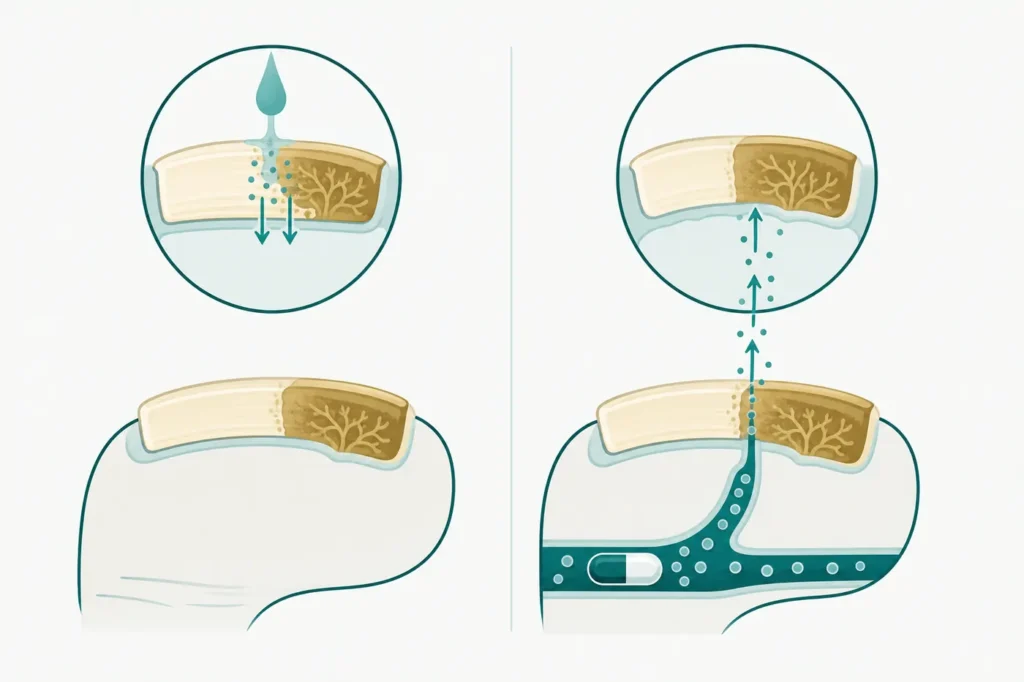
Combination therapy (oral terbinafine + topical efinaconazole) has been studied in small trials. The rationale is that the oral agent delivers systemic antifungal action via the bloodstream, while the topical acts on the nail surface — potentially addressing the infection from both directions.
Some published small trials suggest improved mycological cure rates with combination therapy, but the evidence is limited and no large-scale RCT has established a standard combination protocol. Most guidelines do not currently recommend combination therapy as first-line.
Practical implication: Some prescribers use combination therapy for resistant cases or patients with very thick, severely involved nails. If you are not responding to monotherapy, discuss combination options with your dermatologist or podiatrist.
Prescription treatments need a doctor or podiatrist. If you want something you can buy today, these are the best options available without a prescription. None is FDA-approved to cure nail fungus, so expect slow, modest results and see a clinician if the nail gets worse.
Over-the-counter terbinafine 1% cream. It is approved for athlete’s foot, ringworm and jock itch, not for nails, so use it on the skin around the nail and between the toes, where fungus often re-seeds the nail. Evidence for nails: Limited (skin-fungus approval data only). Typically about $10–$20.
Undecylenic acid 25% liquid with a brush applicator, for mild, early cases and the surrounding skin. Product evidence: Anecdotal (no trial of the product; undecylenic acid: Limited). Usually under $15.
Urea + lactic acid nail treatment that softens and visibly improves thick, discolored nails in 2–8 weeks. It is cosmetic, not an antifungal. Product evidence: Anecdotal (urea: Limited).
By complete cure rate, no: oral terbinafine (~38%) outperforms Jublia (15–18%). Jublia is better in specific situations: when oral terbinafine is contraindicated (liver disease, drug interactions, patient preference). For the typical healthy adult with confirmed toenail fungus, oral terbinafine is the more effective and cost-effective choice. See full evidence comparison →
Oral terbinafine is the most effective treatment with the strongest evidence base (~38% complete cure in the FDA label trials; Lamisil prescribing information). The next-best evidence is for oral itraconazole. Prescription topicals (efinaconazole, ciclopirox) are second-line options. OTC products have limited-to-anecdotal evidence. No treatment cures nail fungus in 100% of patients. Full treatment guide →
Among prescription topicals, efinaconazole 10% (Jublia) has the strongest published RCT evidence (15–18% complete cure; Elewski, JAAD 2013). Ciclopirox 8% lacquer (Penlac) has also been FDA-approved for onychomycosis and has published trial data, with slightly lower mycological cure rates in head-to-head comparisons. Terbinafine vs ciclopirox comparison →
Terbinafine can cause liver enzyme elevation (hepatotoxicity) in a small proportion of patients. The rate of clinically significant hepatotoxicity is approximately 1 in 50,000–120,000 — rare, but potentially serious. Baseline liver function tests (LFTs) are recommended before starting. Terbinafine is contraindicated in patients with pre-existing liver disease. Report any unexplained fatigue, nausea, or jaundice to your prescribing physician immediately. Full terbinafine guide →
Onychomycosis is a fungal infection of the nail, most commonly caused by dermatophytes (Trichophyton rubrum in most cases). It affects up to about 1 in 10 adults (3–12%; AAFP 2015) and becomes more common with age. Lab confirmation (KOH smear or nail culture) is recommended before treating, as about half of suspected cases test negative (thickened or discolored nails can have non-fungal causes).
Medical disclaimer: This content is for informational purposes only and is not a substitute for professional medical advice, diagnosis or treatment. Jublia and terbinafine are prescription drugs requiring physician evaluation. Always consult a qualified healthcare provider before starting, changing or stopping any medication.
Answer 4 quick questions and get a recommendation matched to your nails.