Home › Treatment Comparison › Kerasal vs Fungi-Nail

Kerasal vs Fungi-Nail (2026): Evidence-Graded Head-to-Head

Affiliate Disclosure: This page contains affiliate links. If you buy through our links we may earn a commission at no extra cost to you. Evaluations are independent and evidence-based. Full disclosure →
A plain brush-cap bottle beside a slim tube on a bathroom counter, comparing Kerasal and Fungi-Nail

The Short Answer

Fungi-Nail Anecdotal Evidence (undecylenic acid: Limited) contains undecylenic acid — an FDA-approved antifungal for skin. Kerasal Fungal Nail Renewal Anecdotal Evidence (urea: Limited) contains no antifungal; it is a keratolytic that improves nail appearance.

For killing fungus: Fungi-Nail has the advantage (antifungal ingredient). For nail appearance: Kerasal. The best approach for established nail fungus is to use both together — Kerasal to soften the nail for better penetration, Fungi-Nail for antifungal action — while pursuing prescription treatment if the infection is confirmed.

At a Glance

Evidence Strength (both products)

StrongModerateLimitedAnecdotal ✓

How we grade evidence

Side by Side

Fungi-NailKerasal Fungal Nail Renewal
OTC antifungal: undecylenic acid 25% (FDA-approved for skin); ~$7–$18OTC keratolytic, no antifungal: urea 10% + lactic acid; ~$12–$24

Key Facts

Antifungal action

Fungi-Nail

Nail appearance

Kerasal (visible in 2–4 weeks)

Established nail fungus

Both together, plus a prescription

No change at 3 months

See a podiatrist or dermatologist

Kerasal vs Fungi-Nail: Side-by-Side Table

Fungi-NailKerasal Fungal Nail Renewal
TypeOTC antifungalOTC keratolytic
Active ingredientUndecylenic acid 25% (some formulations with tolnaftate)None (urea 10%, lactic acid, propylene glycol)
Antifungal actionYes — undecylenic acid inhibits fungal growthNo
Evidence gradeAnecdotal Evidence (undecylenic acid: Limited)Anecdotal Evidence (urea: Limited for appearance)
What it doesTargets fungal growth on skin/nail surfaceSoftens and thins thickened nail; improves appearance
What it cannot doLow nail plate penetration limits clearance of deep infectionDoes not eliminate nail fungus
Typical cost~$7–$18~$12–$24
Buy linkAmazon →Amazon →

Kerasal vs Fungi-Nail: Head-to-Head

Fungi-Nail

VS

Kerasal Fungal Nail Renewal

Verdict: For antifungal intent: Fungi-Nail. For nail appearance: Kerasal. For best results: use both together (Kerasal to soften, Fungi-Nail for antifungal). For confirmed nail infection: prescription oral terbinafine has the strongest evidence. See full comparison →

How Fungi-Nail Works

Anecdotal Evidence — Fungi-Nail is an OTC antifungal containing undecylenic acid (active ingredient in most formulations at 25%) or tolnaftate 1%. Undecylenic acid is derived from castor oil and is FDA-approved to treat fungal infections of the skin (athlete’s foot, ringworm). It disrupts fungal cell membrane function, inhibiting growth.

The nail plate challenge: While undecylenic acid works well on skin fungal infections, getting it through the hard, dense nail plate to reach the nail bed (where dermatophytes live in nail fungus) is a significant barrier. No OTC topical antifungal — including Fungi-Nail — has demonstrated the nail penetration levels of prescription ciclopirox lacquer or efinaconazole.

FDA labeling: Fungi-Nail is FDA-approved for athlete’s foot and skin fungal infections. Its labeling does not specifically approve it for onychomycosis (nail fungus). Full Fungi-Nail review →

How Kerasal Fungal Nail Renewal Works

Anecdotal Evidence — Kerasal contains urea 10%, lactic acid and propylene glycol — all keratolytics. These break down excess keratin in thickened, damaged nails. The result: a softer, thinner, less discolored nail — often noticeably better within 2–4 weeks.

Important clarification on the name: “Fungal Nail Renewal” is a marketing name. Kerasal contains no antifungal molecule. It cannot kill the fungi causing the infection. What it does is cosmetically restore the nail’s appearance. This is clinically valuable — especially as an adjunct to prescription antifungals — but it is not a treatment for the underlying infection. Full Kerasal review →

Kerasal vs Fungi-Nail: Evidence Comparison

TreatmentGradeWhat evidence showsSource
Fungi-Nail (undecylenic acid)Anecdotal Evidence (undecylenic acid: Limited)FDA-approved for skin; nail penetration limited. No nail-specific RCT.FDA monograph
Kerasal (keratolytic)Anecdotal Evidence (urea: Limited)Improves nail appearance. No antifungal action.Ingredient literature

Prescription treatments, for information only (a doctor or podiatrist can prescribe these; they are not products we sell or pick):

  • Oral terbinafine — Grade: Strong Evidence; What evidence shows: ~38% complete cure at 48 wks (FDA label); Source: FDA Lamisil label
  • Efinaconazole 10% (Jublia) — Grade: Moderate Evidence; What evidence shows: 15–18% complete cure; Source: Elewski, JAAD 2013

Kerasal vs Fungi-Nail: How Long Does Each Take?

Kerasal vs Fungi-Nail: Side Effects

Fungi-Nail

Kerasal

Kerasal vs Fungi-Nail: Cost and Where to Buy

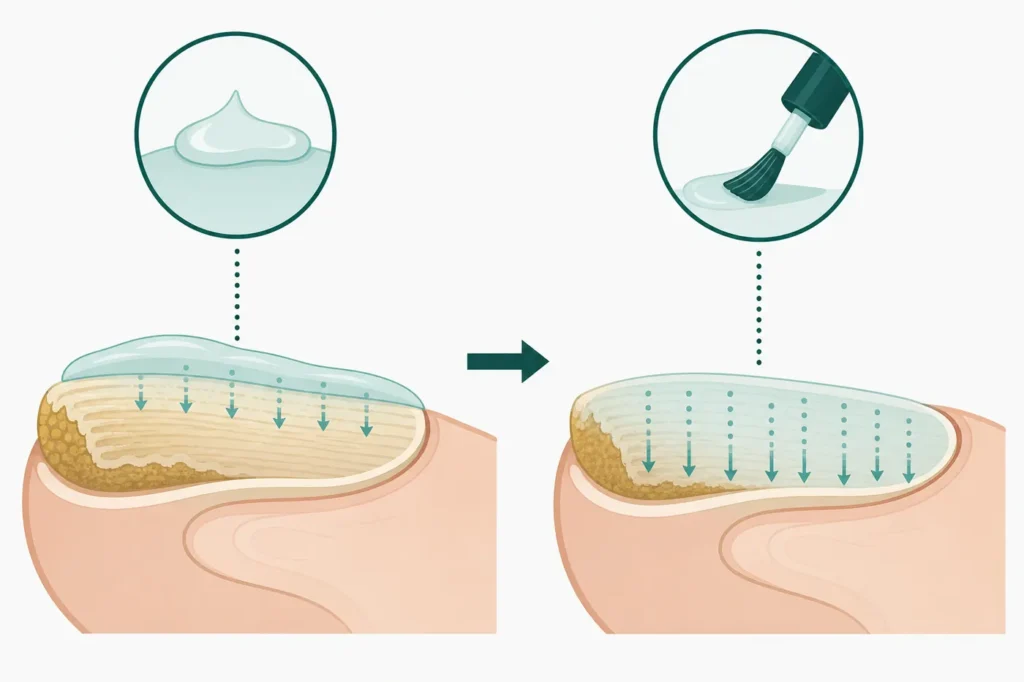
Can You Use Kerasal and Fungi-Nail Together?

Yes — and this is likely the most logical OTC approach:

Diagram of using a nail softener first, then an antifungal liquid that penetrates the softened nail

Kerasal vs Fungi-Nail: Who Should Choose Which

Choose Fungi-Nail if:

Choose Kerasal if:

For confirmed toenail fungus requiring clearance: consider prescription oral terbinafine. Terbinafine guide →

Kerasal vs Fungi-Nail: Common Questions

For antifungal intent, Fungi-Nail is better: it contains undecylenic acid, an FDA-approved antifungal. Kerasal has no antifungal ingredient. For nail appearance improvement, Kerasal is better: its keratolytics effectively soften and thin nails. The best OTC approach is to use both together: Kerasal to prep the nail surface, Fungi-Nail for antifungal action. For confirmed infection requiring clearance, prescription oral terbinafine has much stronger evidence.

No. Kerasal Fungal Nail Renewal contains no antifungal medication. It contains urea, lactic acid and propylene glycol — all keratolytics that soften nail tissue. It improves nail appearance but does not kill the fungi causing the infection. Full Kerasal review →

Fungi-Nail is FDA-approved for skin fungal infections. It is not specifically FDA-approved for onychomycosis (nail fungus). The main limitation is nail plate penetration: the dense nail plate makes it difficult for topical antifungals to reach the nail bed where dermatophytes live. Fungi-Nail may help with surface-level or periungual (around-the-nail) fungal involvement. Full Fungi-Nail review →

Most podiatrists and dermatologists recommend confirming the diagnosis via lab test first (KOH smear or culture) — about half of suspected nail fungus cases test negative. First-line treatment for confirmed onychomycosis is typically oral terbinafine or itraconazole. Topical prescription options (efinaconazole, ciclopirox) are second-line for mild/moderate cases. OTC products are generally considered adjunctive, not primary treatment. Full treatment guide →

Sources

  1. L.I.ON. study. Terbinafine vs itraconazole. BMJ 1999;318:1031–1035.
  2. Elewski BE et al. Efinaconazole 10%. JAAD 2013;68(4):600–608.
  3. FDA. OTC drug monograph: undecylenic acid. fda.gov (accessed Nov 2026).
  4. Ferrari J. Fungal toenail infections. Am Fam Physician 2015;92(2):132–133.
  5. AAD. Nail fungus: tips for managing. aad.org (accessed Nov 2026).
  6. Kerasal product information. kerasal.com (accessed Nov 2026).

Medical disclaimer: This content is for informational purposes only and is not a substitute for professional medical advice, diagnosis or treatment. Always consult a qualified healthcare provider before starting any treatment.

Not sure which treatment fits your case?

Answer 4 quick questions and get a recommendation matched to your nails.