Home › Treatment Comparison › Kerassentials vs Kerasal

Kerassentials vs Kerasal (2026): Evidence-Graded Comparison

Affiliate disclosure: This page contains affiliate links, including links to the official Kerassentials sites and to Amazon. If you buy through them we may earn a commission at no extra cost to you. That does not change our evidence grades, which are based on published research only. Full disclosure → See how we review →
Generic oil bottle and ointment tube compared side by side with a nail file

The Short Answer

Kerassentials is a ClickBank oil supplement with Anecdotal Evidence (undecylenic acid, tea tree oil: Limited) for nail fungus (ingredient-level only) — no product-specific RCT exists. Kerasal Fungal Nail Renewal is an OTC keratolytic with Anecdotal Evidence as a product (urea: Limited) — it improves nail appearance but contains no antifungal. Neither product has the evidence of prescription oral terbinafine (~38% complete cure in the FDA label trials; Lamisil prescribing information). Kerasal (urea 10%, lactic acid) costs about $12–$24 and can make nails look thinner and smoother within 2–4 weeks; Kerassentials (undecylenic acid plus botanicals) is sold through its vendor, with no buy link on this page. Neither needs a prescription. For confirmed toenail fungus, see a healthcare provider for a diagnosis and treatment plan.

At a Glance

Side by Side

KerassentialsKerasal
Botanical oil with undecylenic acid; Anecdotal (ingredients Limited); no product RCTOTC urea 10% keratolytic; Anecdotal (urea Limited); improves looks, no antifungal

Key Facts

Clears fungus?

Neither is proven to

Better-looking nails

Kerasal: visible in 2–4 weeks

Kerasal price

$12–$24 (10 mL)

Confirmed infection

Rx terbinafine: ~38% complete cure

Kerassentials vs Kerasal: Head-to-Head

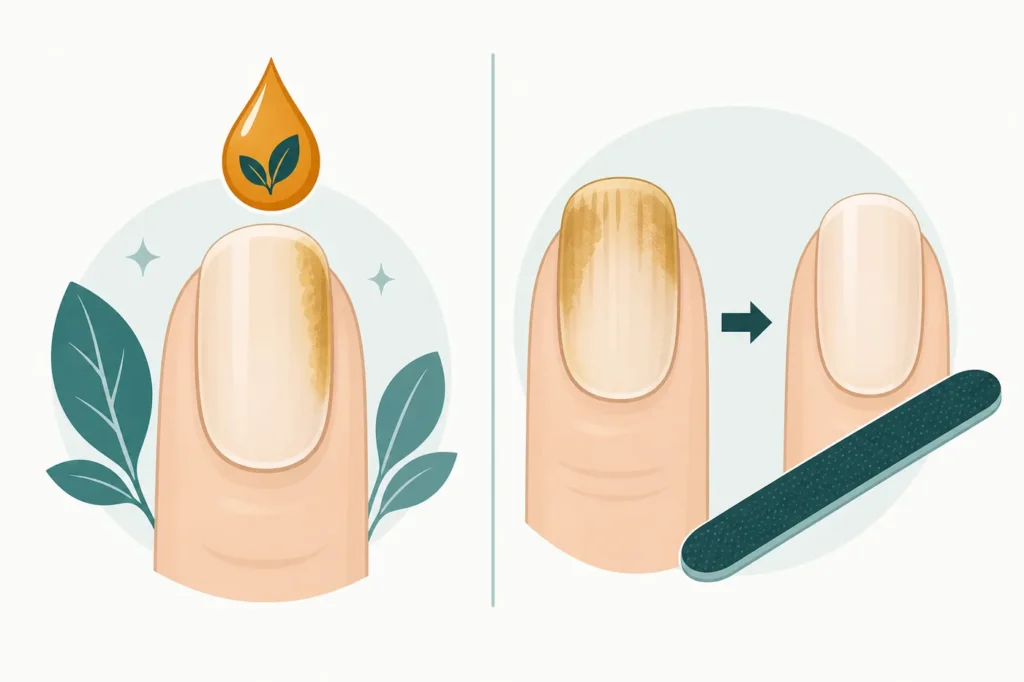
Illustration comparing a botanical oil with a nail-softening ointment

Kerassentials

VS

Kerasal Fungal Nail Renewal

Verdict: Neither product has the evidence of prescription antifungals. Kerasal improves nail appearance (not infection); Kerassentials has no product RCT. For confirmed nail fungus, see a healthcare provider. See evidence-backed treatments →

How Kerassentials Works on Toenail Fungus

Anecdotal Evidence — Kerassentials is an oil blend applied with a dropper or brush to the nail and surrounding skin. The formula includes undecylenic acid (antifungal, FDA-approved for skin fungal infections), tea tree oil, lavender oil, aloe vera and other botanical extracts.

Plausible mechanisms: Undecylenic acid inhibits fungal growth on skin. Tea tree oil has in-vitro antifungal properties. The combination of an oil vehicle with antifungal botanicals has a logical basis as a topical skin application. However, for nail fungus (onychomycosis), the nail plate creates a significant penetration barrier.

Critical limitation: No randomised controlled trial of Kerassentials for nail fungus has been published. The ClickBank distribution model and marketing around this product class commonly uses dramatic testimonials, before/after photos and earnings claims that are not independently verified. Do nail fungus supplements work? → | Full Kerassentials review →

How Kerasal Works on Toenail Fungus

Anecdotal Evidence — Kerasal contains urea 10%, lactic acid and propylene glycol. These are keratolytics: they break down excess keratin, softening and thinning the nail. The result is a less thick, less discolored nail — often dramatically so within weeks.

What Kerasal achieves:

What Kerasal does not achieve: It contains no antifungal molecule. The fungi (typically Trichophyton species) living in the nail bed remain untreated. Improved appearance does not mean the infection is gone. Full Kerasal review →

Kerassentials vs Kerasal: Cure Rates and What the Evidence Shows

Neither product has published complete-cure rate data from a registered RCT. Here is how the evidence compares across the treatment landscape:

TreatmentEvidence gradeComplete cure rateSource
Fungi-Nail (undecylenic acid)Anecdotal Evidence (undecylenic acid: Limited)No RCT nail-fungus data—
Kerasal (keratolytic)Anecdotal Evidence (urea: Limited)Not an antifungal; no cure rate—
Kerassentials (oil blend)Anecdotal Evidence (undecylenic acid, tea tree oil: Limited)No product RCT published—

Prescription medicines are not in this table because we can’t offer or prescribe them. For information:

  • Oral terbinafine: Evidence grade: Strong Evidence; Complete cure rate: ~38% at 48 wks (FDA label); Source: FDA Lamisil label.
  • Efinaconazole (Jublia): Evidence grade: Moderate Evidence; Complete cure rate: 15–18%; Source: Elewski, JAAD 2013.

Kerassentials vs Kerasal: How Long Each Takes

Both products share the same fundamental constraint: toenails grow roughly 1.5 mm per month. A full nail takes 12–18 months to replace.

Kerassentials vs Kerasal: Side Effects and Safety

Kerassentials Safety

Kerasal Safety

Kerassentials vs Kerasal: Cost and Where to Get It

Who Should Choose Kerassentials and Who Should Choose Kerasal

Consider Kerassentials if:

Consider Kerasal if:

Important: Neither product is a substitute for a confirmed diagnosis and evidence-backed treatment. If you have established toenail fungus, see a podiatrist or dermatologist. A lab test (KOH smear or culture) confirms the diagnosis — about half of suspected nail fungus cases test negative. See our full treatment comparison →

Can You Use Kerassentials and Kerasal Together?

There is no known interaction between using an oil-based topical (Kerassentials) and a keratolytic ointment (Kerasal). However, applying multiple topical products simultaneously may dilute each one. If using both, consider alternating: use Kerasal in the morning and Kerassentials in the evening, or use Kerasal to file/prep the nail and Kerassentials as the main treatment application.

That said, neither product has sufficient evidence to clear established nail fungus on its own. If you are combining OTC products and not seeing improvement in 3 months, escalate to a prescription option. See our full treatment guide →

Kerassentials vs Kerasal: Common Questions

Kerasal works very well at improving the appearance of damaged nails — it is an effective keratolytic. However, it contains no antifungal and does not clear the underlying fungal infection. Think of Kerasal as a nail appearance restorer, not an antifungal treatment. Full Kerasal review →

Fungi-Nail has an advantage for antifungal intent: it contains undecylenic acid, an FDA-approved antifungal for skin. Kerasal has no antifungal ingredient. If your goal is cosmetic nail restoration: Kerasal. If your goal is antifungal action: Fungi-Nail. For confirmed nail fungus: neither is as effective as prescription oral terbinafine. Fungi-Nail review →

Onychomycosis (tinea unguium) is a common fungal infection of the toenails or fingernails, caused by dermatophytes (most commonly Trichophyton rubrum), yeasts or non-dermatophyte molds. It affects up to about 1 in 10 adults (3–12%; AAFP 2015) and is more common with age and in people with diabetes. Symptoms include thickened, brittle, discolored (yellow/white/brown) or separated nails. Lab confirmation (KOH smear or culture) is recommended before treating, as about half of suspected cases test negative.

In Japan, onychomycosis is primarily treated with prescription antifungals — oral terbinafine and itraconazole are first-line, the same as in the US. Topical lacquers (ciclopirox, efinaconazole) are also prescribed. There is no uniquely Japanese OTC remedy with proven efficacy for nail fungus.

Sources

  1. L.I.ON. study. Terbinafine vs itraconazole. BMJ 1999;318:1031–1035.
  2. Elewski BE et al. Efinaconazole 10%. JAAD 2013;68(4):600–608.
  3. Ferrari J. Fungal toenail infections. Am Fam Physician 2015;92(2):132–133.
  4. FDA. Undecylenic acid OTC monograph. fda.gov (accessed Nov 2026).
  5. FDA. DSHEA overview. fda.gov (accessed Nov 2026).
  6. AAD. Nail fungus: tips for managing. aad.org (accessed Nov 2026).

Medical disclaimer: This content is for informational purposes only and is not a substitute for professional medical advice, diagnosis or treatment. Dietary supplements are not FDA-evaluated to diagnose, treat, cure or prevent any disease. Always consult a qualified healthcare provider before starting any treatment.

Not sure which treatment fits your case?

Answer 4 quick questions and get a recommendation matched to your nails.