Home › Product Reviews › ProNail Complex Review

ProNail Complex Review (2026): Ingredients, Evidence Grades and What to Expect

Disclosure: This is an editorial review. No affiliate or purchase link for ProNail Complex appears on this page. The page does contain affiliate links to the official Kerassentials and Metanail Complex sites, and some links point to other pages on this site that may contain affiliate links. If you buy through them we may earn a commission at no extra cost to you. Our evidence grades are based on published clinical data only and are not affected by commercial relationships. See how we review → Full disclosure →


Plain spray bottle with botanical sprigs on a bathroom shelf, for a ProNail Complex review

ProNail Complex Review: Our 60-Second Verdict

Evidence grade: Anecdotal Evidence

ProNail Complex is a topical mist spray sold through ClickBank and marketed for toenail and foot health. It contains 16 ingredients including undecylenic acid, tea tree oil, clove bud, lavender, aloe, sweet almond oil and several other botanicals. No product-specific clinical trial has been published for ProNail Complex for onychomycosis. Undecylenic acid (the strongest individual ingredient) is FDA-approved for skin fungus only; its evidence grade for nail fungus specifically is Limited due to poor nail-plate penetration. The product overall grades as Anecdotal for treating confirmed toenail fungus. No OTC product is FDA-approved to treat onychomycosis.

At a Glance

Evidence Strength

StrongModerateLimitedAnecdotal ✓

How we grade evidence

The Claim vs. the Evidence

The marketing claimWhat the evidence says
A micro-particle mist that reaches under the nail plateNo product trial; 14 of 16 ingredients graded Anecdotal

Key Facts

Price

~$49–$69 per bottle (vendor)

Form

Topical mist spray, 16 ingredients

Best for

Mild cases or athlete’s foot near the nail

Trials

None for ProNail Complex

No published clinical trials of this exact blend.

What Is ProNail Complex?

ProNail Complex is a topical “micro-particle mist” spray designed to be applied to toenails and surrounding skin. The product is marketed via a ClickBank video sales letter. The spray format, as opposed to a brush applicator, is a claimed advantage — the vendor suggests the mist reaches under the nail plate and around cuticles more easily. We address this penetration claim in a dedicated section below.

Format: Topical spray mist in a pump bottle.

Manufacturer: Vendor identity not prominently disclosed on the sales page; distributed via ClickBank.

Number of ingredients: 16 — a larger formulation than most comparable products in this category.

Regulatory status: No OTC cosmetic, supplement or mist product is FDA-approved to treat onychomycosis. Undecylenic acid within the formula is an FDA-approved OTC ingredient for skin fungus, but the product as a whole is not an FDA-approved nail fungus drug.

The vendor describes this as “doctor-formulated.” We did not locate a named, verifiable physician on record as the formulator. We do not repeat this claim as fact.

All 16 ProNail Complex Ingredients Graded

We graded each of the 16 reported ingredients in ProNail Complex independently using published clinical data. Ingredient concentrations are not publicly disclosed; we used the full ingredient list from the vendor’s label and sales page. How we grade treatments →

Illustration of 16 botanical ingredients, only a few with any evidence
IngredientGradeRole claimedEvidence summary
Undecylenic acidLimited EvidenceAntifungal (key active)FDA-approved OTC antifungal for skin (athlete’s foot, ringworm). Limited evidence for nail penetration. No confirmed RCT for onychomycosis with this product. Highest-grade ingredient in this formula.
Tea tree oil (Melaleuca alternifolia)Limited EvidenceAntifungal, antisepticSmall RCT (Buck 1994) showed cosmetic improvement vs placebo. No large nail RCT for mycological cure.
Clove bud oilAnecdotal EvidenceAntifungal (eugenol)Eugenol has in vitro antifungal activity; no human onychomycosis trial.
Lavender oilAnecdotal EvidenceAntiseptic, skin soothingIn vitro antifungal data only. No human nail trial.
Lemongrass oilAnecdotal EvidenceAntifungal (lab claims)Antifungal in lab settings; no human nail RCT.
Aloe veraAnecdotal EvidenceSkin healing, moisturisingWell-evidenced for skin healing and hydration; not an antifungal agent for nails.
Sweet almond oilAnecdotal EvidenceCarrier / moisturiserEmollient carrier oil. No antifungal nail evidence.
Jojoba seed oilAnecdotal EvidenceCarrier oilCarrier and skin conditioner. No antifungal nail evidence.
Canola oil (rapeseed)Anecdotal EvidenceCarrier / emollientCarrier oil with no meaningful antifungal evidence.
Vitamin E (tocopheryl acetate)Anecdotal EvidenceAntioxidant, nail conditionerAntioxidant ingredient. No antifungal nail evidence; may support nail appearance cosmetically.
Walnut oilAnecdotal EvidenceSkin nourishmentEmollient; no antifungal nail evidence.
Flaxseed oilAnecdotal EvidenceSkin healthContains omega-3 fatty acids; no antifungal nail evidence.
MentholAnecdotal EvidenceCooling sensation, skin penetration aidMay improve skin penetration of some actives; no nail fungus RCT for this use.
CamphorAnecdotal EvidenceAntiseptic (traditional)Traditional antiseptic; topical antifungal use is not FDA-recognized. Avoid contact with damaged skin.
Clove flower oilAnecdotal EvidenceAntifungal (eugenol, similar to clove bud)Similar profile to clove bud oil; no human nail RCT.
Oregano oilAnecdotal EvidenceAntifungal (carvacrol)In vitro antifungal (carvacrol); some small skin studies. No nail onychomycosis RCT.

Summary of grades: 1 ingredient at Limited (undecylenic acid), 1 at Limited (tea tree oil), 14 at Anecdotal. No ingredient in this formula has Strong or Moderate evidence for nail fungus specifically. The best individual evidence is for skin fungus (undecylenic acid — FDA-approved OTC), not for the nail plate itself, where penetration is a known barrier.

Undecylenic Acid: The Strongest Ingredient in ProNail Complex

Evidence grade for undecylenic acid for onychomycosis: Limited Evidence

Undecylenic acid is the most credentialed antifungal ingredient in ProNail Complex, so it deserves its own section.

What undecylenic acid is:
Undecylenic acid is an FDA-approved Category I active ingredient for the OTC treatment of athlete’s foot (tinea pedis) and ringworm (tinea corporis). It has genuine antifungal activity against dermatophytes including Trichophyton rubrum and T. mentagrophytes — the fungi that most commonly cause toenail infections.

The critical limitation for nails:
Undecylenic acid’s FDA approval is for skin fungus, not nail fungus. The nail plate is 0.5 to 0.75 mm thick and is composed of densely packed keratin. Most topical antifungals — including undecylenic acid at concentrations found in OTC products — do not reliably penetrate to the nail bed where the fungus lives. This is not a theoretical problem; it is why all FDA-approved nail fungus treatments are either oral or specifically formulated lacquers. Why topical creams rarely work for nails →

What this means for ProNail Complex:
The mist spray format with a small-particle delivery mechanism may partially address this penetration issue, but no peer-reviewed human trial has established that this product’s delivery of undecylenic acid reaches therapeutic concentrations at the nail bed. Until such data exists, the grade for nail use remains Limited rather than Moderate or Strong.

Does ProNail Complex Work on Toenail Fungus? (Evidence Grade)

Overall evidence grade for ProNail Complex for onychomycosis: Anecdotal Evidence

No product-specific clinical trial has been published for ProNail Complex for toenail fungus. PubMed, Cochrane and ClinicalTrials.gov searches return no registered or completed trial for this product.

This does not mean the product is definitely ineffective — especially for mild surface-level infection or athlete’s foot that has started to affect the nail edges. Undecylenic acid is a real antifungal, and multiple ingredients have genuine antifungal activity in the lab. What it means is that we have no peer-reviewed evidence to tell us what percentage of users see meaningful improvement, at what severity of infection, and over what timeframe.

What evidence we do have (ingredient level):

The vendor’s claims: The sales page includes testimonials describing clear nails and eliminated infections. We grade these as Anecdotal. They are not from confirmed onychomycosis cases at baseline, do not control for natural nail growth, and are selected by the vendor. Why ‘instant’ nail fungus cure claims are false →

The Nail Penetration Problem (Why This Matters for Any Topical)

Understanding this helps you evaluate ProNail Complex — and every other topical nail fungus product.

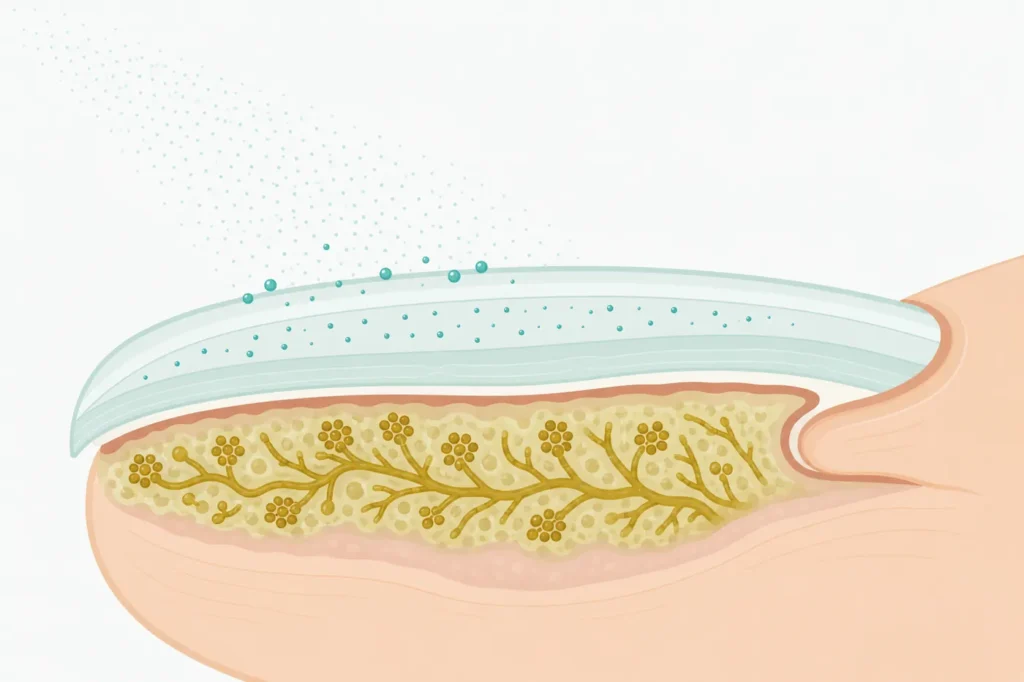
Onychomycosis is not a surface infection. The fungus lives in and under the nail plate, in the nail bed, and sometimes in the matrix. A topical product must cross the full thickness of the nail to reach these sites at a concentration that inhibits fungal growth.

Diagram of a mist spray landing on a thick nail but not reaching fungus in the nail bed

The penetration data:

This is not a reason to dismiss ProNail Complex entirely — especially for mild nail involvement or athlete’s foot spreading to the nail edge, where the fungus is closer to the surface. It is a reason to understand what this product realistically can and cannot do for established, moderate-to-severe nail fungus. More on topical penetration limits →

How to Use ProNail Complex (and What to Realistically Expect)

Per the vendor’s instructions:

Realistic timeline regardless of product:
A great toenail takes 12 to 18 months to grow in completely. Even if ProNail Complex were effective (which is not established), you would not see a fully clear nail for at least 12 months. Any improvement you see before that is partial — visible at the base of the nail as it grows. If you see no improvement in the first 3–4 months, we recommend a clinical assessment and potentially a prescription antifungal. How to get a prescription online without a clinic visit →

Who is most likely to see benefit from this product (hypothetically):
Mild, early nail involvement with the fungus still near the surface; athlete’s foot affecting the skin around the nail (where undecylenic acid has real evidence); users who want a cosmetic improvement in nail appearance alongside conventional treatment.

ProNail Complex Side Effects and Precautions

ProNail Complex contains several active botanical oils. Side effects are expected to be primarily local and mild for most users, but are not trivial for all:

No serious systemic toxicity is expected from normal topical use on intact skin. The spray format may reduce over-application risk compared to oil formulas.

ProNail Complex Price, Guarantee and Where to Buy

Pricing per the vendor’s sales page as of November 2026 (unverified by us):

No affiliate or purchase link appears on this page.

Cost comparison:
Prescription oral terbinafine generic costs approximately $10–$30 for a 90-day course with GoodRx. That course has an approximately 38% complete cure rate in the FDA label trials. At the ProNail Complex 6-bottle price of approximately $294, you are paying for a product with no published cure rate. This is not automatically a bad trade-off — some people are not candidates for oral terbinafine — but the cost-to-evidence ratio is worth noting before purchasing.

ProNail Complex Customer Reviews and Complaints

Third-party reviews (Trustpilot, Reddit, independent blog compilations) show a mixed picture consistent with most ClickBank health products in this category:

ProNail Complex Marketing Red Flags (FTC Context)

The Federal Trade Commission has published guidance on health product advertising standards. FTC Health Products Compliance Guidance (as of Nov 2026): ftc.gov/business-guidance/resources/health-products-compliance-guidance

Red flags to watch for in any nail-fungus ad — not an assertion about any one product:

Our position: ProNail Complex is not a fraud in the sense of containing no real ingredients. It is a real product with real (if unproven for nails) antifungal ingredients. The concern is that marketing claims in this category typically exceed what the published evidence supports. Decide accordingly.

ProNail Complex Pros and Cons

ProsCons
Contains undecylenic acid — an FDA-approved OTC antifungal (for skin)No product-specific clinical trial for onychomycosis
16-ingredient formula with multiple botanicals that have in vitro antifungal activityIngredient concentrations not publicly disclosed
Spray format may allow better distribution than brush-on productsSpray delivery does not substitute for published nail-penetration data
Likely safe for most healthy adults; unlikely to cause serious harmCamphor and oregano oil can cause skin irritation
Vendor offers a 60-day refund policy (per vendor; not independently verified)Customer complaints about refund difficulties on third-party platforms
Broad botanical formulation may help with athlete’s foot affecting the nail edgesHigh cost compared to evidence-backed prescription alternatives

ProNail Complex vs Alternatives Backed by Better Evidence

AlternativeTypeEvidenceComplete cure rate
Oral terbinafine (best choice)Oral RxStrong Evidence~38% at 48 wks (FDA label)
Jublia (efinaconazole topical)Topical RxModerate Evidence15–18%
Ciclopirox nail lacquer (Penlac)Topical RxModerate Evidence5.5–8.5%
OTC undecylenic acid (Fungi-Nail)OTC topicalLimited EvidenceNot established (skin fungus use)
ProNail ComplexOTC topicalAnecdotal EvidenceNot established (no nail RCT)

ProNail Complex: Common Questions

No product-specific clinical trial has been published for ProNail Complex for onychomycosis. The product contains undecylenic acid (FDA-approved for skin fungus) and tea tree oil (Limited nail evidence for cosmetic improvement). Overall evidence grade: Anecdotal. For confirmed nail fungus, prescription oral or topical antifungals have far stronger evidence.

No. ProNail Complex is not an FDA-approved drug for treating onychomycosis. No OTC topical product is FDA-approved to treat toenail fungus specifically. Undecylenic acid within the formula is an FDA-approved OTC antifungal for skin fungus (athlete’s foot, ringworm) — but the product itself is not an approved nail fungus treatment.

The strongest evidence-backed treatment for onychomycosis is oral terbinafine (generic Lamisil): approximately 38% complete cure in the FDA label trials (Lamisil prescribing information). The best topical nail option is efinaconazole (Jublia): 15–18% complete cure in phase-III trials. Use our treatment finder →

Undecylenic acid is FDA-approved for skin fungus (tinea pedis, tinea corporis) but not specifically for onychomycosis. Its nail penetration through the nail plate is limited. There is no large RCT demonstrating a mycological cure rate for undecylenic acid in nail fungus specifically. Evidence grade for nail fungus: Limited.

The product contains real ingredients with genuine antifungal activity in lab studies. It is not a “scam” in the sense of being a sugar-pill product. The concern is that the marketing claims (“eliminates fungus from the root,” “doctor-formulated”) exceed what the published evidence supports. The FTC has issued guidance about this type of health product advertising pattern. Whether that constitutes misleading advertising is a legal determination; we document the gap between the claims and the evidence.

Sources

1. Buck DS, et al. Comparison of two topical preparations for the treatment of onychomycosis. JFP. 1994;38(6):601–605.

2. Evans EG, Sigurgeirsson B. Double blind, randomised study of continuous terbinafine compared with intermittent itraconazole in treatment of toenail onychomycosis (L.I.ON). BMJ 1999;318(7190):1031–5.

3. Elewski BE, et al. Efinaconazole 10% solution for onychomycosis. JAAD. 2013;68(4).

4. FDA. Topical antifungal drug products (21 CFR Part 333). Federal Register.

5. FTC Health Products Compliance Guidance (as of Nov 2026). ftc.gov/business-guidance/resources/health-products-compliance-guidance

6. ClinicalTrials.gov search for “ProNail Complex onychomycosis”: no registered trials found (Nov 2026).

7. Scher RK, et al. Onychomycosis: diagnosis and definition of cure. JAAD. 2007;56(6):939–944.

Medical disclaimer: This page is for informational purposes only and does not constitute medical advice. Always consult a qualified healthcare professional before starting any treatment, particularly if you have diabetes, liver disease, or are pregnant or breastfeeding.

Not sure which treatment fits your case?

Use our finder to match your severity level to the best-evidenced option.