Home › Product Reviews › Dr. Scholl’s Fungal Nail Revitalizer Review

Dr. Scholl's Fungal Nail Revitalizer Review (2026): Does It Actually Work?

Affiliate disclosure: Some links on this page are affiliate links. If you buy through them, we may earn a commission at no extra cost to you. See our disclosure policy →

Drugstore foot-care aisle with a basket holding a nail file and socks, for an OTC nail kit review

The Short Answer

Dr. Scholl’s Fungal Nail Revitalizer is one of the most visible OTC nail fungus products at US pharmacies, Walmart and Target. It is a 2-step OTC kit: Step 1 uses undecylenic acid (an FDA-registered antifungal active) and Step 2 is a nail conditioning treatment. Undecylenic acid is approved under the FDA OTC monograph for athlete’s foot and ringworm, not for onychomycosis (nail fungus). No product-specific clinical trial exists for the Revitalizer system. Evidence grade: Anecdotal for the product itself: no study has tested the Revitalizer system. Its antifungal active, undecylenic acid, has Limited evidence (skin-fungus data, no nail trial); the most visible benefit is cosmetic nail improvement. Talk to your doctor or pharmacist before treating confirmed nail fungus.

No OTC product is FDA-approved to treat nail fungus. Many users do see cosmetic improvement (nails look lighter, smoother and less discolored after several weeks), but whether that is antifungal clearing or surface improvement is impossible to know without a lab test.

Who it may suit: someone with very mild, superficial nail changes or athlete’s foot spreading to the nail margin, as a low-risk cosmetic support product. It is not appropriate as a sole treatment for established onychomycosis.

At a Glance

Evidence Strength

StrongModerateLimitedAnecdotal ✓

How we grade evidence

The Claim vs. the Evidence

The marketing claimWhat the evidence says
Marketed for nail fungus: improved appearance, less yellowing, clearer nailsUndecylenic acid is approved for athlete’s foot, not nail fungus; gains are mostly cosmetic

Key Facts

Price

$15–$35 by kit size and retailer

Form

2-step kit: antifungal liquid + nail conditioner

Best for

Very mild, superficial nail changes

Trials

No product-specific clinical trial

No published clinical trials of this exact product.

What Is Dr. Scholl's Fungal Nail Revitalizer?

Dr. Scholl’s Fungal Nail Revitalizer is a 2-step OTC system: a liquid antifungal treatment (Step 1) and a nail revitalizer cream or serum (Step 2). It is sold at Walmart, Target, Walgreens, CVS, and online. Price is typically $15–$35 depending on the size and retailer.

The Dr. Scholl’s brand also sells related products including the Fungal Nail Clear & Cure Swabs and a Light-Activated Therapy Kit. This review focuses on the Fungal Nail Revitalizer System.

Dr. Scholl’s markets this product for nail fungus, with claims including improved nail appearance, reduced yellowing, and clearer nails. The active antifungal ingredient in the liquid step is undecylenic acid. No OTC product is FDA-approved to treat onychomycosis.

Dr. Scholl's Fungal Nail Revitalizer Ingredients and What the Research Says

Step 1 — Antifungal Liquid:

  • Undecylenic acid (antifungal active): A fatty acid antifungal active against dermatophytes and some Candida species. FDA OTC monograph: approved for tinea pedis (athlete’s foot), tinea corporis (ringworm), and tinea cruris (jock itch). Not approved for onychomycosis. Poor nail penetration is the fundamental barrier for nail use: the active cannot reliably reach the nail bed where the infection resides. (Source: FDA 21 CFR 333; Halteh P, Scher RK, Lipner SR. Cutis 2016.)

Step 2 — Nail Revitalizer:

  • Urea (nail conditioner): Urea at the concentrations used in OTC cosmetic products softens and conditions the nail and surrounding skin. At higher concentrations (20–40%), urea is used medically for nail debridement. The OTC concentration is a cosmetic nail conditioner, not a debridement agent. Urea itself has no antifungal properties.
  • Salicylic acid (in some formulations): A keratolytic agent that helps thin thickened, rough nail surfaces. No antifungal action.
  • Additional conditioning agents (varies by formulation): moisturizers, emollients, nail-strengthening ingredients.

The 2-step approach is logical: Step 1 delivers an antifungal active, Step 2 improves nail texture and appearance. The main limitation is that neither step penetrates the nail plate reliably to reach the nail bed.

Does Dr. Scholl's Fungal Nail Revitalizer Work on Toenail Fungus? (Evidence Grade)

Anecdotal Evidence   Evidence grade for nail use: Anecdotal for the product (undecylenic acid, urea: Limited)

No randomized controlled trial has tested the Dr. Scholl’s Fungal Nail Revitalizer against placebo for onychomycosis with lab-confirmed outcomes. The evidence for nail use rests on three indirect lines:

  1. Undecylenic acid’s antifungal activity: Well-established in lab and clinical data for athlete’s foot. Active against dermatophytes. Poor nail plate penetration is the core limitation.
  2. Urea’s nail-softening effect: Limited evidence (small studies, appearance endpoints) that urea improves nail texture and potentially enhances surface contact between antifungal and nail. The concentration in Step 2 is likely too low for clinical debridement.
  3. OTC topicals in general: A 2015 review in Dermatologic Therapy found insufficient evidence to recommend OTC topical antifungals (including undecylenic acid) for established onychomycosis. They may be appropriate for mild superficial changes or athlete’s foot prevention.

AI Overview and retailer reviews report: users frequently report cosmetic improvement — nails appear lighter, less yellow, smoother — within 2–7 days of consistent use. This rapid cosmetic change suggests the Step 2 revitalizer is contributing to surface appearance improvement. Whether the nail infection itself is being cleared requires a lab test to confirm — cosmetic improvement is not mycological clearing.

How to Use Dr. Scholl's Fungal Nail Revitalizer (and How Long Before You See Clear Nail)

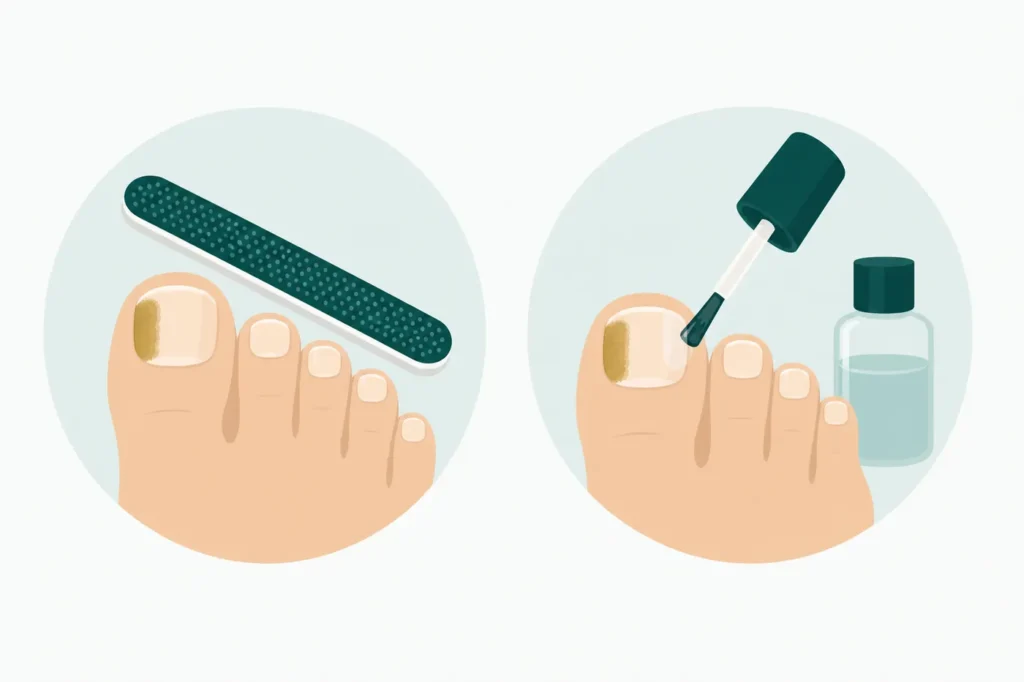
Follow the label directions. The general approach for a 2-step system:

Illustration of a two-step routine: buff the nail, then brush on a topical liquid
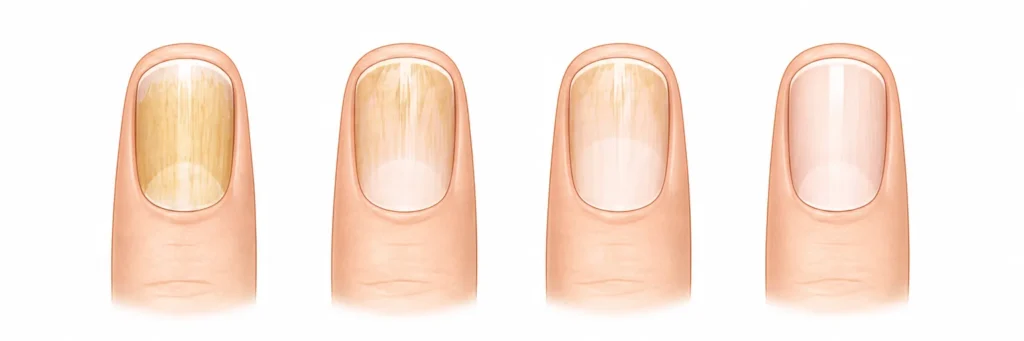
Four toenails showing fungus progression from infected to clear

Realistic timeline: Toenails grow roughly 1–1.5 mm per month, and a full nail regrowth cycle takes 12–18 months. Any nail treatment — including prescription antifungals — requires this biology to play out. The cosmetic improvement (lighter color, smoother texture) you may see within days is the Step 2 revitalizer working on surface appearance. Whether new clear nail is growing at the base of the nail takes months to assess.

If you see no new clear nail growth at the base after 2–3 months of daily use, that is a signal to pursue a confirmed diagnosis and prescription treatment.

Dr. Scholl's Fungal Nail Revitalizer Side Effects and Who Should Avoid It

The Revitalizer system has an excellent safety profile for most adults:

  • Undecylenic acid: Well-tolerated. Rare mild skin irritation or contact dermatitis in sensitive individuals.
  • Urea / salicylic acid (Step 2): Can cause mild stinging if applied to cracked or broken skin around the nail.
  • No significant systemic absorption for any ingredient. No liver monitoring required. No drug interactions.

Who should use caution or avoid self-treating:

  • Known allergy to any component (check the full ingredient list on the label).
  • Open wounds, cuts, or severely inflamed periungual tissue — avoid applying to broken skin.
  • Diabetic patients: Do not self-treat nail infections without consulting a podiatrist or physician first. Foot infections in diabetes can progress quickly to serious complications. When to see a podiatrist →

Dr. Scholl's Fungal Nail Revitalizer Price, Guarantee and Where to Buy

The Dr. Scholl’s Fungal Nail Revitalizer system is typically priced at $15–$35 depending on the kit size and retailer. It is widely available at Walmart, Target, Walgreens, CVS, and online retailers.

We do not have a direct affiliate link for Dr. Scholl’s Fungal Nail Revitalizer. If you are comparison-shopping OTC options, Kerasal Fungal Nail Renewal and Fungi Nail are alternatives with similar ingredient profiles (undecylenic acid, urea) and are available through the links below:

Neither Kerasal nor Fungi Nail is FDA-approved to treat onychomycosis. These are alternatives for cosmetic nail improvement or athlete’s foot prevention, not confirmed nail fungus treatment.

Dr. Scholl's Fungal Nail Revitalizer Customer Reviews and Complaints

Based on aggregated retailer review summaries (Amazon, Walmart, Target — not independently verified by us):

Positive reports:

  • Cosmetic improvement is frequently reported: lighter nail color, less yellowing, reduced debris within days to weeks.
  • The 2-step system is praised for ease of use and pleasant texture.
  • Some long-term users report gradual improvement in overall nail health over several months of consistent use.

Mixed/negative reports:

  • Some users see no meaningful change in nail appearance or thickness, particularly those with long-standing, severe infections.
  • Disappointment is common when users expect the nail to fully clear — that outcome is not typical for any OTC product, and the biology of nail regrowth takes months regardless.
  • Price-to-performance concerns for users who do not see improvement.

Important context: Cosmetic improvement is not mycological cure. A nail can look lighter and cleaner while the fungal infection persists underneath. If nail improvement is your primary goal (managing appearance while awaiting proper treatment), Dr. Scholl’s may serve that purpose. If clearing the actual infection is the goal, prescription options have significantly stronger evidence.

Dr. Scholl's Fungal Nail Revitalizer Pros and Cons

Pros

Cons

Dr. Scholl's Fungal Nail Revitalizer vs Alternatives Backed by Better Evidence

TreatmentEvidence GradeFDA-Approved for NailsComplete Cure Rate
Dr. Scholl’s Fungal Nail RevitalizerAnecdotal (undecylenic acid, urea: Limited)NoNot established for onychomycosis
Kerasal Fungal Nail Renewal (urea + lactic acid)Anecdotal (urea: Limited)NoNot established for onychomycosis

Prescription medicines are not in this table because we can’t offer or prescribe them. For information:

  • Ciclopirox 8% (Penlac): Evidence Grade: Moderate; FDA-Approved for Nails: Yes; Complete Cure Rate: 5.5–8.5% (FDA label, 48 wks).
  • Jublia (efinaconazole 10%): Evidence Grade: Moderate; FDA-Approved for Nails: Yes; Complete Cure Rate: ~15–18% (JAAD 2013).
  • Terbinafine oral (generic): Evidence Grade: Strong; FDA-Approved for Nails: Yes; Complete Cure Rate: ~38% at 48 wks (FDA label).

No OTC product is FDA-approved to treat onychomycosis. Cure rates are for complete mycological cure in controlled trials.

If you have confirmed onychomycosis and want a treatment with established clinical evidence:

When to See a Doctor

See a podiatrist or dermatologist if: the infection covers more than half the nail, multiple nails are affected, you have diabetes or vascular disease, the nail is painful or separating from the nail bed, or home treatment has not helped after 3 months. Lab confirmation (KOH scraping, PAS stain, or culture) is important — roughly half of nails that look infected are another condition. Learn when to see a podiatrist →

Dr. Scholl's Fungal Nail Revitalizer Review: Common Questions

Dr. Scholl’s Fungal Nail Revitalizer contains undecylenic acid — an FDA OTC antifungal active proven to treat athlete’s foot. Whether it penetrates the nail plate to clear established nail fungus (onychomycosis) is not established by any clinical trial. The most reliable user reports suggest cosmetic nail improvement rather than mycological clearing. Evidence grade: Anecdotal for the product (undecylenic acid: Limited).

Most podiatric guidelines recommend confirming the diagnosis first (KOH scraping or PAS stain) before prescribing treatment. First-line treatment for mild-moderate onychomycosis: oral terbinafine (~38% complete cure in the FDA label trials; Lamisil prescribing information). For patients who cannot take oral antifungals: ciclopirox 8% nail lacquer (Penlac, FDA-approved topical, 5.5–8.5% complete cure) or Jublia (efinaconazole 10%, ~15–18% complete cure).

The cosmetic improvement from Step 2 (nail revitalizer) may be visible within days to 1–2 weeks. Whether the antifungal (Step 1) is making progress on the infection takes months to assess, since toenails grow at approximately 1–1.5 mm per month and a full nail takes 12–18 months to grow out. If no new clear nail is growing at the base after 2–3 months of consistent use, seek a confirmed diagnosis and prescription treatment.

No treatment guarantees permanent elimination of nail fungus; recurrence is common. Oral terbinafine achieves the highest complete cure rates (~38% in the FDA label trials; Lamisil prescribing information). Preventing recurrence requires continued prevention: antifungal foot spray, breathable footwear, keeping feet dry, treating any athlete’s foot immediately, and treating shoes with antifungal powder. Reinfection from public pools, gyms, and locker rooms remains a constant risk.

No. Applying any topical antifungal product over nail polish or lacquer significantly reduces its ability to contact the nail surface. The nail and surrounding skin should be clean, dry, and free of nail polish before applying Step 1 or Step 2. This applies to all topical nail fungus treatments including prescription options.

Undecylenic acid has stronger evidence than tea tree oil for surface antifungal action: it is an FDA OTC monograph antifungal (approved for athlete’s foot), while tea tree oil has Limited evidence from one small comparative study. Neither has an RCT for nail fungus (onychomycosis). Both are appropriate low-risk adjunct approaches for mild nail margin changes; neither is a substitute for prescription antifungal treatment for established nail infection.

Nail psoriasis and nail fungus can look very similar: both cause thickening, discoloration, and nail separation. Key differences: psoriasis often affects multiple nails simultaneously and is associated with skin psoriasis elsewhere on the body; it also typically shows pitting (small depressions) in the nail. Nail fungus (onychomycosis) tends to start at the nail tip or sides and spread inward. A KOH scraping or PAS stain is essential to distinguish them — antifungal treatment will not help nail psoriasis.

Yes. Onychomycosis is caused by dermatophyte fungi that spread person-to-person and from surfaces. Shared showers, locker rooms, nail salons, and walking barefoot in public areas are common transmission routes. Within a household, sharing towels, nail clippers, or walking on common bathroom floors can spread infection. Prevention: wear sandals in shared wet areas, dry feet thoroughly, and do not share nail tools without disinfecting them.

Medical disclaimer: This page is informational only and not medical advice. Consult a licensed clinician before treating onychomycosis. If you have diabetes or circulatory disease, see a podiatrist before applying any foot treatment.

Sources: FDA 21 CFR 333 (OTC antifungal drug monograph — undecylenic acid); Halteh P, Scher RK, Lipner SR. Over-the-counter and natural remedies for onychomycosis: do they really work? Cutis 2016;98(5):E16–E25 (OTC and natural remedies review); FDA Lamisil (terbinafine tablets) prescribing information, NDA 020539 (~38% complete cure at week 48); Elewski BE et al., JAAD 2013 (efinaconazole ~15–18% complete cure at 52 weeks); FDA label for ciclopirox nail lacquer (Penlac, 5.5–8.5% complete cure at 48 weeks); accessed Nov 2026.

Looking for a treatment with stronger evidence?

Use our finder to match your case to the right option.