Home › Treatments › Vicks VapoRub for Toenail Fungus

Vicks VapoRub for Toenail Fungus: Does It Work? (Honest 2026 Answer)

Affiliate disclosure: Some links on this page are affiliate links. If you buy through them, we may earn a commission at no extra cost to you. See our disclosure policy →

Natural home remedies laid out on a kitchen counter, for a roundup of natural toenail fungus treatments

The Short Answer

Vicks VapoRub is one of the most-searched home remedies for toenail fungus because it is cheap and widely available. It contains thymol and camphor, which have shown antifungal activity in lab studies. One small clinical study (Derby et al., JABFM 2011, n=18) found it modestly helpful in some patients. Evidence grade: Anecdotal. Vicks does not penetrate deep into the nail bed where the fungus lives, and no rigorous clinical trial has established it as an effective treatment for onychomycosis. It will not clear an established infection on its own. Plan 12–18 months for any toenail to fully regrow.

At a Glance

Evidence Strength

StrongModerateLimitedAnecdotal ✓

How we grade evidence

The Claim vs. the Evidence

The claimWhat the evidence says
Vicks VapoRub clears toenail fungusOne uncontrolled pilot (n=18): 5 of 18 had positive outcomes

Key Facts

Verdict

Will not clear an established infection alone

Evidence

Anecdotal; no controlled trial

Source

Derby et al., JABFM 2011

Cost

~$5

Vicks VapoRub for Toenail Fungus: Does It Work?

Anecdotal Evidence   Evidence grade: Anecdotal

Vicks VapoRub contains three ingredients that have shown antifungal properties in lab conditions: thymol (from thyme oil), camphor, and eucalyptus oil. Lab studies confirm these compounds can inhibit the growth of dermatophyte fungi (T. rubrum and T. mentagrophytes) in petri dishes.

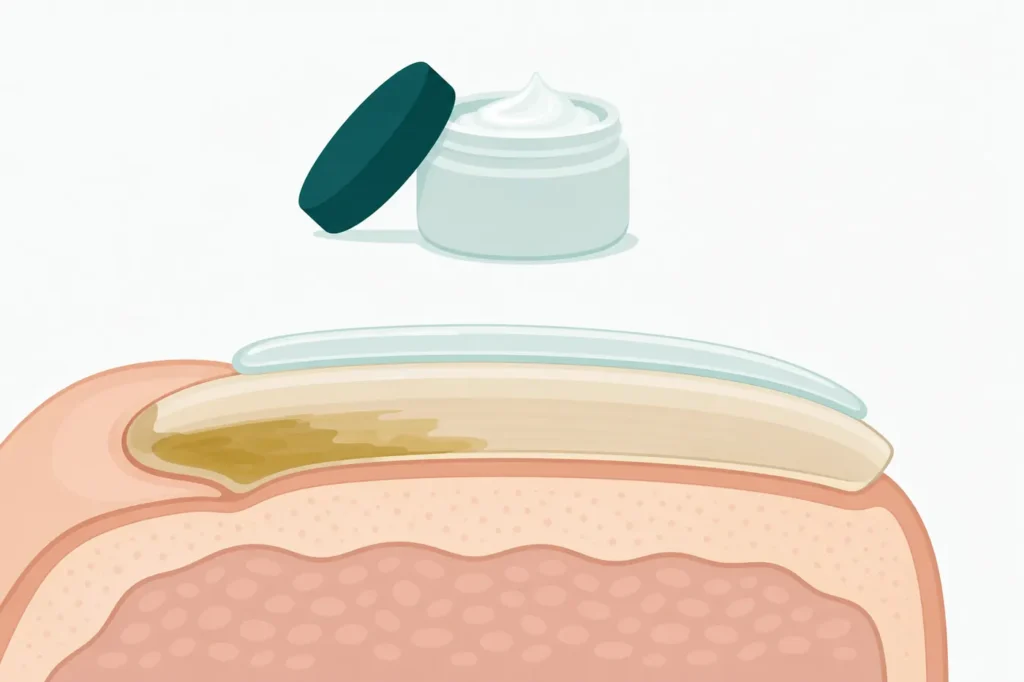
The clinical picture is different. Toenail fungus lives deep inside the nail plate and nail bed. Vicks is a thick ointment designed for chest application; it does not penetrate the hard keratin of a nail plate in clinically meaningful concentrations. The only published clinical study (Derby et al., J Am Board Fam Med, 2011) enrolled 18 patients, found “positive” outcomes in 5 of 18, and noted partial improvement in 7 more. No control group, no mycological confirmation, very small sample. That is the entire clinical evidence base. No rigorous randomized controlled trial has tested Vicks against placebo for onychomycosis.

What the Research Says About Vicks VapoRub and Nail Fungus

  • Derby et al., JABFM 2011 (n=18, uncontrolled pilot): 5/18 patients showed “positive” mycological outcomes; 7/18 partial improvement; 6/18 no improvement. No control group, no blinding. This is the only published clinical study of Vicks on nail fungus.
  • Lab data (thymol): Thymol inhibits T. rubrum and T. mentagrophytes in vitro. Lab activity does not translate automatically to clinical efficacy through a nail plate.
  • What is missing: No randomized controlled trial, no comparison to placebo, no data on nail-penetration kinetics in humans, no mycological cure data.

Bottom line: Vicks may offer modest cosmetic improvement for very mild, superficial cases while you pursue a confirmed diagnosis and proper treatment. It is not a substitute for prescription antifungals in established onychomycosis.

Diagram showing Vicks VapoRub staying on the nail surface instead of reaching the nail bed

How People Use Vicks VapoRub on Toenail Fungus (and Safety Limits)

If you decide to try Vicks while seeking a diagnosis, here is what people do — and what the limits are.

Safety limits: Do not apply to broken or inflamed skin. Vicks is not intended for nail use and is not FDA-approved for onychomycosis. If your skin becomes irritated or the nail worsens, stop and see a clinician. Do not use Vicks as the sole treatment if you have diabetes, peripheral artery disease, or a weakened immune system — see a podiatrist first.

Vicks VapoRub Risks and Side Effects

  • Skin irritation: Camphor and eucalyptus oil can cause contact dermatitis in sensitive individuals.
  • Delay in real treatment: Relying on Vicks may delay a proper diagnosis and effective therapy, allowing the infection to progress.
  • Not safe for diabetics without medical guidance: Foot infections in diabetic patients carry serious risks; never self-treat without clinician oversight.
  • No antifungal drug registration: Vicks is not registered as an antifungal medication in any country. Any use for nail fungus is off-label and unsupported by regulatory approval.

How Long Vicks VapoRub Would Take on a Fungal Toenail

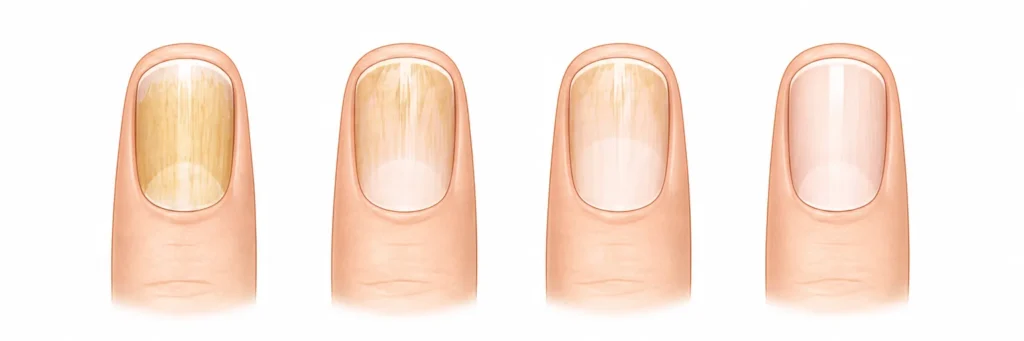
Even in the small Derby 2011 study, the protocol ran months. Toenails grow roughly 1–1.5 mm per month. A full toenail takes 12–18 months to grow from base to tip. Any treatment that works — whether prescription or home remedy — requires this same biology to play out. You will not see a clear nail in weeks regardless of what you apply.

Four toenails showing fungus progression from infected to clear

If you are applying Vicks daily and see no new clear nail growth at the base of the nail after 2–3 months, that is a signal to pursue a confirmed diagnosis and evidence-based treatment.

Vicks VapoRub vs OTC and Prescription Toenail Fungus Treatments

TreatmentEvidence GradeComplete Cure RateCost (est.)
Vicks VapoRubAnecdotalNot established~$5
OTC topical (undecylenic acid)LimitedNot established for onychomycosis$12–$24
Tea tree oilLimitedNot established$5–$15
Terbinafine oral (generic)Strong~38% at 48 wks (FDA label)$10–$40 / month
Jublia (efinaconazole 10%)Moderate~15–18% (JAAD 2013)$65–$830+ per 4 mL

No OTC product is FDA-approved to treat onychomycosis. Cure rates are for complete mycological cure; partial improvement rates differ.

Better-Evidence Alternatives to Vicks VapoRub

If you want to treat onychomycosis beyond a home remedy, here are your options in evidence order.

For diabetics, immunocompromised individuals, or anyone with painful nails: see a podiatrist or dermatologist before starting any treatment. Get a KOH test or culture to confirm the diagnosis — roughly half of nails that look like fungus are something else (psoriasis, nail trauma, etc.).

When to See a Doctor

See a podiatrist or dermatologist if: the infection covers more than half the nail, multiple nails are affected, you have diabetes or vascular disease, the nail is painful or separating from the nail bed, or home treatment has not helped after 3 months. Lab confirmation (KOH scraping or PAS stain) is important; many look-alike conditions do not respond to antifungal therapy.

No rigorous study has established a reliable timeline. The only published study (Derby 2011) ran for months without a defined endpoint. Because toenails grow 1–1.5 mm per month, any real improvement — with any treatment — will not be visible as a clear nail for at least several months. If you see no new clear growth at the nail base after 2–3 months, pursue other options.

There is no clinical evidence that Vicks clears established onychomycosis completely. The one small study showed modest outcomes in some patients, but no mycological confirmation was used. It is not a treatment supported by clinical guidelines.

Generally safe for most healthy adults when applied topically to intact skin and nail. Avoid if you have broken, inflamed, or infected skin around the nail. Do not use if you have diabetes or circulation problems without first consulting a clinician. Camphor can be harmful if ingested.

Tea tree oil has similar evidence to Vicks — lab antifungal activity, limited clinical data for nail fungus. A small study (Buck et al., 1994) found it comparable to clotrimazole topical at 6 months, but evidence for established onychomycosis remains Limited. See our full tea tree oil review →

No unique Amish remedy is clinically validated for toenail fungus. Ads and social media posts claiming an “Amish secret” for nail fungus are not supported by evidence. The same antifungal principles apply: for mild cases, topical antifungals; for established infection, prescription oral antifungals have the strongest evidence.

Medical disclaimer: This page is informational only and not medical advice. Consult a licensed clinician before treating onychomycosis. If you have diabetes or circulatory disease, see a podiatrist before applying any foot treatment.

Sources: Derby et al., J Am Board Fam Med, 2011 (Vicks pilot study, n=18); AAFP 2015 (prevalence 3–12%); FDA Lamisil (terbinafine tablets) prescribing information, NDA 020539 (~38% complete cure at week 48); Elewski et al., JAAD 2013 (Jublia 15–18%); Mayo Clinic, University of Utah Health (accessed Nov 2026).

Ready to try a treatment with stronger evidence?

Use our finder to match your case to the right option.