Home › Treatments › Fluconazole for Toenail Fungus
Fluconazole for Toenail Fungus: Off-Label Use, Evidence, and FDA Warnings
By Best Toenail Fungus Treatments · Reviewed 15 Nov 2026 · 11 min read

Home › Treatments › Fluconazole for Toenail Fungus
By Best Toenail Fungus Treatments · Reviewed 15 Nov 2026 · 11 min read
Fluconazole (brand: Diflucan) is not FDA-approved for onychomycosis (toenail fungus). Its approved indications are vaginal candidiasis, oropharyngeal and esophageal candidiasis, cryptococcal meningitis, and prophylaxis of candidiasis in bone marrow transplant patients. Use for toenail fungus is off-label in the United States. Prescribing physicians assume additional responsibility when prescribing off-label. Talk to your doctor or pharmacist about whether this is the right choice for your situation.
Fluconazole is an azole antifungal that is prescribed off-label for onychomycosis in the US. It is mainly used when other oral antifungals are not tolerated or drug interactions rule out terbinafine or itraconazole; the once-weekly schedule is convenient, but the course is long. Weekly oral dosing (150–300 mg/week for up to 12 months) is the common regimen in published studies. Evidence grade: Moderate. In a head-to-head trial, fluconazole 150 mg once weekly for 12 or 24 weeks gave about 49–51% mycological cure at week 60 (Havu et al., Br J Dermatol 2000). Key risks: hepatotoxicity (liver failure, some fatal); QT interval prolongation; and Category D in pregnancy (teratogenic — do not use in pregnancy). Talk to your doctor or pharmacist before starting fluconazole.
Evidence Strength
StrongModerate ✓LimitedAnecdotal
Time to Results
| Weekly | 9–12 mo | Week 60 | 12–18 mo |
|---|---|---|---|
| 150–300 mg once a week | Typical published course length | ~49–51% mycological cure (Havu 2000) | Full nail grow-out |
Key Facts
Status
Prescription; off-label for nails
Key risks
Liver, QT prolongation, pregnancy
Best for
When terbinafine or itraconazole are ruled out
Dosed
Once weekly, 9–12 months
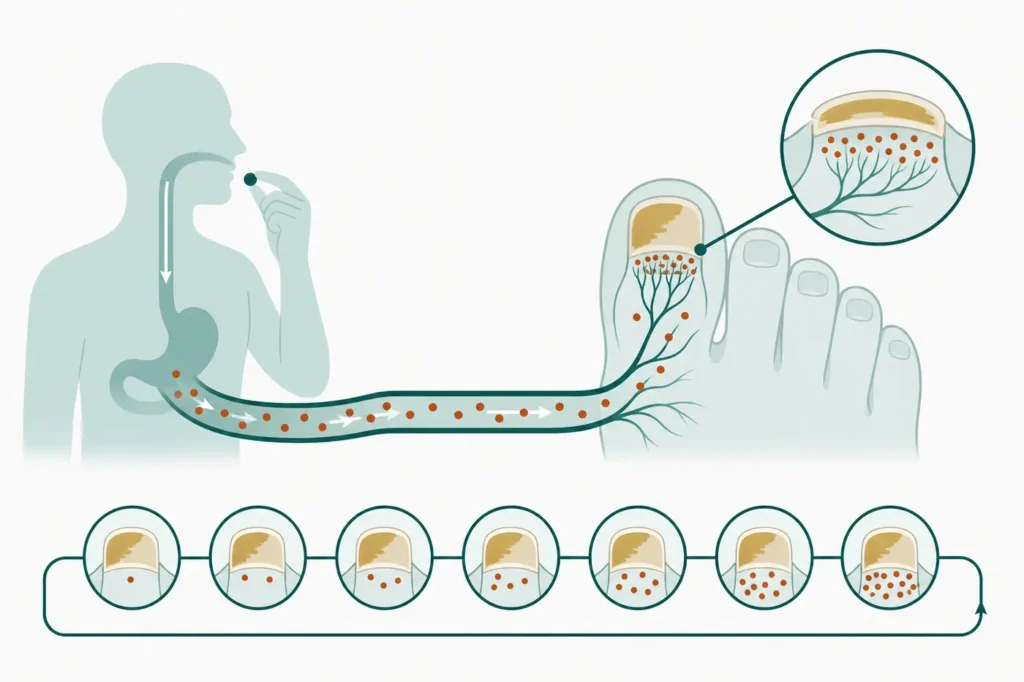
Fluconazole is a triazole antifungal that works by inhibiting lanosterol 14α-demethylase, a key enzyme in the fungal ergosterol synthesis pathway. Depleting ergosterol disrupts fungal cell membrane integrity, inhibiting fungal growth (fungistatic). Fluconazole has good oral bioavailability (approximately 90%) and is active against dermatophytes (Trichophyton species), Candida, and Cryptococcus.
Fluconazole penetrates nail tissue and can be detected in nail clippings for weeks after a dose, which supports weekly dosing schedules for onychomycosis. Unlike CYP3A4 inhibitors (itraconazole), fluconazole inhibits CYP2C9 and CYP3A4 — creating a different drug interaction profile. It is also a less potent CYP3A4 inhibitor than itraconazole, though significant interactions still occur.
Moderate Evidence Evidence grade: Moderate (off-label use)
Several randomized controlled trials have evaluated fluconazole for onychomycosis, though none led to FDA approval for this indication. Key study findings:
Fluconazole for toenail fungus is primarily considered when terbinafine and itraconazole are contraindicated or not tolerated, and after a clinician-to-patient discussion about its off-label status.
Because fluconazole is not FDA-approved for onychomycosis, there is no official FDA-label dosing guidance for this use. The regimens described in published studies include weekly dosing (150 mg or 300 mg once weekly) for periods of 9 to 12 months.
The rationale for weekly dosing: fluconazole has a long half-life and achieves sustained nail tissue concentrations with once-weekly administration.
Important: This page does not provide dosing advice. Dosing, duration, and suitability for off-label fluconazole must be determined by your prescribing clinician based on your specific situation, weight, kidney function, and other medications. Talk to your doctor or pharmacist about the right regimen for you.

High-dose fluconazole (400–800 mg/day) has been associated with a rare and distinct set of birth defects in infants born to mothers who received long-term high-dose treatment during the first trimester (abnormal facial features, skeletal abnormalities, cardiac defects). The FDA updated the label to state that chronic, high-dose fluconazole should be avoided in pregnancy. Even at lower doses (150 mg single dose), fluconazole use in the first trimester has been associated with a possible increased risk of spontaneous abortion in some studies.
Do not use fluconazole for onychomycosis if you are pregnant or trying to become pregnant. Use effective contraception during treatment. Source: FDA label, fluconazole.
Serious hepatic reactions, including rare cases of fatal liver failure, have been reported with fluconazole. These have occurred in patients with serious underlying medical illnesses. The FDA label states: patients who develop abnormal liver function tests during fluconazole therapy should be monitored for the development of more severe hepatic injury. Fluconazole should be discontinued if clinical signs and symptoms consistent with liver disease develop that may be attributable to fluconazole.
Fluconazole has been associated with QT interval prolongation — a cardiac electrical abnormality that in rare cases leads to torsades de pointes, a life-threatening arrhythmia. The FDA label states that fluconazole should be used with caution in patients with potentially proarrhythmic conditions. The risk is higher with higher doses, with other QT-prolonging drugs, with electrolyte abnormalities (hypokalemia, hypomagnesemia), and in patients with structural heart disease.
Tell your doctor if you have any history of heart rhythm problems or are taking other medications that prolong the QT interval.
Fluconazole inhibits CYP2C9 and, to a lesser extent, CYP3A4. This creates important interactions with many drugs:
Tell your doctor and pharmacist about all prescription, OTC, and herbal medications before starting fluconazole. Warfarin, diabetes medications, and seizure medications are among the most clinically important.
Talk to your doctor or pharmacist if any of these apply. FDA-approved alternatives (terbinafine, itraconazole, ciclopirox) may be more appropriate.
| Treatment | FDA-Approved for Nails | Evidence Grade | Key Risk |
|---|---|---|---|
| Fluconazole oral | No — off-label | Moderate | Hepatotoxicity, QT, pregnancy |
| Terbinafine oral | Yes | Strong | Hepatotoxicity, taste/smell, CYP2D6 |
| Itraconazole oral | Yes | Moderate | CHF boxed warning, hepatotoxicity, CYP3A4 |
| Ciclopirox 8% (topical) | Yes | Moderate | Local irritation only; no systemic effects |
Fluconazole is not FDA-approved for onychomycosis. Its use for this indication is off-label in the US.
No. Fluconazole (Diflucan) is not FDA-approved for onychomycosis. Its approved indications are vaginal candidiasis, oropharyngeal and esophageal candidiasis, cryptococcal meningitis, and prophylaxis of candidiasis in immunocompromised patients. Use for toenail or fingernail fungus is off-label in the United States. Some physicians prescribe it off-label for onychomycosis, particularly when FDA-approved options are contraindicated or not tolerated. Talk to your doctor or pharmacist about whether off-label use is appropriate for you.
No antifungal can guarantee permanent cure of onychomycosis. Published studies on weekly fluconazole dosing (not FDA-approved for this use) reported mycological cure of about 49–51% at week 60 in one head-to-head trial (Havu et al., Br J Dermatol 2000). Complete cure (negative culture + fully clear nail) rates are lower. Recurrence rates after treatment are significant across all antifungals. Long-term prevention strategies (keeping feet dry, treating athlete’s foot promptly) reduce but do not eliminate recurrence risk. See our prevention guide →
In one head-to-head trial, once-weekly fluconazole gave about 49–51% mycological cure at week 60 (Havu et al., Br J Dermatol 2000). Complete cure rates (negative culture and clear nail) were lower. In the same trial, oral terbinafine achieved higher mycological cure than weekly fluconazole (89% vs 49–51%). Individual results depend on infection severity, nail involvement, the causative organism, adherence to the full treatment course, and other factors.
Medical disclaimer: This page is informational only and not medical advice. The FDA label is the authoritative source for fluconazole prescribing information. Fluconazole is not FDA-approved for onychomycosis; use for toenail fungus is off-label in the United States. Consult a licensed clinician before starting, stopping, or changing any medication. Talk to your doctor or pharmacist about drug interactions, pregnancy risk, and whether off-label use is appropriate for you.
Sources: FDA label fluconazole (NDA 019949; DailyMed, accessed Nov 2026); Havu V et al., Br J Dermatol 2000;142(1):97–102 (weekly fluconazole ~49–51% mycological cure at week 60); Evans & Sigurgeirsson, BMJ 1999 (L.I.ON trial; terbinafine vs itraconazole); FDA Drug Safety Communication on fluconazole and birth defects (2016); Mayo Clinic, AAFP 2015 (accessed Nov 2026).
Use our finder to match your case to the right option, including FDA-approved alternatives.