Home › Product Reviews › Fungi-Nail Review

Fungi-Nail Review (2026): Evidence Grade and What Buyers Should Know

Affiliate Disclosure: This page contains affiliate links. If you buy through our links we may earn a commission at no extra cost to you. Evaluations are independent and evidence-based. Full disclosure →
Generic pen applicator and dropper bottle on a bathroom tray, illustrating an OTC nail antifungal

Our Verdict in 60 Seconds

Evidence grade: Anecdotal Evidence

Anecdotal for the product itself: no study has tested Fungi-Nail. Its active ingredient, undecylenic acid, has Limited evidence (skin-fungus data, no nail trial).

Fungi-Nail is an over-the-counter antifungal product containing undecylenic acid (1–25% depending on the specific formulation). Undecylenic acid is FDA-approved for skin fungal infections (athlete’s foot, ringworm, jock itch), but no OTC product is FDA-approved to treat nail fungus (onychomycosis). The key limitation is nail penetration: the nail plate is a dense keratin barrier that OTC topicals penetrate poorly. The fungi live in the nail bed and subungual space, below the nail surface — a concentration that is effective on skin may not reach therapeutic levels in nail tissue.

Fungi-Nail may help with mild, superficial nail involvement or as a maintenance product, but for established nail fungus, prescription options have significantly stronger evidence: oral terbinafine (~38% complete cure in the FDA label trials; Lamisil prescribing information) and efinaconazole topical (15–18%; Elewski, JAAD 2013).

Who it may suit: Early-stage superficial infections; maintenance/prevention after clearing an infection with prescription treatment; athletes wanting daily nail protection.

Who should seek more: Anyone with established, moderate or severe nail fungus (thick, deeply discolored nail), or who has tried OTC topicals without improvement.

At a Glance

Evidence Strength

StrongModerateLimitedAnecdotal ✓

How we grade evidence

The Claim vs. the Evidence

The marketing claimWhat the evidence says
An OTC antifungal for nail fungusFDA-approved for skin fungus only; penetrates the nail poorly

Key Facts

Price

Low OTC price; varies by retailer

Form

Solution, ointment or pen

Best for

Mild, superficial cases; maintenance

Trials

None shown to reach the nail bed

No published trial shows an OTC undecylenic acid product reaching the nail bed.

What Is Fungi-Nail?

Fungi-Nail is an OTC antifungal product available as a solution, ointment, or pen applicator. The active antifungal ingredient is undecylenic acid (concentration varies: some formulas use 1%, others up to 25%), and some formulas contain tolnaftate 1%. Both undecylenic acid and tolnaftate are FDA-approved active ingredients for skin fungal infections (athlete’s foot, ringworm, jock itch) — not for nail fungus.

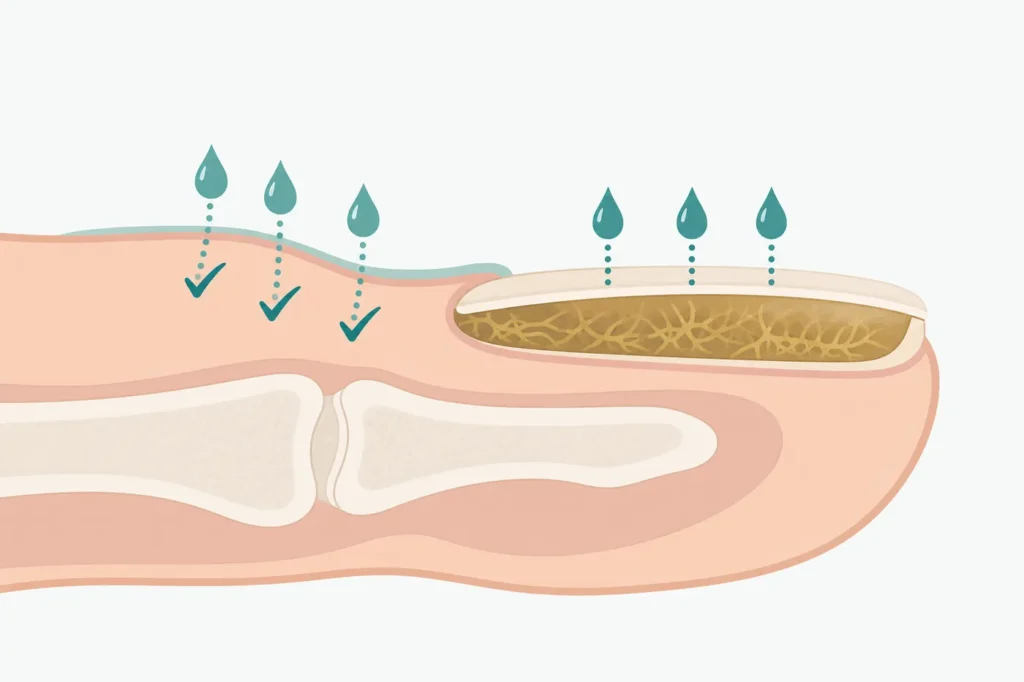
The challenge for all OTC topicals on nail fungus is delivery: toenail fungus lives under the nail plate (subungual space) and in the nail bed. The nail plate is a dense keratin barrier that blocks most topically applied agents from reaching the therapeutic concentrations needed to clear the infection. This is why prescription topicals like efinaconazole (Jublia) use specially engineered vehicles to improve penetration.

See our full treatment guide →

Fungi-Nail Ingredients and What the Research Says

Diagram showing a topical working on skin but struggling to pass through the nail to the fungus
IngredientFDA statusEvidence for nail fungus
Undecylenic Acid (varies 1–25%)FDA-approved OTC for skin fungal infections (athlete’s foot, ringworm)Limited Evidence — Effective on skin; nail plate penetration is poor. No RCT data specific to nail fungus.
Tolnaftate 1% (some formulas)FDA-approved OTC for skin fungal infectionsLimited Evidence — Same limitation as undecylenic acid: effective on skin; nail penetration is a barrier.

The penetration problem in detail: OTC undecylenic acid is approved for athlete's foot, not for nails, and no published trial has shown that an OTC undecylenic acid product reaches the nail bed (where the fungus lives) at levels that clear an established nail infection.

Exception: white superficial onychomycosis (WSO). This superficial subtype, which affects the top layer of the nail only, may respond better to topical treatments including OTC antifungals. Most toenail fungus cases are distal-lateral subungual onychomycosis (DLSO), which is the deep subtype that OTC topicals struggle to reach.

Does Fungi-Nail Work on Toenail Fungus? (Evidence Grade)

Evidence grade: Anecdotal Evidence

Fungi-Nail contains a real antifungal (undecylenic acid or tolnaftate), which puts it ahead of products like Kerasal that contain no antifungal. However, the nail penetration barrier limits its effectiveness for established nail fungus. Here is what the evidence realistically supports:

No OTC topical has achieved the efficacy rates of prescription treatments in head-to-head trials. The 15–18% complete cure rate for Jublia (efinaconazole), a prescription topical, used an FDA-approved, penetration-engineered vehicle. OTC topicals lack this vehicle and have substantially lower efficacy. Our evidence grading methodology →

How to Use Fungi-Nail (and How Long Before You See Clear Nail)

Fungi-Nail Side Effects and Who Should Avoid It

Fungi-Nail is generally well tolerated. No significant systemic side effects are expected from topical undecylenic acid or tolnaftate.

Fungi-Nail Price and Where to Buy

Fungi-Nail is widely available OTC at pharmacies, grocery stores and online. Price varies by formulation and retailer (verify current price at checkout). No prescription required. At the low price point, it is accessible as a first attempt for mild/early cases or as a maintenance product.

Fungi-Nail Customer Reviews and Complaints

We do not reproduce unverified testimonials. The following reflects patterns in publicly available consumer feedback.

Fungi-Nail Pros and Cons

Positives

Limitations

Fungi-Nail vs Alternatives Backed by Better Evidence

Fungi-Nail Review: Common Questions

Fungi-Nail contains undecylenic acid (antifungal), which is FDA-approved for skin fungal infections. For toenail fungus, its effectiveness is limited by the nail plate, which blocks most topical agents from reaching the fungus in the nail bed. It may help with superficial (white) nail infections or very mild cases. For established nail fungus, prescription oral or topical antifungals have significantly better evidence. See our full comparison →

No. Remove all nail polish before applying Fungi-Nail. Cosmetic nail polish creates a physical barrier that prevents the product from reaching the nail surface and the nail-skin junction. Some antifungal nail polishes (prescription or OTC) are specifically formulated to be active treatments, but standard cosmetic nail polish should always be removed before applying Fungi-Nail.

Oral prescription terbinafine is the most evidence-backed first-line treatment for onychomycosis, with ~38% complete cure in the FDA label trials (Lamisil prescribing information). Prescription topical efinaconazole (Jublia) achieves 15–18% complete cure in phase 3 trials. OTC options (Fungi-Nail, Kerasal) have limited evidence for established nail fungus. See our full evidence-graded comparison →

Apply to clean, dry nails twice daily (morning and night). File or trim the nail beforehand to remove as much thickened nail material as possible. Apply to the nail surface, under the free edge, and to the skin immediately surrounding the nail. Remove all nail polish before each application. Continue for at least 8–12 weeks before assessing any results. If no improvement after 3 months, see a podiatrist for a confirmed diagnosis and prescription options.

Sources

  1. L.I.ON. study. Terbinafine vs itraconazole. BMJ 1999;318:1031–1035.
  2. Elewski BE et al. Efinaconazole 10%. JAAD 2013;68(4):600–608.
  3. Fungi-Nail product label. Fungi-Nail Anti-Fungal Solution. 2024.
  4. FDA. OTC monograph M006 (antifungals). fda.gov (accessed Nov 2026).
  5. Ferrari J. Fungal toenail infections. Am Fam Physician 2015;92(2):132–133.
  6. Drugs.com. Fungi-Nail (undecylenic acid topical) reviews. drugs.com (accessed Nov 2026).
  7. Mayo Clinic. Nail fungus: diagnosis and treatment. mayoclinic.org (accessed Nov 2026).

Medical disclaimer: This content is for informational purposes only and is not a substitute for professional medical advice, diagnosis or treatment. Always consult a qualified healthcare provider before starting any treatment.

Not sure which treatment fits your case?

Answer 4 quick questions and get a recommendation matched to your nails.